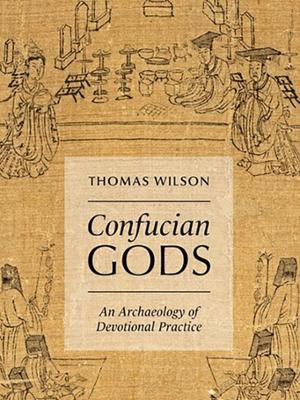
 Oxford University Press describes the book: “Confucian Gods offers an intellectual history of Confucian conceptions of the gods found in the Classics and feasted by the imperial court in rituals from the seventh until the early twentieth century. The book examines court debates surrounding these canonical gods and the devotional rites to feast them at imperial altars and temples during the Tang (618-907), Song (960-1279), and Ming (1368-1644) dynasties.
“Ritual officers of the court exhaustively studied the Classics that recorded the rites performed by the ancient sages, debated details of the proper rites at the imperial court, composed the liturgies based on their understanding of the Classics, personally conducted the rites, and assisted their sovereign in conducting canonical rites at official temples and altar terraces. The rites devoted to these gods constituted an essential mode of governing, which imperial sources called ‘ritual governance.’
“While Confucians differed in numerous ways the rules governing their debates on gods, particularly at court, remained relatively consistent from the seventh to seventeenth century. Confucian officers and classically educated literati outside of government based their positions on the official canon-the Five Classics as well as the Classic of Filial Piety and the Analects.
“This study focuses on two cults of the official pantheon, the cult of Heaven-High God and the cult of Confucius. Rather than reduce these rites to strategies to legitimate the status quo, Wilson poses the question: What do the sources tell us about how Confucians understood the gods they worshipped and the invisible forces that circulated in the cosmos?”
Support for Wilson’s research was provided by grants from the National Endowment for the Humanities, the American Council of Learned Societies, the Institute for Advanced Studies, Princeton, and the Center for Chinese Studies in Taiwan. Wilson presented parts of this work at talks at Freie Universität Berlin, the University of Michigan, Cornell University, University of Wisconsin, University of Tennessee, and The China Institute, New York and in Chinese at conferences in Taibei, Taiwan, Seoul, South Korea, and Dengfeng, Henan, PRC.
Posted April 2, 2026


