Necrology
Because Hamilton Remembers
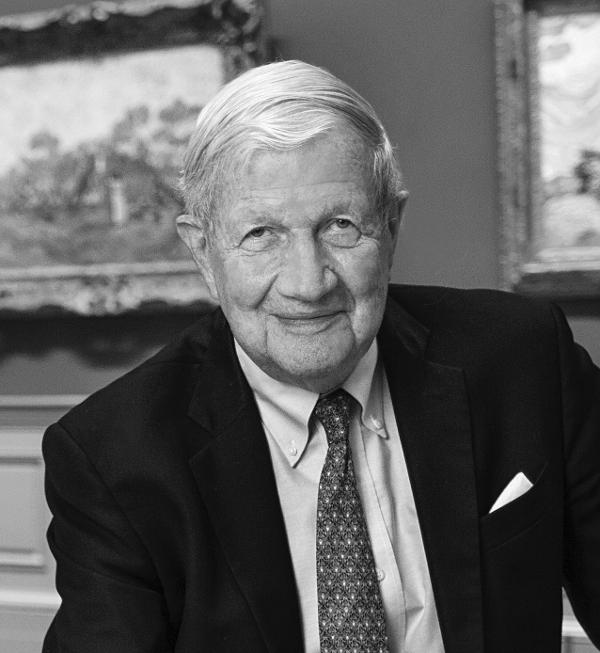
William Henry Luers '51
May. 15, 1929-May. 10, 2025
What can one accomplish in life having earned a bachelor’s degree in mathematics and chemistry at Hamilton? William Henry Luers ’51, GP14, who died on May 10, 2025, at his home in Washington Depot, Conn., demonstrated that those subjects and others embedded within his academic record prepared him, if not actually for everything, for a career in the Foreign Service that included two ambassadorships, president of the Metropolitan Museum of Art in New York, chairman and president of the United Nations Association of the U.S.A., and founder of The Iran Project, a program that sought to establish an ongoing dialogue with Iranian political leaders following 9/11 and the Bush administration’s characterization of the country as part of an “Axis of Evil.” Thereafter, he also served on the board of Sotheby’s, one of the nation’s leading art auction houses.
Born in Springfield, Ill., on May 15, 1929, Bill graduated from Springfield High School in 1947 feeling ambivalent about a college education. His father, a banker in the city, had never attended college and clearly prospered, but it was his father who insisted that his son would be college-bound. Several of Bill’s friends had gone to West Point, and so he and his father struck a deal: Bill would attend college for one year to see if he liked it. He chose Hamilton because of its proximity to West Point so he could visit his friends. One such visit constituted a dose of reality when he saw how first-year cadets (plebes) were treated by upperclassmen: his view of Hamilton suddenly became considerably more favorable.
Bill chose to major in mathematics and chemistry in anticipation of pursuing graduate studies in engineering. At the end of his sophomore year, he was awarded the Oren Root Prize Scholarship in Mathematics as one of the two rising juniors with the highest grade point average in the subject who were planning to continue their study in their third year. He graduated with honors in chemistry.
When not in the classroom, laboratory, or library, Bill was active on campus. A member of Alpha Delta Phi fraternity, he became its president as a senior. He was in Doers & Thinkers honor society as a sophomore, Was Los as a junior, and Pentagon in his final year. He played on both the basketball and golf teams all four years and was captain of the golf team as a senior. On the planning committee for Winter Carnival as a junior, he served on the College’s social committee the next year.
While he assumed that his career would be in engineering, something happened his senior year that challenged his assumption and sparked a new passion: a seminar in the history of philosophy. It was the first course of several in the humanities he had taken that captured his intellectual imagination. Nonetheless, having been promised a scholarship at Northwestern University for chemical engineering, he dutifully headed off to Evanston, Ill., but soon concluded that he hated the subject. He changed course and began to study philosophy, theology, and literature, focusing specifically on the work of James Joyce and the complexities of Joyce’s novel Ulysses.
For a time Bill considered becoming an Episcopal priest, but then the Korean War intervened, and in 1952 he was admitted to the U.S. Navy’s Officer Candidate School. His subsequent service included two years as a shore patrol officer in Naples, Italy, giving him the opportunity to discover Southern Italian art, music, and cuisine. He also threw himself into the task of mastering Italian. (By his own admission, his record of achievement in French at Hamilton was undistinguished.) Italian would be the first of four languages that he became fluent in, the other three being Spanish, Russian, and, for important reasons later on in his life, Czech.
Honorably discharged with the rank of lieutenant in 1956, Bill began graduate work in political science at Columbia University, earning a master’s degree in Russian Studies in 1958. It was in this period that he met and, on June 9, 1957, in Setauket, N.Y., married Jane A. Fuller, a Bennington College alumna who also studied at the Russian Institute at Columbia. They would have three sons and a daughter.
Though he later claimed he knew nothing about the foreign service, in 1958 he took the entrance examination required for it, passed, and began what would become a 31-year career. Thanks to his self-directed immersion in Italian life while in the Navy, his first assignment took him back to Naples. Then, in 1959, he became the State Department’s first junior officer in the newly established Office of Soviet Affairs in Washington. This assignment no doubt prompted his study of Russian, for in 1963 he began a two-year assignment in Moscow as second secretary of the American embassy, an assignment that fed an enduring interest in the Soviet Union.
Thereafter, Bill’s career continued to unfold with a series of increasingly senior assignments. By 1967, he was working in Washington assigned to the State Department’s intelligence and research branch. Two years later, his portfolio included serving as chief of affairs for Guyana, Surinam, and the Netherlands Antilles. In that same year, he was promoted to Foreign Service Class 3.
In 1971, he was political counselor for the American Embassy in Caracas, Venezuela. In 1973, he became an aide to then-Secretary of State Henry Kissinger; he hand-delivered to him President Nixon’s 1974 letter of resignation at the climax of the Watergate scandal. In 1979, he was appointed ambassador to Venezuela, having previously held the position of deputy assistant secretary of state for European affairs. His first marriage having ended, on Oct. 18 of the same year he married Wendy Woods Turnbull, a native of San Francisco.
Bill stepped away from active diplomatic service in 1982 to accept appointment as the director’s visitor at the Institute for Advanced Study at Princeton University for the 1982-83 academic year. Returning to the State Department in the summer of 1984, he and Wendy packed their bags and traveled to Prague, when Bill was appointed ambassador to Czechoslovakia. Before their departure, he accepted an honorary Doctor of Laws degree from Hamilton and delivered the commencement address. He encouraged graduates to give serious thought to public service.
By the early 1980s, many Czechs were chafing against their repressive government that suppressed free speech and any criticism of its regime. Among the leading dissidents was the essayist and playwright Václav Havel. Having recently been released from prison after serving a four-year sentence for his subversive writings, he first met Bill at a reception for an art exhibit that Bill and Wendy had mounted for 150 guests in their residence. Thus began one of the hallmarks of Bill’s career: his use of art to provide a setting for diplomatic engagement with representatives and citizens of other nations.
Havel had made clear his loathing of communism, expressing the view that every individual had a responsibility to help bring about a better and more open society. His writings envisioned a social structure that accommodated freedom of thought and speech, in stark contrast to the totalitarian state that was then Czechoslovakia, which had imprisoned him on multiple occasions for his views.
He and Bill had numerous conversations on these subjects, and Bill realized first that Havel was likely to become the most effective leader of the opposition to the communist regime and, secondly, that he would need to be protected from further harassment by the state. Bill concluded that the best way to build that protection was to do everything in his power to make Havel a very public international figure: he invited leading American artists, writers, and other intellectuals to Prague to meet Havel and arranged for news conferences within the embassy to spread the word of Havel’s activism beyond the reach of the tightly controlled Czech press.
In an interview with a reporter for The New York Times in 2022, Bill explained: “[I] spent a lot of my career with artists and writers promoting the arts. I was worried that the Communists might poison [Havel] or put him back in prison. My strategy was to shine as much light on Havel as possible. So, I brought in John Updike, Edward Albee, and many other people to talk about how great an artist and cultural leader he was.” Those “many other people” included the artist Richard Diebenkorn, owner of The Washington Post Katherine Graham, novelists E.L. Doctorow, Kurt Vonnegut, and William Styron, director of the Metropolitan Museum of Art Philippe de Montebello, and producer-director Joseph Papp.
The strategy worked. Though the secret police photographed all of the visitors, which did not intimidate anyone, the authorities soon realized that given the worldwide attention accorded Havel, turning him into a target risked adverse international consequences for the government. Indeed, even after Bill and Wendy left Prague and the State Department in 1986, the regime stayed away from Havel. In 1989, he was a leader of the “Velvet Revolution” that liberated Czechoslovakia from the Soviet Union without a shot being fired. He subsequently became its first president. His leadership continued when the nation split into the Czech Republic and Slovakia in 1993 in what was later termed “the Velvet Divorce.” Havel then became the first president of the Czech Republic, serving two terms before stepping down in 2003. Bill would later say, “[my] greatest satisfaction was the success of Václav Havel. Havel proved my point that culture makes a difference, especially in international relations.”
In 1986, the Metropolitan Museum of Art offered Bill its presidency. He would later recall: “When they offered me the job, it just seemed like a dream come true. And I’d lived outside the country, with my Naval and foreign service for so many years that I just felt detached.” As president, Bill shared leadership of the museum with the aforementioned director, Phillipe de Montebello. While the director was in charge of artistic matters, Bill handled fiscal matters, including finances, fundraising, and outreach to government agencies.
Before he stepped down in 1999, Bill doubled the museum’s endowment, modernized the financial systems, enlarged the staff to 1,800 full-time employees, and oversaw construction of new galleries, wings, exhibitions, and public programs. One of his signal accomplishments was the acquisition of Walter Annenberg’s collection of Impressionist and Post-Impressionist paintings valued at the time at around $1 billion. By the end of his tenure, the Met had an annual budget of $116 million, and on weekends often hosted more than 50,000 attendees.
In 1993, Bill and Michael Brainerd ’65 began a 10-year collaboration to honor the Russian city of St. Petersburg on the occasion of its tricentennial in 2003. This period followed the collapse of the Soviet Union when relations between the U.S. and Russia were no longer adversarial.
Michael led the Citizens Exchange Council ArtsLink that had begun to develop ties to St. Petersburg in 1993. When Bill came on board, the two of them established the American Committee for St. Petersburg, and, funded in part by the Rockefeller Family Foundation, began a series of exchanges. The purpose of this initiative was to help deal with the financial and administrative crises that threatened some of Russia’s most important cultural institutions following the collapse of the Soviet regime. They organized exchanges of art and provided the administrators of many of St. Petersburg’s major cultural institutions the opportunity to update their expertise in museum management, including marketing and curatorial education.
It turned out that Bill was a master of fundraising as well as developing professional contacts with those who would provide further assistance to the Russians. In June 2003, Bill and Wendy led members of the American Committee for St. Petersburg to that city to attend the official celebration of its tercentenary which the Russian government had organized. During that event, Bill and Michael were awarded medals for their contributions. The medals were accompanied by a note of acknowledgement and signed “V. Putin.”
In 1999, Bill turned 70, an age that might call for stepping back and letting others take the reins. He did step back to engage once again in foreign relations, now as founder and president of the United Nations Association of the U.S.A. Its mission was to repair relations with the world organization not only through regular interactions with U.N. leadership, including the secretaries-general Kofi Annan and Ban Ki-moon, but also by providing research and other services.
This work not only provided assistance to the U.N. but also served as a means to building relations with leaders of some of our nation’s adversaries. This work behind the scenes — “back-channel diplomacy” — was crucial to the success of what came to be known as The Iran Project. In the aftermath of 9/11 when the Bush administration was openly hostile to Iran because of its support of Al-Qaeda, Bill along with others with experience in diplomacy created this non-governmental agency dedicated to persuading our government to negotiate with Iran concerning its nuclear program.
Bill wrote numerous articles on this subject that appeared in leading newspapers and foreign policy journals. He gave public lectures and taught at Princeton, George Washington, Columbia, and Seton Hall universities as well as at the School of Advanced International Studies at Johns Hopkins University. Over time, his work and that of other project leaders helped to lay the foundations for the Joint Comprehensive Plan of Action, known to many as the Iran Nuclear Treaty, that was successfully negotiated with Iran and seven other countries in July 2015.
In addition to all of these responsibilities, Bill accepted appointments to the boards of directors of several corporations and foundations, including the Foundation for Art and Preservation in Embassies and Christie’s, Inc. As he would write in his 50th reunion yearbook entry: “I am overcommitted and underrested.”
As for Hamilton’s influence upon him, in that same entry Bill recalled: “I arrived on the Hill from Central Illinois interested in sports, math, and science, having read one or two novels on my own initiative, and never having had any interest in the humanities or the arts and certainly no interest in foreign affairs. ‘Digger’ [Graves] pulled me to history almost by chance, following the required first-year course in history. I still attribute much of what I have done to the Hamilton experience that opened me up to all those strange career shifts that have characterized my life.”
In return, Bill contributed to the Hamilton Fund and supported the Class of 1951 Scholarship. He also was engaged in activities at the Levitt Center and as a Career Center volunteer.
Predeceased by his son, William H. Luers is survived by his wife, two sons, and a daughter, in addition to five grandchildren, including his granddaughter Erin Luers ’14, and five step-grandchildren.
Note: Memorial biographies published prior to 2004 will not appear on this list.
Necrology Writer and Contact:
Christopher Wilkinson '68
Email: Chris.Wilkinson@mail.wvu.edu

The Joel Bristol Associates
Hamilton has a long-standing history of benefiting from estate and life payment gifts. Thoughtful alumni, parents, and friends who remember Hamilton in their estate plans, including retirement plan beneficiary designations, or complete planned gifts are recognized and honored as Joel Bristol Associates.
Contact
Office / Department Name
Alumni & Parent Relations
Contact Name
Jacke Jones
Director, Alumni & Parent Relations
