Rouben Cholakian
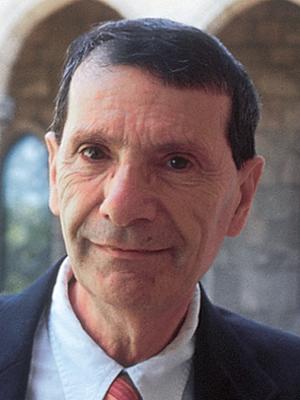 Professor of French (1963-96)
Memorial minute for Rouben Cholakian, the Burgess Professor of Romance Languages and Literatures emeritus, presented by Professor of French and Francophone Studies Cheryl Morgan on Feb. 24, 2026.
Rouben Cholakian had been at Hamilton since 1963 when I arrived on the Hill in 1990. We had not yet met since he was directing the Hamilton program in France the year of my hire. So, when he first saw me in person, I was unprepared for his exuberant proclamation: “Why, the last time I saw you, you were just a baby sitting on your dad’s knee!” This may indeed have been true, for in the late 1950s, Rouben and my father both started teaching at the Pingry School, then in Hillside, N.J. Moreover, they were also pursuing advanced degrees in their respective fields: my father in history at NYU and Rouben at Columbia University (where, coincidentally, I would earn my doctorate in French 30 years later). Rouben frequently ironized about being an elder, but never played the paterfamilias. In fact, he rejected the conventions and habits of hierarchy (departmental, at least) in favor of harmony and acceptance. I still wear proudly the somewhat forlorn Columbia hood that he passed on to me when he retired.
Rouben Charles Cholakian was born on July 9, 1932, in Hartford, Conn., to Armenian immigrants Varsig and Kazaros Cholakian. His father was a butcher who had a store in Bridgeport. Rouben grew up in Norwalk with three brothers, two of whom his parents adopted when their parents (Armenians as well) passed away. After high school, Rouben spent two years attending a local teacher’s college living with his adored grandparents before he transferred to Bates College. According to his daughter Kathryn, Rouben spoke only Armenian and did not know English upon starting kindergarten. Should we be surprised to learn, then, that he began studying, and then majored in, French at Bates?
Bates was also where Rouben met the love of his life and intellectual soulmate, Patricia. The couple married in 1955 and moved to New Jersey where Rouben juggled the demands of his teaching job at Pingry, first-time fatherhood, and graduate school in Manhattan. Researching the earlier parts of Rouben’s life, I was amused to come across another connection: in 1960, he accepted a position as instructor of French at the University of Virginia and spent the next three years teaching there, welcoming daughter #2, Anna, and finishing his dissertation!
In 1963, with his newly minted Ph.D. on the “life and work” of the relatively unknown 19th-century French author and critic Arsène Houssaye, Rouben and family came to Hamilton where he would spend the next three decades teaching, directing the program in France, singing in the Oratorio Society, and helping raise his two musically talented daughters up on Ernst Road. This was a magical place where Patricia’s green thumb created a beautiful garden and for a while goats helped trim the grass … until they started in on the garden, at which point, they had to go.
Kathryn noted that Rouben wasn’t all that interested in the 19th century and was irked that he had been steered to write on such a relatively obscure figure. Thus, in 1964, after publishing an article on Houssaye and the Comédie française, Rouben pretty much turned away from the 19th century in favor of Rabelais and Villon, Charles d’Orléans, Marcabru, and other courtly poets. His scholarly production continued apace over the decades and throughout most of his retirement years. In addition to many articles on the medieval authors just mentioned, Rouben published valued editions of Renaissance and 17th-century tales and a curious 1971 critical bibliography of Hamilton’s special and enviable collection of Provençalia, bequeathed to the College by Romance Languages Professor William P. Shepard in 1948.
In 1990 came The Troubadour Lyric: A Psychocritical Reading with Manchester University Press in which Rouben offers a feminist and psychoanalytical reading of troubadour poetry. Rouben’s literary interests could at times take him afield, resulting in some surprising projects. Colleague Martine Guyot-Bender describes Rouben’s interest in francophone texts as ahead of its time and which resulted in his collection of francophone Caribbean tales, published in 1998 by Edwin Mellen Press. Another such surprise came in 2000 in the form of a mystery novel, Murder on the Junior Year Abroad, in which program director Garabed Tourian and his sharp and beloved wife conduct their own investigation of the murder of one of the program students in 1968 Paris.
We would be wrong to think that Rouben slowed down after he and Patricia left Clinton in 1996 for a New York apartment on Cabrini Blvd near the Cloisters. In fact, despite Patricia’s battle with cancer, she and Rouben worked to finish their joint labor of love, a biography of Marguerite de Navarre, published by Columbia University Press in 2006. Rouben quipped that after 50 years of married life and different directions in research, he and Patricia finally met again in the Renaissance thanks to this important project. With Patricia’s passing, Rouben continued to work on Marguerite de Navarre, co-editing and translating with Mary Skemp a bilingual edition of the Renaissance author’s selected writings for the University of Chicago Press’ Other Voices Series in 2008.
In the classroom and in Paris, Rouben left his mark on several generations of students. One of those students, Claire Goldstein ’94, now a professor of French and director of the humanities program at UC Davis, shared the following that seems to come from another era, and I mean that in the best way possible: “I am teaching poetry this quarter so I have been thinking of Rouben often as his Renaissance poetry class was so formative. He would arrive early to write sonnets (by memory) on the blackboard, recite them by memory, and then we would mark them up together. Week by week the balance shifted — by the end of the semester, students took turns arriving early to write poems on the board, recite by memory, and preside over the chalkboard dissection of the verse. Rouben supervised my honors thesis, encouraging me to work on Louise Labé at an era when women poets of the Renaissance were only just starting to be recognized by scholars.”
Claire remembers Rouben this way: “The word that comes immediately to mind with Rouben is sparkle. He loved to make a witty remark, delivered with verve, rigor, but also warmth. Rouben radiated pride whenever he talked about his daughters and Patricia.”
Like his former student, his colleague Martine Guyot-Bender remembers Rouben’s penchant for the bon mot. “He was a poet himself and loved playing with words, all types of words. … His sense of humor was as surprising as many other aspects of his personality. … I remember Rouben … in the department early in the morning — usually the first one there … seeming to have a happy song on his mind. He was always in motion and cheerfully greeting everyone as they came in. He often asked me, as I was getting ready for my class, ‘Tell me something surprising. I like to learn something new every day, as early as possible.’ As a junior faculty member, it was a most intimidating question and it has stayed with me.”
Colleague Bonnie Krueger shared this early impression: “During my first years at Hamilton, Rouben went out of his way to mentor the first female-line hire in what was then romance languages. Being a good professor was not only about teaching grammar, writing, and literature, it was especially about sharing your talents and passions with students. For Rouben, these were his love for music, troubadour poetry, and francophone and French literature.”
Dear friend to both Rouben and Patricia, Professor of Comparative Literature Emerita Nancy Rabinowitz shared remarks that also speak volumes: Rouben “was a feminist and an understated activist; I remember him urging us to act affirmatively when we had the chance,” and he and Patricia were the “only people who befriended Kirkland professors.” Associate Professor of Russian Emeritus Frank Sciacca also remembers being nurtured by Rouben and Patricia: They “took me under their wings offering advice and, equally importantly, served as a deep memory bank of old pre-Kirkland Hamilton. They had great stories and anecdotes.”
Curious and funny, Rouben was also creative. He handmade greeting cards and made fashion statements with his handsewn bow ties, snappy caps, and scarves. He loved to embroider. He was a good baker to boot. He loved to sing and he loved to read. He loved children; he loved his dog. He especially loved Patricia and his daughters, Kathryn and the late Anna Cholakian.
Rouben’s “boundless embrace of the world” that Frank Sciacca witnessed on a group trip to Russia not long after the collapse of the Soviet Union continued on in the Cholakians’ last years in Clinton. Frank remembers that Rouben produced a series of watercolors, but we are not talking impressionistic landscapes here. For Frank, these “satirical caricatures of College personalities” are “a beautiful expression of Rouben’s rebellious and sometimes sarcastic world view.” Indeed, Rouben’s wit could be razor sharp or quite fanciful. And yet, unsurprisingly, that gaiety was tinged with a melancholy, a quiet anguish about the world that undoubtedly led Patricia and him to eastern Turkey in 2000 and his mother’s hometown of Van. This personal connection to the Armenian genocide must have played its part in making Rouben someone who marveled at, created, and needed beauty.
Rouben passed away on Sept. 24, 2025, in Olympia Wash., having retained his sense of humor until the end, according to Kathryn, who lives nearby. I will conclude with her insightful remarks about her beloved father: “His great love, of course, was the Middle Ages and in particular the troubadours. In fact, I would say that he was not really a man of the present time. He really spent most of his life in the Middle Ages, both in his head and in his mannerisms.”
