Publications
-

- From the Editor
- “Late Recruits for Britain”: Anti-Shaker Propaganda During the American Revolution
- Introduction by David D. Newell
- Reprint of the 1782 Dialogue
- Harmonisches Gesangbuch 1827: The Hymnal of a Religious Community in Early Nineteen-Century America by Hedwig T. Durnbaugh
- From the Russells to the Pilots: The Beginning and End of North Union by Cathie Winans
- Two Publications of Interest
- Hamilton College Library “Home Notes”
- Communal Societies Collection: New Acquisitions
Front cover illustration: [Stereoview: detail] Group of Shakers. [Group of seventeen Sisters and Brothers from the Mount Lebanon North Family of Shakers in front of the 1818 North Family dwelling house]. For a full description, see page 149.
-
- From the Editor
- The Shaker Peace Conference of 1905: Witness and Hope at the North Family of Mount Lebanon by Stephen Paterwic
- Eros and its Discontents: The Israelite House of David and Their Almost Eden by Shannon McRae
- News and Notes by Walter Brumm
- Hamilton College Library “Home Notes”
- Communal Societies Collection: New Acquisitions
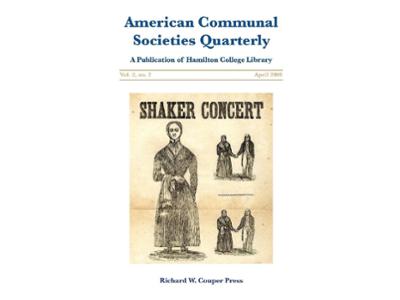
Front cover illustration: Broadside [detail]. Top part of the “Shaker Concert” broadside with woodcut illustrations which are among the earliest visual depictions of Shaker costume. The smaller image showing a sister and brother holding hands is described by Richmond (Shaker Literature, no. 1282). The larger image of the sister, obviously done by the same artist, is apparently not included in other playbills and appears to be undocumented. See pages 96-97 for more details.
-

- From the Editor
- “The Mythical Structure is Created”: Planning and Construction of the Center Family Dwelling House, Mount Lebanon, 1856-1868 by Lauren A. Stiles
- From Bishop Hill to Pleasant Hill: The Swedish Shaker Experience by John E. Norton
- News and Notes by Walter A. Brumm
- Hamilton College Library “Home Notes”
- Communal Societies Collection: New Acquisitions
Front cover illustration: Mount Lebanon Center Family dwelling house, first occupied in January 1868. The image is taken from a stereoview created between 1869 and 1875 by a photographer named Irving from Troy, N.Y. Betsy Crossman’s diary for August 10, 1869 states that “a man from Troy has been taking pictures of this place [Mount Lebanon]” — possibly a reference to Irving. The image was published in Charles Nordhoff’s Communistic Societies in the United States, in 1875. (From the Hamilton College collection)
-

- From the Editor
- Shaker Seminar 2007: South Union and Pleasant Hill, Kentucky by Christian Goodwillie
- A Meeting of Angels: Thomas Merton and the Shakers by Paul M. Pearson
- “Dear Friend and Sister”: Laura Holloway-Langford and the Shakers by Diane Sasson
- Hamilton College Library “Home Notes”
- Communal Societies Collection: New Acquisitions
- Richard W. Couper Press
Front cover illustration: Photograph of Thomas Merton at Pleasant Hill, Kentucky Shaker Village, by James Laughlin, courtesy of the Estate of James Laughlin and the New Directions Ownership Trust.
-

- From the Editor
- Sally Dean and Her Letter to “Respected Friend Phineas”
- Introduction by Glendyne Wergland 99
- Reprint of letters 105
- The Shaker Leaf Song: Solving a Perplexing Puzzle by Roger L. Hall
- Church of Christ unto a People in Kentucky
- Introduction by Ralph Stenstrom
- Reprint of document
- Comment
- Hamilton College Library “Home Notes”
- Hamilton College Acquires The Shaker Messenger Archive
- Communal Societies Collection: New Acquisitions
Front cover illustration: [Photograph, 1920s]. House of David baseball players. Front row, l. to r.: Dutch Faust, shortstop; Cookie Hannaford, outfielder; David Harrison, third baseman; back row: Zeke Baushke, second baseman; and Andy Bell, utility player. The House of David barnstorming baseball team was famous for its pepper game and performed from ca. 1912 to 1936. Faust, who may have been the best natural athlete at the House of David, and Baushke were known as the “diamond cutters” for their prowess at turning the double play. Photo from Clare Adkin’s House of David collection, which was recently acquired by the Hamilton College Library. More information about the collection will be available in a future issue of the Quarterly.
-

- From the Editor
- The Copley-Lyman Shaker Family of Enfield, Connecticut:
- An Annotated Genealogy
- Genealogical Charts by M. Stephen Miller
- Michigan’s Siberia: The House of David on High Island by Clare E. Adkin, Jr.
- News and Notes by Walter A. Brumm
- Hamilton College Library “Home Notes”
- Communal Societies Collection: New Acquisitions
- News from the Communal Studies Association
Front cover illustration: [Product label, detail]. “Pure Cayenne, put up in the United Society, Shirley Village, Mass. Address John Whitely.” Detail of an uncut sheet of five labels, 10” x 8”, each label 3 1/8” x 1 7/8”. The labels date from ca. 1875-1885. Note the “e” missing from “Village” in the bottom label. Brother John Whitely (1819-1905) joined the South Family at Shirley in 1849 and moved to the North Family in 1861 where he became first elder. He was appointed to the Harvard/Shirley ministry in 1871.
-
193 pages with 32 black and white illustrations, 2007. ISBN: 978-0-9796448-1-8 ($25)
Chester Gillette was accused of the murder of Grace Brown in 1906. After a sensational trial, covered by newspapers across the country, Gillette was convicted of first degree murder and sentenced to die in the electric chair. This case was the basis for Theodore Dreiser’s classic novel An American Tragedy, the 1951 Academy-award-winning movie A Place in the Sun, and a 2006 opera. Revealed here for the first time are Chester’s private thoughts in his final months as he recorded them in his diary from September 1907 through March 1908. The diary was believed lost for nearly a century and only came to light in 2007 when Marlynn McWade-Murray, the grandniece of Chester Gillette, donated it to Hamilton College. In addition to the diary, the publication contains twelve letters Chester wrote from prison: eleven to Bernice Ferrin, a friend of the family; and one to his sister Hazel, written the day before his execution.Topic -
- From the Editor
- The Road From Harmony by Eileen Aiken English
- Mother Lucy’s Last Visit to Watervliet
- Introduction by David D. Newell
- Reprint of manuscript
- A Sampling of Rare Shaker Broadsides by Christian Goodwillie
- Hamilton College Library “Home Notes”
- Hamilton College Library’s Special Collections: An Overview
- Communal Societies Collection: New Acquisitions
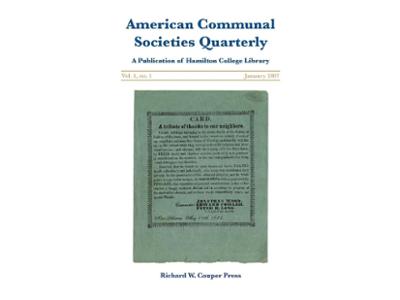
Front cover illustration: Card. A Tribute of Thanks to our Neighbors. New Lebanon [N.Y.], 1852. See p. 32 for full description.
-
American Communal Societies Series, no. 1. 382 pages with 15 b/w illustrations, 2007.
ISBN: 978-0-9796448-0-1 ($35)
Visiting the Shakers is a compilation of ninety-eight accounts written by visitors to four Shaker villages. According to the preface by Elizabeth De Wolfe, “This volume gathers together these period observations, ranging from short diary entries to lengthy periodical articles. The majority of these sources have not been seen in print for more than 150 years. An award-winning independent scholar, Wergland guides the contemporary reader through the phenomenon of ‘visiting the Shakers,’ providing the social and historical context for the praise and criticism offered by these numerous and diverse visitors.”
About the author:
Glendyne Wergland grew up in the Southwest and spent her twenties as the trailing spouse of an engineer who moved nine times in eight years. After they settled in Pittsfield, Massachusetts, she “met” the Shakers through volunteer work at Hancock Shaker Village. Returning to school at age forty, she pursued her interest in the Shakers at Mount Holyoke College, where she graduated with honors before going to University of Massachusetts Amherst for her PhD. Her book, One Shaker Life: Isaac Newton Youngs, 1793-1865, won the Communal Studies Association's Outstanding Publication Award in 2006. Wergland’s current work on Shaker sisters examines the difficulties and rewards of nineteenth century communal life.Topic -

- From the Editor
- Introducing the Richard W Couper Press
- William Scales' 1789 "Mystery of the People Called Shakers"
- Introduction by David D. Newell
- Reprint of Scales' article
- News and Notes by Walter A. Brumm
- Hamilton College Library "Home Notes"
- The Shaker Manifesto Digitized
- New Acquisitions by Hamilton College Library's Communal Societies Collection
- Subscription information
Front cover illustration: Hamilton College Library recently acquired Honey: Soul of Flowers to Sweeten the Soul of Man, a four-page price list from Mount Lebanon. The cover illustration is unusual and striking. Mary Richmond notes (Shaker Literature, no. 340) that W H. Cathcart attributes the cover design to "Brother Peter Neagoe, a Roumanian living at the North Family, Mount Lebanon, N.Y in 1906."
