While Hamilton College did host radio broadcasts as early as 1929, when Utica radio station WIBX broadcast select Hamilton football games, a truly established Hill radio station first took the airwaves in 1941, when a Saturday Evening Post article discussed successful low-power collegiate broadcasts. That article described how student engineers used their universities’ gas heating pipes and electrical sockets as a closed-circuit broadcast network — one could place an AM radio close to these metal pipes and receive a reasonably clear AM radio signal.
The article inspired Wentworth D. Fling, a professor in linguistics and romance languages, to attempt such a similar network, with a two-room studio in the basement of Root Hall and a three-letter call signal — WHC, which could refer to either “Wireless Hamilton College,” or “William H. Cowley” (Hamilton’s President), or even “Wentworth Has Clicked.”
WHC’s first true broadcast took place on Nov. 8, 1941, when “Spook” Zaehringer ’42, P’73 traveled with the football team to Haverford College for a game. During the game, Zaehringer called the station offices, where two other students, Bob Scott ’43, GP’96 and Art Ward ’43, relayed Zaehringer’s play-by-play to the campus broadcast audience. The broadcast test was a success — until the $90 long-distance telephone bill arrived.
WHC held its official dedication ceremony on Jan. 31, 1942, as part of Hamilton’s Winter Carnival festivities, and President Cowley stepped to the microphone and said, “This is Station WHC,” throughout the station’s on-campus broadcast radius. And from there, WHC’s first official broadcast months — featuring a mixture of recorded music, radio plays, and discussion panels — garnered curious interest both on and off the Hill.
The station went silent after 1943 due to World War II, but returned to the airwaves for the 1946-47 school year, operating five days a week, Monday through Friday, from 7:30-10 p.m. WHC’s lineup at that time was a blend of classical music, roundtable discussions, and debates. They even returned to Haverford for another football game, and the broadcast — a full live play-by-play instead of a telephone relay — established a record for the longest distance for a college radio remote transmission, over 250 miles from the station headquarters.
But by 1948, WHC’s out-of-date equipment began to fail. Professor Fling, who cobbled the broadcast network together through on-campus electrical wiring, was no longer associated with Hamilton, and he never bothered to write down or preserve his wiring schematics. The 1946 resurrection of WHC lasted until Feb. 20, 1948, when the station’s control board seized up. By March 1948, WHC went silent once more.
In April 1948, a proposal was offered to restart the station, to operate under the call letters WVHC as part of a partnership with radio stations at Cornell and the University of Rochester. Unfortunately, the staggering cost to repair and upgrade WHC’s defective equipment critically doomed the project.
Ten years passed before radio could return. That rebirth came from Lee Ostrander ’61, who created an on-campus “radio club,” and took the original WHC framework and rebuilt it for broadcast. By 1960, the station offered both music and interviews, and Ostrander and his radio club expanded the “gas pipe” network to include several fraternity houses, as well as the newly built Dunham.
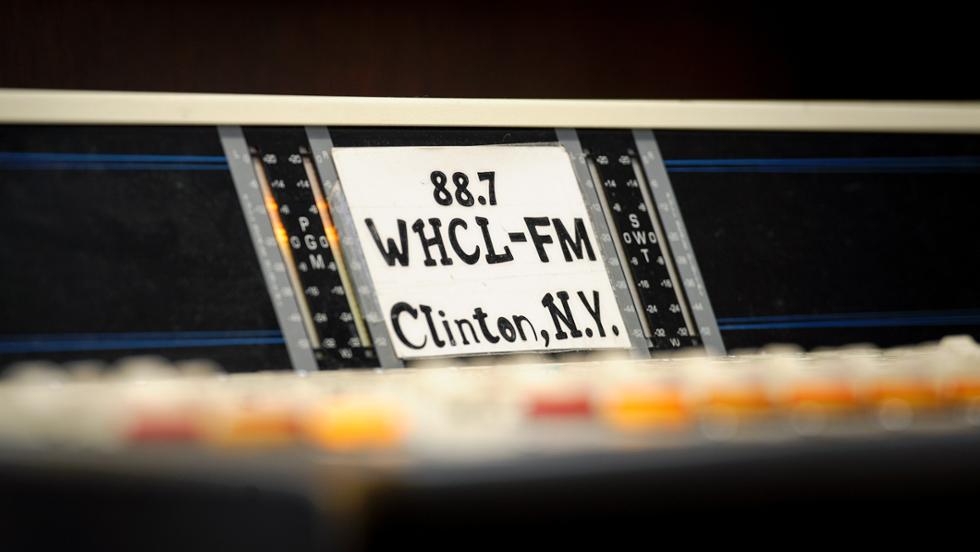
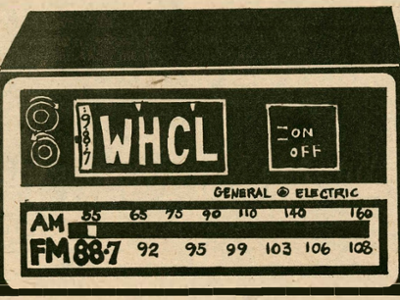
November 1960 brought a change to WHC: the addition of a fourth letter to their call sign, following a Federal Communications Commission requirement that stations expand to a four-letter identifier. Thus, WHC became WHCL. The station also moved from the cramped Root Hall studios to a new, custom-built facility in the basement of the new Minor Theater. And with that change came an end to the gas-pipe closed-circuit broadcast radius; on Feb. 18, 1963, armed with a new Class D noncommercial license from the FCC, WHCL-FM activated its new transmitter signal atop South, becoming the first educational FM station in the Mohawk Valley. No longer restricted to an AM bandwidth with a radio close to a radiator, WHCL now operated at 16 watts of monaural broadcast strength at 88.7 on the FM dial.
As a noncommercial station, WHCL’s content now included a variety of public affairs programs and discussions, as well as broadcasting blocks featuring popular and classical music. The station also welcomed on-air talent from Clinton; one of the earliest Clinton-centric programs aired Fridays at 10 p.m., as Rev. John F.H. Gordon of St. James Episcopal Church aired “Make a Joyful Noise,” a collection of religious and classical melodies.
By 1968, WHCL promoted rock music on Friday and Saturday nights, putting them in direct competition with Utica commercial radio station WTLB. Sundays were often reserved for classical music, while many weeknight shows featured discussion panels or prerecorded programming. At the same time, two of WHCL’s more popular and dedicated staff members, Robert Tupper ’69 and Greg Ritz ’70, took their love of folk music and turned it into a popular campus folk duo, Teakwood. After earning prize money in several appearances at the New England Intercollegiate Folk Festival, Tupper and Ritz recorded a full-length studio album, Teakwood (the LP’s name synonymous with Tupper’s and Ritz’s membership in the TKE fraternity). Copies of the Teakwood LP are considered highly prized today among record collectors and folk music aficionados.
The landscape changed in 1968, when Kirkland College was established. WHCL was one of the first Hamilton student organizations to welcome Kirkland women under its aegis, as Sandy Rowell Clay K’72 and Jennie Morris K’72 received plum broadcast timeslots on the station. Sarabelle Hitchener K’72 started the 1969-70 academic year as WHCL’s first female studio manager. By 1974, nearly half the students involved with the station were from Kirkland.
“While I can’t recall all the details of how we got started,” Jennie Morris recalled in a blog post, “I know that show producer Merrill Jones K’72 (who passed away in 1979) took me on as an announcer. Together we worked on a playlist of contemporary folk offerings and commentary. Within a year, I was producing live music broadcasts in cooperation with the Kirkland Coffee House.”
On Feb. 17, 1979, as a WHCL broadcaster prepared his show for the evening, the Minor Theater’s studio workshop suddenly burst into flames. The quick-thinking broadcaster called the fire department, and the building was saved from ruin. Although WHCL’s studios did suffer some smoke and water damage, the insurance proceeds from the fire allowed the College to invest in a new stereophonic mixing board and two modern turntables.
The Minor Theater fire was just part of the problems facing WHCL in the late 1970s. A rash of thefts from the station’s record libraries plagued on-air quality, and replacing the stolen items was an expense the station could not afford. And some record companies, citing WHCL’s low-power radius, no longer sent free record albums to the station. All of these factors hurt on-air performance — so much so that, in 1981, the Publications Board placed the station on probation.
While WHCL dealt with those calamities, the FCC forced the station into a new era. When it received its FCC license in 1963, the station was designated as a Class D noncommercial station, operating at low power (10 to 16 watts) so that its signal would not interfere with other commercial stations. By 1979, the FCC ended the Class D designation, and the low-powered stations on the dial had three choices: boost their broadcast signal to greater than 100 watts; relocate their signal to a new bandwidth (jammed between more powerful commercial signals); or shut down completely.
Eventually, through a combination of new studio equipment, new connections with record companies, and a favorable ruling from the FCC, WHCL improved both their on-air sound and their broadcast range. On Nov. 12, 1982, Hamilton College President J. Martin Carovano ceremonially “flipped the switch,” activating WHCL’s newly-installed stereophonic signal. One year later, WHCL received permission from the FCC to increase the broadcast range to 210 watts and operate as a Class A educational station. Not only could WHCL now operate as a “viable listening alternative” to area rock stations like WOUR and WRCK, they could also compete with Utica College’s WPNR and its 450-watt broadcast range.
In 1986, WHCL was allowed to boost its signal strength to a whopping 275 watts of broadcast range. The station could now reach most of Oneida County, to the point where travelers on the New York State Thruway could pick up 88.7 FM on their car radios as they passed between Exits 31 and 33. WHCL now operated with a yearly budget of $27,000 — one of the largest budgets for any student-run organization — and remained a popular viable listening option for area news and alternative music.
Thirty years after WHCL moved into the Minor Theater, the studios relocated to the Bristol Center. The new studios, in an area that once housed both the bookstore and the basement bowling alley, opened for business in February 1993.
In 1996, one of WHCL’s discussion programs, Double Take, received national acclaim when the show was featured on CNN’s program Inside Edition. The show, hosted that night by Cary Devorsetz ’96, Raphael Allen ’97, and Dan McAllister ’99, discussed the impact of affirmative action and its influence on the College’s minority population. CNN host Jonathan Karl noted in the TV program: “College radio has a new sound this year — political talk instead of the alternative music formats for which so many campus stations are best known. At Hamilton College … students are tuning in to WHCL, the campus radio station, for talk with a political beat.”
On May 4, 1999, WHCL added a new broadcast source. In addition to the 88.7 FM radio stream, the station introduced whcl.org for streaming shows. One year later, the station broadcast their first shows through the RealAudio streaming service. With the new online service, WHCL refocused its musical catalog toward independent music and local sports, shying away from the commercial rock music available on other local stations. “Broadcasting over the internet will allow us to reach Hamilton alumni, parents, relatives, and prospective students,” wrote Keith Brown ’00 in The Spectator. “This will enable parents to hear as their sons and daughters compete in Hamilton sports, allow alumni and prospective students to hear speakers who come to the campus, and let us broadcast Commencement ceremonies.”
WHCL stayed at the Bristol Center until 2010, when the station moved to the newly constructed Sadove Center at Emerson Hall. It offered a larger studio space as well as modern electronics and a pleasing view of campus. No more basement broadcasting.
Although WHCL prides itself as a broadcasting outlet for students and faculty, the station also provides community resources throughout the Mohawk Valley. In 2015, WHCL acquired two new local programs when commercial radio station WUSP folded. Mark Fuller migrated the format of WUSP’s oldies show as “Mohawk Valley Memories,” while Gary Sroka’s “Saturday Polka Show,” previously at WTLB and WUSP, found residency on Saturday mornings.
By February 2020, WHCL was riding high, as the station hosted the indie rock band Melt (along with college-based band Uptown Booty) for a campus concert. At the same time, Rob Lane ’20 interviewed then-up-and-coming singer Chappell Roan on his WHCL radio show The Jubilee Line.
One month later, the campus was in lockdown as COVID-19 spread. At that time, the only on-campus entity still in operation was WHCL. Modern technology had evolved to the point where students could pre-record their radio shows on their computer desktops and laptops in lockdown and then transfer the digital product to the station. And in the summer of 2020, a new crop of WHCL broadcasters returned to the airwaves: alumni eager to keep the station on the air throughout the pandemic.

“During the early days,” said Dave Bolger ’99, “an email was sent to alums of WHCL asking if anyone would be interested in recording radio shows at home to help keep the station on the air. During my time at WHCL, I had multiple shows, was the sports director, and did the play-by-play for several sports. I loved it so much that I thought it was what I would do for my career. … The email to alums presented a fun opportunity to finally get back into it.”
So, today, 85 years after its debut, the station that once was tethered to nearby radiator pipes and available for campus listeners only can now “pump the wattage” through Bluetooth headphones to anyone, anywhere in the world.
Posted March 10, 2026