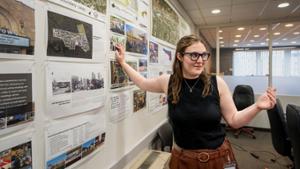
On her computer, Alix keeps data that she created during an Emerson Grant project mapping the parks and trees of Utica. Every day, she is reminded of the work she put in to get to her current position as a city planner in Utica, N.Y.
While at Hamilton, Alix discovered her passion for spatial analysis and Geographical Information Systems (GIS) through her coursework, taking three classes dedicated to the subject. “I started with the courses, and then every single chance I got to use it to solve a problem faster, I did. It became a hobby for me,” she said.
As Alix learned how to apply GIS to environmental science problems, it wasn’t long before she started asking herself, how else can we use it? “In my Emerson summer, I explored new uses, which is how I got interested in city government. That self-exploration helped me understand how to troubleshoot, how to solve problems, and how to take the data I have and what I want to do with it and figure out that middle ground without having to get walked through it,” she said.
“That self-exploration helped me understand how to troubleshoot, how to solve problems ... and figure out that middle ground without having to get walked through it.”
Alix’s knowledge of GIS has helped her tackle an array of issues, from digitizing Utica’s sewer data to designing websites displaying local road quality for general public and engineering usage. Her work has assisted efforts across City Hall due to the flexible applications of spatial data analysis.
“In order to know what people are doing, what people want, and how we optimize space in a city that we’re trying to develop, we look at things like road networks, sewer data, trashcans, billboards,” Alix explained. “I can find out what people like because they’re geotagging it, which helps us understand how we’re growing our city.”
Alix also attributes her success in rising to meet these challenges to the self-confidence she developed through participating in public speaking at Hamilton. In her McKinney Award-winning speech at the annual Public Speaking Competition, she addressed a topic that most would rather ignore: failure. Her speech was not abstract, either, but a vulnerable admission of her own experience failing Calculus II.
Of her topic choice, Alix said, “I had seven minutes to give this speech in front of everyone in the Chapel and then put it on YouTube with my name attached to it until the day that YouTube goes down. How could I take my seven minutes to actually say something important?
“I had something I needed to say. If I could leave Hamilton with one thing, it’s that we’ve got to rethink the way we’re thinking about failure,” she continued. “In that moment, I saw that people really resonated with what I was saying, whether they failed a class or a homework. Watching people’s facial expressions really left a mark on me.”
Empowered by her commitment to learning, her reframing of failure, and her passion for GIS, Alix has brought her skills from the Hill to its neighbor, Utica, giving back to the Upstate New York community that nurtured her growth.
Posted April 27, 2026