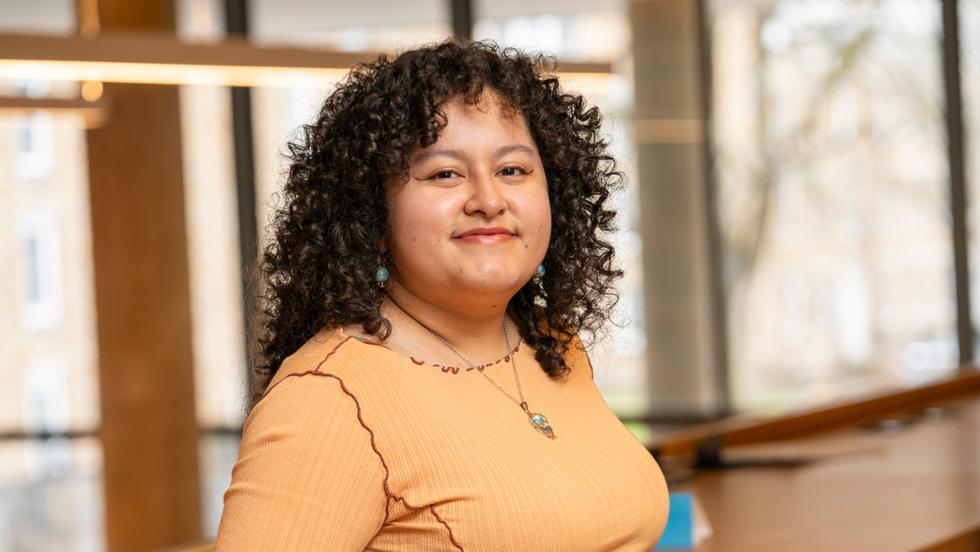
With support from her professors, study abroad programs, and extracurriculars, Callejas has discovered and nurtured a love for ethnomusicology, the study of the cultural aspects behind music. She’ll soon be heading to Boston University for a master’s degree in the subject.
Communications Office student writer Alejandro Sosa Hernández ’26 sat down with Callejas to learn more about her intellectual pursuits. (Interview paraphrased and abridged for clarity and brevity.)
Q
Did you always know you wanted to study music, Japanese, and/or Hispanic studies?
When I first came to Hamilton, I was considering a double major with music and something else. I was discussing with Prof. Cornelia Brewster how interesting the sociological aspects of my class, Black Voices in Song were, and she said I might like ethnomusicology. Even though Hamilton doesn’t offer that, I talked to Kelvin Nuñez ’24 about it. He was one of my biggest mentors and had created an interdisciplinary major of his own. He made me realize that I could combine certain disciplines to “major” in ethnomusicology, and so I combined Japanese, music, and Hispanic studies.
Q
What research opportunities in ethnomusicology have you had?
I started doing research in ethnomusicology as a rising sophomore. My first project explored cultural authenticity within Mexican and Salvadoran music and dance. In Mexican music, I researched zapateado, a form of dance created through resistance to the transatlantic slave trade. As for El Salvador, I explored folklorico and how El Salvador’s government suppresses representations of indigenous culture. Through my research, I learned about ethnomusicologist Maria de Barrera, who integrated native music and instruments into symphonics to remind Salvadoran people that they also have native blood. Then, from December 2024 until March 2025, I researched salsa music in Japan with a grant from Hamilton’s Steven Daniel Smallen Fund for Student Creativity. I was able to interview many Japanese and Latin American artists who spoke about how they were trying to bring salsa and bachata to Japan.
Q
What kind of support did you receive from Hamilton’s faculty and staff?
Even though Hamilton doesn’t have such a field of study, Prof. Alex Bádue really helped educate me on ethnomusicological literature by giving me books to read over breaks. Prof. Charlotte Botha has also helped me understand when a musicologist is speaking as an “insider” or as an “outsider,” which is important because many of them speak in a “colonized” way. Depending on one’s perspective, the way one speaks about music can be very different, which can result in one harming or elevating a culture.
My ALEX advisor Noelle [Niznik], has really helped me with my mental and emotional health. When an idea comes to me to create change, there’s a lot of emotional weight to it, so having a person I could speak to during those moments made me feel safe. In my first year, we’d meet weekly. As a senior, I’ve started doing this again because this year is a transition period for me, so it’s really nice during these times to have someone to talk things out with.
Q
Have you incorporated what you’ve learned into any extracurricular activities?
When I joined Hamilton’s only Latin dance group, Tropical Sol, as a first-year student, I felt disillusioned with the club’s whitewashed idea of what Latin music and dance was. At the time, I was the only Latina in the club. My research motivated me to tell the Tropical Sol e-board, “This is what I see, this is how it makes me feel, and this is how I want to change it.” This taught me how to actually do something about things that aren’t the way they should be. I started to rebrand the club in my sophomore year as the vice president, and by junior year, I was president. I’m very proud of how it has become a place for Latinas to feel at home, but it’s still a place where non-Latinos can participate. Now, there’s more of a community where we can value each other’s individual perspectives. I hope future students carry that on after I graduate.
Q
What else have you learned by blending these disciplines?
My discipline has brought out in me an assertiveness I didn’t think I was capable of. I’m now generally a lot more outspoken about things. My brother once told me, “You’ve always been outspoken. You’re not just like that with your family.” That made me realize that music has really helped me open up to people I don’t know as well. I know what I want to say, when I want to say it, and whom I want to say it to.
Q
What’s next after Hamilton?
I was offered admission to Boston University’s MA program in ethnomusicology. BU was my top choice, so this is a dream come true for me! I want to polish up my tutoring skills at BU because I want to be a professor of ethnomusicology. I’m really excited to start the upcoming year with new people, learning new things and old things in new ways.
Posted April 7, 2026