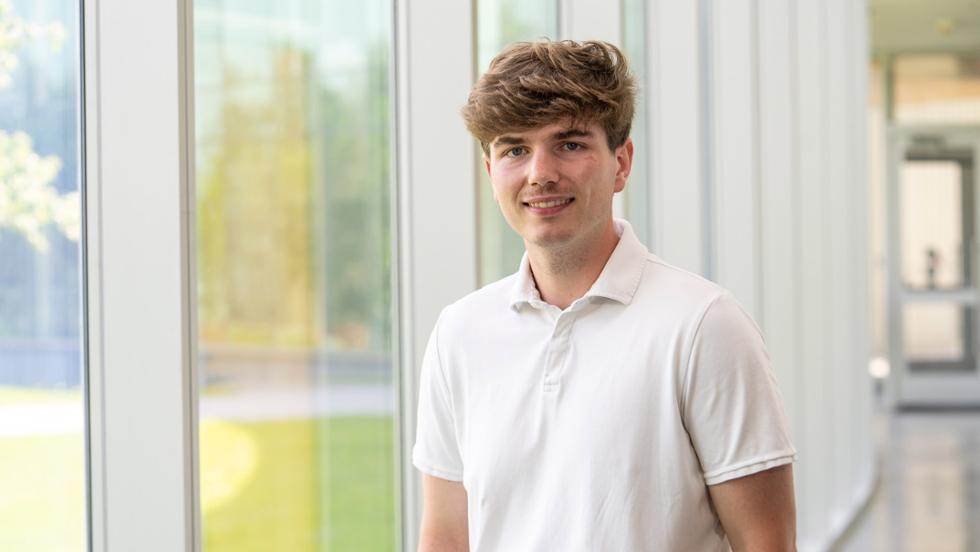
Sinardo, a biochemistry major and Africana Studies minor, enjoyed introducing classmates to local staples and attractions while immersing himself in the residential college experience. Through his leadership within the health professions track, in addition to mentorship and direct service roles both on campus and in local schools, he ensured a supportive intellectual and social environment for under-resourced pre-med students.
Beau Sinardo '26
Major: Biochemistry/Molecular Biology
Hometown: Waterville, N.Y
As an underclassman, Sinardo was the rare student who enjoyed Organic Chemistry I and II, which spurred his attraction to biochemistry, particularly medicinal chemistry. So, he asked to join Associate Professor of Chemistry Max Majireck’s research lab. “I had no idea what I was getting into at the time,” Sinardo admitted, but he loved it. He spent multiple summers on-campus working in the lab, traveled to American Chemical Society (ACS) conferences in San Diego, Washington, D.C., and Atlanta, and contributed to two published articles on the lab’s findings.
Although these projects have taken Sinardo across the country, his compassionate view of medical care flourishes in his own backyard. In high school, he began volunteering as a medical scribe at Digestive Disease Medicine at Mohawk Valley Health System in Utica, where he acquired fundamental skills in stocking supplies, examining patient charts, and assisting in the operating room. There, he became aware of anesthesiologists’ calming presence in doctor-patient interactions. He realized, “Medicine’s not just about physical pain. There are so many different factors that decide a patient’s outcome.”
“Medicine’s not just about physical pain. There are so many different factors that decide a patient’s outcome.”
The same realization guided him in his junior year at Hamilton, when he became a medical assistant at CNY Brain and Spine in New Hartford. Although the neurosurgery clinic is one of the largest in the region, demand is outpacing the practice’s growth. Sinardo interfaced with patients who had driven over two hours for their appointments. This dearth of access, which affected Sinardo in his own childhood, is a barrier he now hopes to mitigate, potentially by specializing in interventional medicine. Sinardo’s research with Majireck further exposed him to delays in healthcare — but it also confirmed to him that “things I was doing on campus could eventually lead to big impacts on the pharmaceutical industry.”
Senior year, while serving as president of Pre-Health Club, vice president of Chemistry Club, a peer mentor, and a volunteer with Hamilton Reads, Sinardo launched his own initiative — NextGen Health Pre-Health Professionals — with the help of Jess Kelly, Quantitative and Symbolic Reasoning Center director, Director of Opportunity Programs Aaron Ray, and Director of Health Professions Advising Courtney Hance. In its first year alone, the program fostered a community of 20 first-gen pre-health first-year students, each of whom will act as a leader to successive cohorts.
“There is a ‘hidden curriculum’ of pre-health that can be difficult to understand and adapt to as a first-gen student,” Sinardo explained. By demystifying this structure, he bolsters a sense of belonging and confidence for first-gen students like himself, many of whom wonder, “Am I smart enough to be at Hamilton? Am I smart enough to be a doctor?”
Sinardo’s post-graduate plans demonstrate confidence is often the key to success. After Hamilton, he’ll join a leading NIH-funded research group at The University of North Carolina at Chapel Hill focused on developing new minimally invasive approaches for treating pain. At first glance, Sinardo did not meet the research group leader’s criteria — he was looking for a short-term position in advance of medical school, and he lacked clinical research experience — but his grit made him stand out. After rounds of interviews and a visit to UNC, the group leader gave him the good news.
As a result, Sinardo said, “I’ve altered my approach. … I was going to play it safe,” but now he keeps an open mind. He is keen on an assortment of specialties and a range of locations — what matters is sustaining longitudinal relationships and patient-centric care.
Posted June 29, 2026
