
Africana Studies
The goal of the Africana Studies department is to take up the field's central questions and debates in multiple contexts and by means of multiple methodologies.In keeping with this goal, many of the department’s course offerings focus extensively and transdisciplinarily on issues of social, structural, and institutional hierarchy as they pertain to race and a host of other dimensions of identity.
About the Major
Hamilton’s Africana studies faculty and students represent a wide range of racial and ethnic backgrounds, bringing to the classroom a diversity of experiences, perspectives, and disciplinary strengths. Students often spend a summer conducting research with a professor; some have earned fellowships to continue their academic work abroad after graduation.
Students Will Learn To:
- Apply at least two disciplinary lenses of analysis that focus on a specific aspect of the life experiences of people of African descent (for example in written/digital assignments, performative or oral presentations)
- Explain, verbally and/or in writing, the interrelationships among people from sub-Saharan Africa, the United States, the Caribbean, Latin America, or other parts of the African diaspora in two or more of the following areas: linguistic, intellectual, political, economic, or cultural
- Define and provide examples of colonization, decolonization, Black liberation/power movements and their legacies
- Explain, verbally and/or in writing, the concept of intersectionality via specific connections with race, ethnicity, class, and gender
- Explain the goals of one or more current social justice initiatives involving people of African descent in the United States and globally
A Sampling of Courses
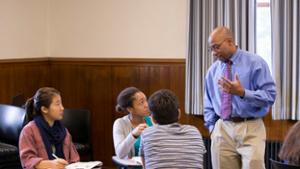
Black Joy: Expressions, Practices, and Existential Significance
This course explores Black joy as a vital site of creativity, resistance, and existential meaning in the lives of people situated as Black. While much scholarship on Black life focuses on structures of oppression and resistance, this course turns attention to the generative, life-affirming practices of joy that animate Black communities across time and place. From music, dance, and literature to spiritual practices, everyday rituals, and collective celebrations, we will examine how joy functions not simply as fleeting pleasure but as a profound mode of survival, a politics of possibility, and an existential grounding in the face of systemic devaluation.
Explore these select courses:
Forefronts the consequences of assumptions based on hegemonic ideas and representations of blackness and Black life. We examine how visual and narrative representations impact our perceptions and sense of collective and individual selves, and the lived experiences of Black subjects. We explore dominant cultural representations of blackness and how they are in dialogue, negotiation, and contestation, along with the tension and interaction between ideas inherited from the outside, and the created inner ones.
The course is designed to examine race and diversity issues in the world of sports from the early 20th century to the present. Topics will examine and provide critical inquiry on the impact of race and racism in major world sports and the Olympic movement, including football (soccer), tennis, boxing, cricket, baseball, American football, and athletics. The course is inter-sectional in scope and interrogates issues of masculinity, gender, the structures of power, as well as new forms of global capitalism in sports, and individuals that have personified their areas of sporting achievement.
A survey of African history from the 19th century to the present. Engages with new research in environmental history to rethink conventional narratives. Features environmental histories of capitalism, colonialism, resistance, resource extraction, the contemporary state system, infrastructure projects, the climate crisis, and ongoing movements for social justice. Students explore a variety of approaches for centering people, places, and actors often marginalized in dominant histories, focusing on how this work contributes to contemporary political and environmental debates.
Meet Our Faculty

culture theory; racial formation; visual culture; diaspora; invisibility and transnational cultural politics

acting; Shakespeare; African-American theatre; Sanford Meisner; Uta Hagen; August Wilson

A. Todd Franklin
Eugene M. Tobin Distinguished Professor of Philosophy and Africana Studies
existentialism, African-American philosophy, and Nietzsche

Critical human geography; race, place, and belonging in Italy, Black Europe, and the U.S.; gender and intersectionality; African Diasporic politics and identity in Italy; Blackness and anti-blackness

history, sociology, and Africana studies

Careers After Hamilton
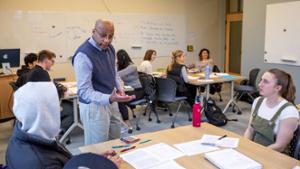
Hamilton graduates who concentrated in Africana studies are pursuing careers in a variety of fields, including:
- Volunteer, U.S. Peace Corps
- Financial Analyst, Lazard Capital Markets
- Architectural Designer, Coyle & Associates
- Foreign Services Officer, U.S. Department of State
- Program Coordinator, Posse Foundation
- Editorial Assistant, EPIX
- Teacher, Bronx Academy of Letters
Explore Hamilton Stories

Westmaas Presents on Haiti and the American Revolution
Professor of Africana Studies Nigel Westmaas delivered the keynote address at a public conference hosted by the University of Guyana.
Westmaas Co-Authors Article on Guyana in The Roundtable
Professor of Africana Studies Nigel Westmaas co-authored the article “Committed to the Cause of Humanity’: Guyana and the Morality of Cuban Medical Internationalism.”
Contact
Department Name
Africana Studies Program
Contact Name
Donald Carter, Chair
Clinton, NY 13323
