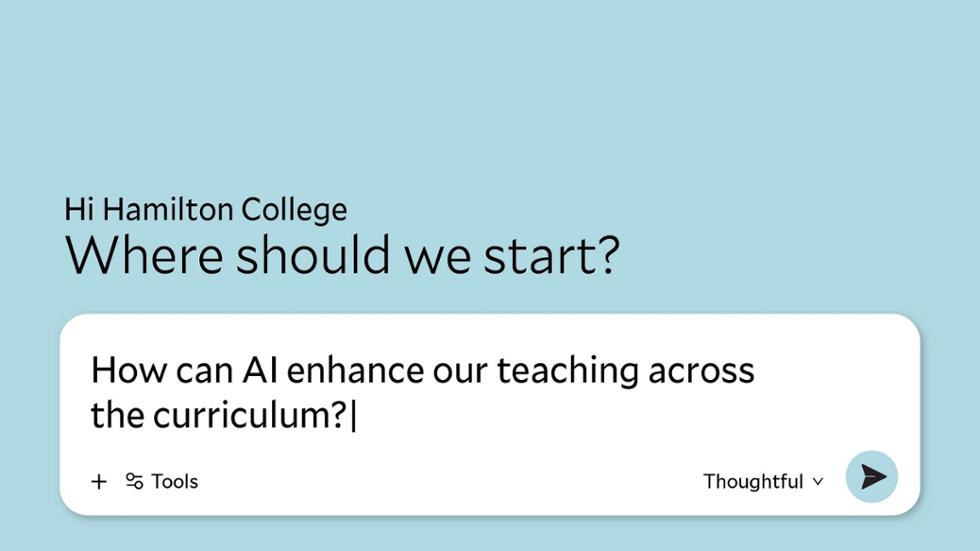
The Lighthouse Fellows program is the creation of Hamilton President Steven Tepper and Provost/Dean of the Faculty Ngoni Munemo. They have urged Lighthouse Fellows to be bold and inspiring and to address the liberal arts generally, not in any course-specific manner. Munemo said, “The faculty have the perspective on their own disciplines. The fellows, as members of the faculty, will think through whether and how AI can enhance their teaching across the curriculum constructively, thinking about the technology more broadly and our liberal arts endeavor.”
Five collaborative groups of faculty responded to the call for those interested in exploring, prototyping and demonstrating high-impact, responsible uses of AI across the liberal arts. Leading the selected group is Associate Professor of Computer Science Darren Strash. The other members represent a broad swath of the curriculum: Professor of History Lisa Trivedi, Associate Professor of Psychology Vik Bejjanki, Associate Professor of Sociology Jaime Kucinskas, Associate Professors of Philosophy Alexandra Plakias, and Justin Clark; and Assistant Professor of Mathematics and Statistics Erin Tripp.
“I want us all to have the opportunity to learn what AI is doing under the hood, understand its impacts, and to empower our community to use AI in a way that serves cognition rather than undermining it.”
Some faculty have expressed interest in exploring AI and identifying possible uses for it in their courses. Yet frequently heard is the comment that there is much they would like to try out, but they don’t have the time to do so. The Lighthouse Fellows, relieved of teaching duties for the academic year, will have the time. All the fellows are pursuing this project with departmental support.
In discussing their goals, Strash said, “The best outcome would be the creation of a community that understands what AI is and what it isn’t, a community that can have conversations about its many facets – I want us all to have the opportunity to learn what AI is doing under the hood, understand its impacts, and to empower our community to use AI in a way that serves cognition rather than undermining it.”
Some of the activities in which the fellows will be involved, beginning this summer, are:
- Conducting literature reviews, including recommending and reading papers from various academic areas, discussing them, and possibly inviting other faculty to participate in discussion lunches,
- Visiting other universities or conferences where AI initiatives are underway,
- Evaluating what AI might mean for writing intensive courses,
- Working with faculty who have expressed interest in developing courses that integrate AI, targeting course offerings for the spring semester aligned with the Innovation Center opening.
- Developing an introductory “What Is AI”course that would help students understand both the capabilities and limitations of AI systems, learning how it works and how it fails, instead of blindly trusting its output.
- Creating modules that will be tested directly in collaboration with students and faculty, designed to be integrated with, and complement, existing curriculum,
- Beginning to conduct a multi-year study into the beliefs, attitudes, and uses of AI by students, capturing and assessing the changing learning habits and how these impact success.
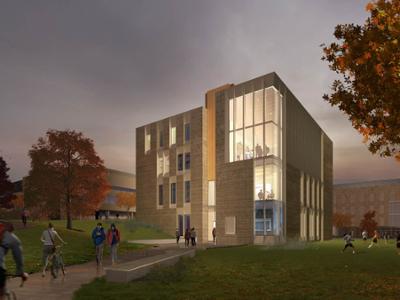
“With the opening of The Nye Center for Innovation and Technology in 2027, Hamilton will have a physical space not just devoted to computer science classes, but we will have a space dedicated to exploring, experimenting, and learning with technology. We hope to work with faculty in a variety of disciplines across Hamilton who want their students to meaningfully engage with technology, including AI, and look forward to them using the Nye Innovation Center to its fullest potential,” Strash said.
"We are excited about what our faculty, given time and resources, can learn and discover about technology and the delivery of a liberal arts education, Munemo said. The Lighthouse Fellows will begin that work soon.
Posted April 17, 2026