
Retiring Faculty Share Defining Teaching Moments
To honor their tenure, we asked each to reflect on a single moment — inside or outside the classroom — that captures what teaching has meant to them. Their answers offer a glimpse into the relationships, discoveries, and quiet transformations that define a life in education.
“The best moments of my career were when something genuinely shifted during class — when a student saw the world a little differently, or when I did too. Those moments cannot be scheduled. They can’t be part of your syllabus. They come from paying attention, staying open, and being willing to let go of the plan.”

“Moments … The most valuable moments in my teaching were never the ones I planned. They came when a student’s question changed the direction of our discussion, when silence gave everyone room to think, or when understanding arrived on its own. Economics — especially when the topics touch inequality, crisis, poverty, and development — cannot live only in formulas and theoretical models. It needs space for doubt, for moral questions, and for the human stories behind the data and the models. The most honest conversations happened when I set aside my lecture notes and followed where the class led: into personal experience, into questions about fairness, into what policy actually means for real people.
“At the heart of my teaching is a simple belief: economics is not about having the right answers. It is about learning to think clearly when the answers are uncertain, when the world is unpredictable. Models matter, but so do their limits. Data informs, but it does not speak for itself. Behind every number is a choice about what we value and who we care about. The best moments of my career were when something genuinely shifted during class — when a student saw the world a little differently, or when I did too. Those moments cannot be scheduled. They can’t be part of your syllabus. They come from paying attention, staying open, and being willing to let go of the plan. That balance — between rigor and inquiry, between structure and spontaneity — is where the real work of my teaching happens. In those moments.”
Professor of Economics Erol Balkan focuses on the formation of middle classes through education and financial liberalization in developing countries. He has received several awards and grants for his work, including the International Development Research Center Grant in 1996 to study the effects of short-term capital flows on the Turkish economy. Having joined the faculty in 1987, Balkan teaches economic development, international finance, and political economy of the Middle East and was a visiting professor at Bilkent University and Sabanci University, both in Turkey. The author and editor of several books and articles, he received the Class of 1963 Excellence in Teaching Award in 1991, the Samuel and Helen Lang Prize for Excellence in Teaching in 2009, and this year the Dean’s Scholarly Achievement Award for career achievement. In addition to service on several College committees, he co-developed Hamilton’s program in New York City. Balkan holds his bachelor’s and master’s degrees from the University of North Carolina at Greensboro and doctorate from the State University of New York at Binghamton.

“When a student asks a question — such as “How many people lived in New York City when Franklin stopped there in 1727?” — I know exactly who to contact for the answer because this is a small place where faculty across disciplines talk to one another casually outside of class and discover shared interests. I have used Dan Chambliss’ essay “On the Mundanity of Excellence” in first-year and Opportunity Program courses since the early ’90s. Dick Bedient and I developed a Sophomore Seminar on the Tom Stoppard play Arcadia because we had discovered a shared love of fractals. The book history I teach with Christian Goodwillie in the library’s Special Collections works because we know who on campus is an expert in what and can bring them into the classroom to talk about cuneiform or Roman literary culture or the Nuremberg Chronicle. Through these conversations and collaborations, we are able to offer students a far more engaging and challenging educational experience than I, at least, could provide on my own.
“One cool moment: I brought first-year students to the library once to look at material in Special Collections related to Frederick Douglass’ “Letter to his Old Master” (Thomas Auld), which we were reading, and thought that I shouldn’t short-change the rest of the library, so would also show them some of the databases available. Earlier a student had asked what effect Douglass’ letter had had in the world. I had to admit I had no idea — and no clear idea of how to go about finding an answer. We searched for Douglass’ letter in the database of newspapers and discovered not the letter we were looking for, but one from a year later. In that letter, Douglass praised Auld for having freed his slaves. We were all stunned. None of us had any idea (and I cannot find any information in the scholarly conversation about it). That is how real research works — a question, some other investigation, and serendipity.
“This student’s question, like the one about about the size of NYC in 1727, are ones that I, bound by disciplinary training, never thought to ask. Having students ask questions from other perspectives makes the classroom experience unpredictable and endlessly interesting.”
Margaret Thickstun, the Jane D. and Ellis E. Bradford ’45 Distinguished Writing Chair in Creative Writing and Literature, arrived on College Hill in 1988, having earned her bachelor’s degree at Mount Holyoke College and her master’s degree and doctorate at Cornell University. Her teaching interests include religious literature and questions relating to the history of the book and literary reception. Specifically, she studies the transition from manuscript to print culture, books as physical objects, the place of women writers, the making and role of anthologies, and the making of a canon. A prolific writer on Milton, Bunyan, Swift, and Puritan women’s spirituality, her most recent book is Milton’s Paradise Lost: Moral Education (2007). The longtime College marshal, Thickstun has served as faculty chair and on several committees, and this year received the Dean’s Scholarly Achievement Award for career achievement. She also hosts an annual communal reading of Milton’s epic poem Paradise Lost that takes about 10 hours to recite.
“I am always energized by students who are passionately curious about French histories, practices, and fictions. The connections we make through our shared interest in language, text, and culture are life sustaining.”

“This is an impossible question! I am, therefore, going to take liberties with the meaning of ‘moment.’ For the last 36 years, I have had the privilege of helping Hamilton students find delight in mastering a new language, discover that Balzac and Annie Ernaux are equally good reads, follow the succession of French governments from the Revolution to the 5th Republic, learn to love taking the bus in Paris, and embrace the challenges of producing a sophisticated argument in French in their senior research paper. In the classroom here on campus, advising Emerson summer research projects, or out somewhere in the city classroom that is Paris, I am always energized by students who are passionately curious about French histories, practices, and fictions. The connections we make through our shared interest in language, text, and culture are life sustaining.
“One ‘moment’ then, if I must choose: In the spring semester of 2015, the twice weekly meetings with my students in the senior seminar, Out in the City: Nineteenth-Century Paris, were my life raft as I was also caring for my terminally ill husband. It turned out that my students were also caring for me. Not only did they strive to make our class meetings intensely rewarding, they also became a support team outside of class, helping care for the family dog, sending flowers, and going so far as to make a group donation in my husband’s memory to Memorial Sloan Kettering cancer research. As I was teaching them about 19th-century urban texts, they provided me with a lesson in gratitude.”
Having joined the faculty in 1990, Professor of French and Francophone Studies Cheryl Morgan is a specialist in 19th-century literature, with particular interest in French women writers, literary humor, and urban literature. A prolific author and presenter at professional conferences, her recent projects include editing a special volume of Women in French Studies on humor and contributing an essay on Paris in contemporary American crime fiction to the book Paris in the Americas: Yesterday and Today (2022). For Hamilton, she has served on the Committee on Academic Policy and as chair of a Middle States Review committee on the curriculum, academic programs, and assessment. Morgan, who earned her bachelor’s degree from Dartmouth College, her master’s degree from Middlebury College, and her doctorate from Columbia University, is a seven-time resident director of the Hamilton in France program.
“An extremely rewarding part of teaching for me is those times when I have been able to change someone’s attitude toward mathematics, when I feel I have been able to share how challenging, how fun, how beautiful the discipline can be.”

“I was teaching Calculus II in the fall semester; in early November, I had handed back the second midterm and it was advising season. A student was in my office hours for help with homework and I told her, ‘You know, you’re really good at math. I hope you take more math courses so that I can see you in my classes in the future.’ Her eyes widened; she looked surprised; she was silent for a minute or two. She told me that nobody had ever told her that before. Her performance in the course only improved from that point. She did keep going with math, and now she is taking one of our most abstract and proof-heavy courses with me — and excelling at it.
“An extremely rewarding part of teaching for me is those times when I have been able to change someone’s attitude toward mathematics, when I feel I have been able to share how challenging, how fun, how beautiful the discipline can be.”
Sally Cockburn, the Samuel F. Pratt Professor of Mathematics and Statistics, joined the faculty in 1991 having earned her bachelor’s and master’s degrees from Queen’s University, a second master’s at the University of Ottawa, and her doctorate at Yale University. Her teaching interests include set theory and the philosophical foundations of mathematics. Cockburn has published on combinatorial optimization and geometric graph theory. A recent paper “Edge Determining Sets and Determining Index,” co-authored with Sean McAvoy ’23, was featured in a 2024 edition of Involve, A Journal of Mathematics. Cockburn has served in numerous College leadership roles, including on the Committee on Academic Policy, the Appeals Board, and the Committee on Academic Standing. From 2004 to 2008, she was head women’s squash coach. A two-time recipient of the Class of 1963 Faculty Fellowship, she earned the Mathematical Association of America’s Carl B. Allendoerfer Award in 2014.
“There’s nothing quite like witnessing someone come into their own strength — not just physically, but mentally and emotionally. That moment when effort turns into understanding, when pressure sharpens into clarity — that has been my greatest privilege to witness, both on the lacrosse field and in the yoga studio.”
“The skills I hoped to cultivate were never just about the game or the yoga practice. They were about learning to meet life with focus, resilience, presence — and, just as importantly, a sense of humor. Those qualities are essential not only to mastering yoga, but to achieving something as demanding and meaningful as a national championship.”
Patricia Kloidt arrived on College Hill in 2003 as the women’s lacrosse head coach and professor of physical education. In 22 seasons, her teams posted a record of 220-127, and she became one of the top 25 all-time winningest women’s lacrosse coaches in Division III. In 2008, Kloidt coached the Continentals to the NCAA Division III championship, the first national team title in the College’s history. That same year she was selected the Intercollegiate Women’s Lacrosse Coaches Association Division III Coach of the Year. Kloidt led Hamilton teams to 17 postseason appearances, including seven trips to the NCAA championship. She coached 17 athletes to a total of 26 all-America honors, and 14 of her players made the all-NESCAC Conference team. She holds a bachelor’s degree from Pennsylvania State University and a master’s degree from Smith College.
“How does an English professor end up in a great camp on a beautiful evening talking about property rights and navigable waterways in the Adirondacks with Hamilton-educated lawyers and 20 exhausted but intensely engaged students? All I can say is that Hamilton College made this joyous, rewarding, and electric evening possible by allowing me to explore my diverse interests in an interdisciplinary class, by funding the field trip, and by connecting us with supportive alums!”

“If I had to pick one moment (or hour), it would be an after-dinner discussion on a field trip with my Adirondacks seminar. We were hosted by the amazingly generous Hamilton alum Jim Schoff [’68] and his wife, Anne, in their stunning great camp, Wenonah, on Upper Saranac Lake. They had hosted the class about a dozen times in total — providing beds and a lavish dinner and amazing breakfast for all 20 of us after a very long day of driving, hiking, and identifying trees, fir waves, and alpine plant zones.
“On this particular evening, Jim had organized a kind of mock trial with his friend Dennis Phillips (a lawyer for a Glens Falls law firm) and Erik Schwenker ’02 (an ADK lawyer) arguing two sides of a complicated case involving the right of canoers to paddle on a tiny stream through a corner of the privately owned Brandreth Park in the central ADKs. The class served as jury for the mock trial. The trial was deeply informative of the complexities of public and private ownership in the Adirondacks and certainly tested the students’ knowledge of the park, as well as their own preferences for open access to wilderness.
“The trial lasted about an hour, and the class engaged in passionate discussion for another hour before coming to a vote (against the paddler, contrary to my expectations!). The whole time I was repeatedly struck by how incredibly lucky I was to be involved in this amazing evening. How does an English professor end up in a great camp on a beautiful evening talking about property rights and navigable waterways in the Adirondacks with Hamilton-educated lawyers and 20 exhausted but intensely engaged students? All I can say is that Hamilton College made this joyous, rewarding, and electric evening possible by allowing me to explore my diverse interests in an interdisciplinary class, by funding the field trip, and by connecting us with supportive alums!”
Onno Oerlemans, the Elizabeth J. McCormack Professor of Literature, focuses his research on British and American Romanticism, ecocriticism, and critical animal studies. His book Poetry and Animals: Blurring the Boundaries with the Human (2018) surveys the ways in which animals have been represented in English-language poetry. His first book, Romanticism and the Materiality of Nature (2003), examines the ways that several British Romantic poets explored the physical, as opposed to transcendent, reality of the natural world. Oerlemans arrived at Hamilton in 1999 and earned his bachelor’s and master’s degrees at Queen’s University and his doctorate at Yale University. He has published articles on a wide range of topics and writers, and is currently working on a history of writing about the Adirondacks. Having served in numerous campus leadership roles, he was associate dean of the faculty from 2017-20.
“What’s one moment — inside or outside the classroom — that captures what teaching has meant to me? I can’t imagine pinpointing one moment or even distinguishing between inside and outside the classroom, and I mean that quite literally. As I have done my best to prepare each student for a ‘life of meaning,’ they have given ‘meaning to my life.’”

Laurie “Ella” Gant, professor of art, teaches courses on video, animation, and the Digital Arts Workshop. She joined the Hamilton faculty in 1991 and studies the intersections among established traditions and contemporary practices in the arts and education. Gant earned her bachelor’s degree at the University of Wisconsin at Madison and her master’s degree from the University of Texas at Austin with a specialization in transmedia. In 2011, she was named a fellow in digital and electronic arts for the New York Foundation for the Arts. Her work is in the permanent collections of the Library of Congress, The Museum of Modern Art’s Franklin Furnace Artist Book Collection, and Texas Folklife Resources. In addition, her work has been shown at the Berlin, London, Melbourne, Los Angeles, and San Francisco LGBT international film festivals. Gant is a recipient of Hamilton’s Richardson Award for Faculty Innovation.


“A moment that captures a part of what teaching means to me occurred in 2016, when I hosted a regional conference on computer science education at Hamilton. The event brings together faculty and students from across the Northeast, and to better serve the latter, several Hamilton computer science students (Mykhailo Antoniv, Kelsey Babcock, Maggie Coleman, Alex Dennis, and Emily Sears) volunteered to organize a career fair for peers seeking jobs in tech. They planned and hosted an event featuring 15–20 regional, national, and international companies. It became, to my knowledge, the largest career fair ever held at Hamilton, and its success led to it being replicated at subsequent conferences.
“This experience reflects a core principle of my teaching: cultivating independence. By the time students leave Hamilton, they should be able to learn and act without relying on faculty guidance. In computer science (in any field, really), students must develop the capacity to direct their own learning, and that growth needs to be intentionally built into the curriculum. Independence, once fostered, extends beyond the classroom and into students’ broader lives. The students’ decision to organize the career fair on their own demonstrated that they had begun to embrace independence, which, to me, is a meaningful measure of success in teaching.”
Appointed to the faculty in 1997, Mark Bailey, the Robert and Pamela Craig Delaney Professor of Computer Science, has earned fellowships from the National Research Council and the Air Force Research Laboratory and grants from the National Science Foundation and Microsoft Research. He has served as a consultant with the Air Force Research Laboratory and Assured Information Security, and his work is widely published in journals and symposia. He holds his bachelor’s degree from the University of Massachusetts and his master’s degree and doctorate from the University of Virginia. Bailey, who has received the Richardson Award for Faculty Innovation, created the course Secrets, Lies, and Digital Threats, which paired teams of Hamilton students with local high schoolers to teach teens about potential dangers of the digital world.
“It is difficult to pinpoint a singular event or a moment that would capture my experience over the last 40 years at Hamilton. It would, of course deal with my relationships with the students. Most of the students I have interaction with are not concentrators, but people who have taken many if not all of the classes I offer. Interaction in class, outside of class, performing with students on stage, and watching their sporting events have been very memorable.”

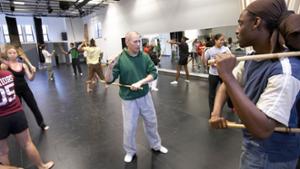
If I were to mention just one, I think it would have to be the most recent. That is Paris Wilcox ’95 (senior lecturer in ballet and dance history) arranging for Charles Thompson ’93 to redo “PENTJAK,” a martial arts-based piece choreographed by Elaine Heekin and myself in 1987 and then set on Paris and Charles for an alumni performance in New York City in 1993. Charles had not performed on stage for 20 years, but due to my retirement, he wanted to come back to show support and bring back the memory. That effort, coinciding with my final choreography/performance in “1221…a retrospective” with seven current students, was very touching and a meaningful end to my career.”
Professor of Dance and Movement Studies Bruce Walczyk combines performance forms with traditional martial arts of Malaysia, Thailand, and the Philippines, bringing them into a contemporary context. His choreographic work emphasizes the Malay concept of dari bunga datang buah, which translates to “from the flower comes the fruit,” meaning from the dance comes the combative application in his martial arts and dance courses. Walczyk regularly presents his research throughout the United States and Southeast Asia. He joined the faculty in 1985 after earning his bachelor’s degree at SUNY Brockport and his master’s degree in choreography from the University of California at Los Angeles.
“For me, those moments where I have seen students truly take to heart something I have told them, and seen how it helped them grow into who they want to be, have been the most rewarding as a teacher.”

“Students come to us highly motivated, very well trained, and extremely intelligent, but often incredibly nervous about how they are perceived. They want us, as their faculty, to have high opinions of them, which leads them to do everything they can to show how smart they are in their work. However, that effort doesn’t always have the desired result.
“I remember one student whose writing was just painful. It was full of complicated constructions and too-fancy words. In conferences and written comments, I told him over and over again to “say what you mean!” without trying to make it sound smarter or fancier. He did eventually take the lesson, and his writing became much clearer and more fluid. He’s now an award-winning journalist.
“At Hamilton, I think students have to do a lot of unlearning: they have been taught, for at least 12 years, to associate their self-worth with their grades. I remember one student in particular who earned a B on a class assignment in their first year with me and having to emphasize, in conversation with them, that the grade was not a reflection of their intelligence or their value as a person. They later concentrated in religious studies, and told me how important that early experience was to their later Hamilton career.”
Quincy Newell, professor of religious studies, joined Hamilton in 2015 after 11 years on the faculty at the University of Wyoming. Her research has focused on American religious history, specifically the construction of racial, gender, and religious identities in the 19th-century American West. Newell’s first book examined the ways Native Americans around the San Francisco Bay adapted, adopted, and rejected Catholicism during the Spanish colonial period. More recently, she has turned her attention to 19th-century African American and Native American Mormons. In addition to serving as co-editor of the Mormon Studies Review, Newell wrote the book Your Sister in the Gospel: The Life of Jane Manning James, a Nineteenth-Century Black Mormon (2019). She holds her bachelor’s degree from Amherst College and her master’s degree and doctorate from the University of North Carolina at Chapel Hill.


Posted May 13, 2026
Related Stories

Professors, Coaches Share Parting Thoughts
Hamilton bids goodbye to a remarkable cohort of faculty as they enter retirement. We asked them to reflect on their careers, changes at the College, and the future.

Five Faculty Retirees Reflect on their Time at Hamilton
Hamilton alumni, students, and colleagues send well-wishes and thanks to five members of the faculty who entered the world of retirement at the conclusion of the 2023-24 academic year. We asked them to reflect on their time on College Hill and what’s next.
