Five Faculty Members Promoted to Rank of Professor
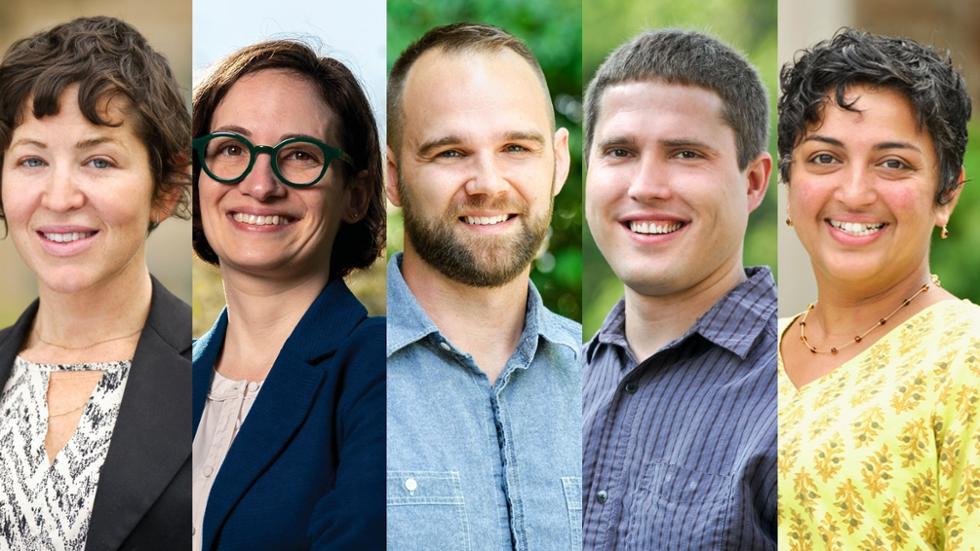

Kate Brown is a theoretical physicist who studies cosmology, fundamental physics and interdisciplinary science. Her first publication appeared in Nature and debunked claims that fractal analysis could be used to identify authentic drip paintings by Jackson Pollock.
Since then, Brown has published (under her maiden name Jones-Smith) on diverse topics such as gravitational radiation arising from cosmological phase transitions, mathematical analogies between ordinary conducting materials and certain models of dark energy, and non-Hermitian theories of quantum mechanics.
She has published numerous papers with Hamilton student and alumni co-authors. “The radial acceleration relation and a magnetostatic analogy in quasilinear MOND” included Leo Kell ’17 as one of Brown’s co-authors on a paper published in the New Journal of Physics. The work was part of Kell’s senior thesis.
“Exploring extra dimensions with scalar fields,” with Mike Verostek ’16 as a co-author, was selected as a featured article in the American Journal of Physics. The project was part of Verostek’s senior thesis work. “An analysis of the LIGO discovery based on introductory physics,” co-authored by Ashton Lowenstein ’17, was translated into Chinese and appeared in the Chinese journal DaXue WuLi (College Physics). The research was related to Lowenstein’s senior thesis.
In a seminar on Widely Applied Mathematics at Harvard University, Brown presented “Jackson Pollock, Lightning Rods, Quantum Mechanics.” She focused on an idea proposed in the late 1990s by a group of physicists who claimed that Pollock’s drip paintings contained fractal patterns so distinctive they could be used to authenticate his work.
Brown was also named to the international editorial board of the Journal of Physics Communications and was inducted as a member of the Foundational Questions Institute.

In 2022, Courtney Gibbons was selected for one of two Science and Technology Policy Legislative Branch Fellowships funded by the American Association for the Advancement of Science (AAAS). Each year, the AAAS places fellows in the executive, judicial, and legislative branches of the federal government where they can use their STEM training to work on policy development and implementation. In academic year 2023-24, Gibbons served as a science policy fellow at the National Science Foundation, and in 2022-23, she was a fellow in the U.S. Senate. In both roles, she brought her mathematical expertise to AI policy. At Hamilton, she is director of the Data Science program.
Gibbons’ mathematical work appears in the Journal of Pure and Applied Algebra, the Journal of Commutative Algebra, the Journal of Symbolic Computation, among others. In 2025, her “Everything I Need to Know About Polygons I Learned from My Pre-Kindergartner” was published as a featured column on the American Mathematical Society (AMS) website. She wrote a piece on mentoring undergraduate research for the early career section of the Notices of the American Mathematical Society, the monthly membership journal for the AMS.
Gibbons’ other publications include “A Hypergraph Characterization of Nearly Complete Intersections” in the Springer volume Women in Commutative Algebra with five undergraduate co-authors, including Chiara Bondi ’22. Gibbons also co-authored “L-dimension for modules over a local ring” in the volume Commutative Algebra: 150 Years with Roger and Sylvia Wiegand.
While at Hamilton, Gibbons has developed a research program involving undergraduates in her work in commutative algebra. She codes for Macaulay 2, an open-source algebra software package, and authors mathematics resources in PreTeXt, a highly flexible and accessible markup language for open-source works.
In 2022, Gibbons was elected to the executive committee of the Association for Women in Mathematics as a member-at-large, and in 2024 was elected chair of its Government Advocacy Committee.

Max Majireck completed his postdoctoral research in chemical biology at Harvard University and the Broad Institute of MIT and Harvard, designing small molecules to study disease biology. At Hamilton, his research laboratory develops new chemical reactions for the synthesis of biologically active compounds and collaborates with several biomedical laboratories to develop new drug leads for infectious disease and cardiovascular medicine. He is director of the Biochemistry/Molecular Biology program.
In 2022, Majireck was awarded a research grant from the National Science Foundation for approximately $247,000 to develop new types of reagents, materials that are used in chemical reactions that can include the synthesis of pharmaceuticals. That same year, he and Postdoctoral Fellow Dr. Khanh Ha of the Masonic Medical Research Institute (MMRI) were awarded a grant for approximately $154,000 from the American Heart Association. Their project “CD47-Targeted Nano-Immunotherapy for Treatment of Atherosclerosis” aims to identify a new type of drug delivery system that targets the plaques found in atherosclerosis, a leading cause of death in adults worldwide.
Majireck, who designed a new course at Hamilton to highlight the role of organic synthesis in human health, often co-authors articles with student collaborators. This year he and members of his research group published “Room-Temperature Nucleophilic Aromatic Substitution of 2-Halopyridinium Ketene Hemiaminals with Sulfur Nucleophiles.” It appears in a special issue of the chemistry research journal ACS Omega focused on Undergraduate Research as the Stimulus for Scientific Progress in the USA. Students included Jordan Merklin, Beau Sinardo, Claire Cooper, and Prim Udomphan, all Class of 2026, and Maddie Boger ’25.
He and members of previous research groups published an article in The Journal of Organic Chemistry, an American Chemical Society publication. “Synthesis of Bench-Stable N-Quaternized Ketene N,O-Acetals and Preliminary Evaluation as Reagents in Organic Synthesis” was the result of four years of work involving 20 Hamilton student co-authors from the classes of 2017 through 2023.

Seth Schermerhorn specializes in the interdisciplinary study of Native American and Indigenous Peoples and traditions, particularly in the Southwestern United States. Although he has partnered with several Indigenous Peoples, he works most extensively with the Tohono O’odham Nation in Southern Arizona and Northern Sonora. He is director of Hamilton’s American Studies program.
In 2019, Schermerhorn published Walking to Magdalena: Personhood and Place in Tohono O'odham Songs, Sticks, and Stories (University of Nevada Press), which has received numerous positive reviews from academic journals crossing disciplinary boundaries of religious studies, anthropology, Native American and Indigenous studies, and history. It was also selected for an American Academy of Religion Author-Meets-Critics panel in 2021.
In 2023, Schermerhorn became the founding editor of Indigenous Religious Traditions, a new interdisciplinary, international, and peer-reviewed academic journal, co-edited by Marie Alohalani Brown of the University of Hawai'i at Manoa. The journal aims to feature “global perspectives, with representation of peoples and traditions from all continents, covering diverse geographical regions and including traditions of the past as well as of the present.”
Schermerhorn received a Faculty Research & Innovation Award from the Arthur Levitt Public Affairs Center to support the launch of the journal. He was awarded a Franklin Research Grant by the American Philosophical Society, the oldest learned society in the United States and one of the top three learned societies in the world.
Among other publications, Schermerhorn and Lillia McEnaney ’17 co-authored an article in Religious Studies and Theology: Interdisciplinary Studies in Religion. “Through Indigenous Eyes: A Comparison of Two Tohono O’odham Photographic Collections Documenting Pilgrimages to Magdalena” was the culmination of almost four years of collaborative student-faculty research. He also published chapters in Native American Rhetoric (University of New Mexico Press) and a special issue on “Movement and Indigenous Religions” in Material Religion: The Journal of Objects, Art, and Belief.
Cinema and Media Studies

Pavitra Sundar is a feminist teacher-scholar with expertise in cinema and media studies, sound studies, postcolonial literary and cultural studies, and women’s and gender studies. She is director of Hamilton’s Cinema and Media Studies program.
This year, she was the lead co-editor of the special issue of the peer-reviewed videographic journal [in]Transition, titled “Cinematic Bodies/Videographic Forms.” Her scholarly video essay “On Listening” from that journal was named in the British Film Institute’s Sight and Sound Poll for the Best Video Essays of 2025.
Also in 2025, “Deafening: The Sense of Sound [Re]Verbed,” Sundar’s video essay, was included in the British Film Institute’s Sight and Sound poll of “the best video essays of 2024.” This prestigious annual list gathers the best of videographic criticism from around the world.
Sundar published a co-edited open-access volume, Thinking with an Accent (University of California Press), which was awarded the 2024 René Wellek Prize for best edited collection by the American Comparative Literature Association. She also contributed an essay to the volume “Listening with an Accent — or How to Loeribari,” which convened scholars of media, literature, education, law, language, and sound to theorize accent as an object of inquiry, an interdisciplinary method, and an embodied practice
Sundar’s 2023 monograph Listening with a Feminist Ear (University of Michigan Press) examines the cultural politics and possibilities of sound in Bombay cinema. The book was longlisted for the 2024 Kraszna-Krausz Moving Image Award, which “recognize[s] individuals who have made an outstanding original or lasting contribution to literature concerning photography or the moving image (including film, television and new media).” It also received a Scaglione Prize for South Asian Studies honorable mention “awarded annually for an outstanding scholarly work in Soh Asian or South Asian diaspora literary or linguistic studies.”
Related Stories
Congratulations to 10 Hamilton faculty members who were approved for tenure at the March meeting of the Board of Trustees. They include Nadya Bair (art history), Charlotte Botha (music), Clark Bowman (mathematics and statistics), Anna Huff (digital arts), Amy Koenig (classics), Heather Kropp (environmental studies), Jack Martinez Arias (Hispanic studies), Arathi Menon (art history), Mahala Stewart (sociology), and Michael Welsh (chemistry).

Retiring Faculty Share Defining Teaching Moments
This year, we celebrate 10 faculty members whose years of teaching have left a lasting mark on the Hamilton community. Retiring in June are Mark Bailey (computer science), Erol Balkan (economics), Sally Cockburn (mathematics), Ella Gant (art), Patty Kloidt (physical education), Cheryl Morgan (French), Quincy Newell (religious studies), Onno Oerlemans (literature), Margie Thickstun (literature), and Bruce Walczyk (dance).
