1976 Kirkland Class Annalist’s Letter
Faith and Rebellion
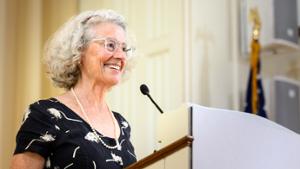
Good morning everyone, Classes of 1976. The creation and delivery of the Half-Century Class Annalist Letter have been an incredible privilege, and I could not have written it without the generous help of my Kirkland classmates. Thank you so much for entrusting me with your stories and memories. Jeremy Katz, the Hamilton College archivist, was indispensable and made sure I had everything I wanted to create this letter. Sam Babbitt’s book Limited Engagement is our history, and I couldn’t have immersed myself in our experience without it.
Before Sam, there was Millicent McIntosh, the retired dean and first president of Barnard College. She was Kirkland’s champion, a contemporary model of the notion that women can have it all — marriage, family, and a serious career. Now some of you youngsters may be blinking at me for suggesting that this wasn’t always a common assumption, but Mrs. McIntosh was a pioneer in defining a new reality for young women in the middle of the 20th century. She was a primary shaper of the founding philosophy on which Kirkland was conceived, and with the enthusiastic blessing of Hamilton’s president, Robert McEwen, our original visionary, she, along with several others, including Hamilton trustees, formed the founding board of Kirkland College.
Many of the policies to which Kirkland aspired while we were there sprung from her beliefs about women’s education. She was responsible for the decision that Kirkland would be student-centered and would focus on the varying stages of a woman’s life with the aim of helping students become lifelong independent learners. Mrs. McIntosh was responsible for the philosophy that faculty and students were both learners, and there was a de-emphasis on seniority and hierarchy. She was firm in her belief that academic life and non-academic life are inseparable. She was instrumental in the hiring of Sam Babbitt, our first, last, and only president. These remarkable long-sighted people set the stage for the college we became. We would not have been Kirkland without them.
When it came time for us to apply, Kirkland had finally rounded out all four years of students, the Class of 1975 being the class that filled the last open level. We were the first class to enter that was not witness to full-scale active construction. It felt like the campus had taken root and belonged to the land on which it sat.
On the application form, we received the instruction, “If you come to visit between October and April, bring BOOTS.” Boots — in all caps. When surveyed, classmates answered the question, “Why did you choose to attend?” Answers ranged from, “I was blown away during a campus visit;” “Kirkland didn’t require gym;” “My parents were indulgent;” “It was the only college on my list whose deadline hadn’t passed;” “My father was on the Hamilton board.”
Two people on two separate occasions said they had accompanied friends and were spotted loitering around KJ by Director of Admissions Carole Walker, who corralled each into her office and after an interview then told them if they applied, they would be accepted. One had a friend who had handed her a pamphlet and said, “This is the place for you.” Melanie Oliviero said her guidance counselor told her mother that there was a college just wacky enough for Melanie, and he was right! Barty Warren-Kretzschmar was so frustrated with the application process that she decided to throw that big catalogue of colleges over her shoulder and apply to the one that popped up on the open page. It was Cornell, but she visited Kirkland on her tour of Upstate NY and then applied early decision. After a painful rejection from Vassar, Anne Albright and her father drove through a miserable snowstorm and hunkered down for the night in a dreary Utica hotel. They arrived on campus the next morning to huge piles of pristine white snow and deep blue skies. She interviewed with Brigid Cosper in front of a roaring fire and a sleeping golden retriever. They talked about their favorite flavors of ice cream and what made them laugh.
Collectively, the Kirkland Class of 1976 was younger than the national average of female matriculant, many of our mothers went to college, and, remarkably, 23% of our mothers held graduate degrees.
When most of us arrived in the fall of 1972, the Hill reflected the current issues and shifting norms of the day. Kirkland and Hamilton already jointly had two co-ed dorms. We were there for the dedication of the shiny brand-new library that felt like an echo of the characteristic Thompson architecture on our side of College Hill Road. Shortly after our arrival, Kirkland received its accreditation by the Middle States Association, which was very positive by how Kirkland presented, except for one glaring issue, the science curriculum. They noted that Kirkland had unwittingly reinforced the logic that science was primarily a male endeavor by deferring its students’ science education to Hamilton. The biggest issue or complaint that repeatedly arose for the College’s Student Life Committee was racism.
Professors were highly influential in the creation and pursuit of our educations. In recollection, Doug Raybeck was repeatedly recognized for creating or changing scholarly trajectories. Eliza Klein recalled the essential support she received from Doug. She had left campus to do fieldwork in Kenya for two years through Montana State University. Doug was instrumental in being able to translate that work into college credit so she could graduate with our class. Others remembered that Doug was so influential, one classmate decided to double major just because; another recalled that Doug allowed her into Advanced Psychological Anthropology as a freshman, which ignited her passion for cultural studies. Aviva Schneider debated majoring in psychology or ceramics, but Raybeck’s Intro to Anthropology class provided her with the framework for working in Appalachia for Planned Parenthood and understanding the tremendous cultural differences she encountered with her clients. She credited that class with her ability to foster connections and help people examine their own values and reach their own goals.
Walter Broughton taught but briefly at Kirkland while we were there but was able to probe Melanie Oliviero’s interest in social science and language and introduced her to the emerging field of sociolinguistics. With the help of Doug Raybeck, she was able to craft a concentration in neurolinguistics that included courses she had to take off campus. Doug was key in helping her get credit for a discipline that did not exist at Hamilton or Kirkland. She recalled that Doug, more than any other professor, challenged her and supported her through an independent study of Indigenous languages in several nearby Iroquois/Haudenosaunee nations. She remembers he championed her career as a social justice and human rights advocate and invited her back to teach during winter study. In contrast to her rigorous academic path, Melanie, in true Kirkland spirit, immersed herself in winter studies in woodworking and welding.
There were other equally influential teachers and guides on both sides of the road. Marylee Stull Ashby remembered January term in London with Fred Wagner as a standout, where the cohort soaked in 22 plays in 21 days including the original productions of Equus and The Rocky Horror Picture Show. Diane Davis reflected that she would never have read and enjoyed all of Faulkner without “Daddy Wags.”
Joanna Langfield remarked that Carole Bellini-Sharp changed her life in ways too many ways to count. With all those acting classes, shifts at WHCL, and campus interviews for her senior project, she was able to carve a path into radio and television where she has spent her career.
Lorraine Hariton started in social justice courses but with the encouragement of her calculus professor took a winter study in computer science. She then transferred to Stanford where she finished her degree and spent her career in Silicon Valley.
Isabel Weinger was interested only in creative writing, but Bill Rosenfeld encouraged her to explore a variety of subjects, because how else can you be a writer? Her favorite? Nadine George’s History of Science. Diane Davis recalled that she had a couple of classes with Bill Rosenfeld, and he became a sympathetic friend and advisor. “We kept up a correspondence for many years after College,” she recalled, “an important relationship for me.” Speaking of Bill Salzillo and Bruce Muirhead, Diane also noted, “These teachers saw something in me. I don’t think I have experienced being ‘seen’ in that way in any subsequent educational endeavors.”
Helen Morse started as a psych major but hit the unscalable statistics wall and switched to photography. Steven Liebman took her under his wing. Helen says she learned more from him than anyone in her life; her close and cherished friendship with him continued until his death.
One classmate wrote that Naomi Lazard become her mentor and father figure until her death in 2021. Naomi introduced her to people who continued her education, supported her when she was estranged from her family, taught her about generosity, and nourished her intellectually and spiritually. That, her enduring friendships, and learning how to learn were the greatest gifts Kirkland gave her.
One Kirkland ’76er wrote that science at Hamilton was not a good fit. She wanted to be a science major, but she was one of a handful of Kirkland students in science classes at Hamilton. She reflected that it was lonely, competitive, and the premed track brutal. She then found Gene Putala and designed her own concentration in environmental biology. Gene opened her mind to the concept of sustainability long before the word was ever used to mean what it does today. He encouraged her to test natural dyes as an independent study. He was the only professor she felt who actually saw her.
Some of us complained about the independent study requirement; some of us were open to its benefits and were able to use it to expand our education. A number of us felt the independent study they undertook directly influenced their career choices. One alum worked on the Blackfoot Reservation helping that community understand their choice between open pit mining and preserving the land unadulterated. This project opened her eyes to the socio-environmental issues that later became her professional focus. One of our many successfully published authors stated that an in-depth study into two major authors remains instructive to this day. One alum spent a semester at sea that helped her develop self-reliance and a sense of adventure.
Lynn Kanter credited Peter and Nancy Rabinowitz for teaching her how to approach literature and the actual act of reading; she remembered them as more influential than any of the teaching in her concentration. Some described Philip Pearle’s The Physicists View of Nature (“Physics for Poets”) as a revelation that made physics, including quantum mechanics, accessible for the non-science or math person.
Many of us didn’t understand, at the time, either the value of going to a single-sex college or the value of a liberal arts education. Anne Albright remarked, “I didn’t understand how going to a women’s college was so valuable until later in life.” Anne summed it up saying the academic environment at Kirkland could be uneven. Curriculum and pedagogy were works in progress. Some offerings were considered, frankly, to be irrelevant by Hamilton. In her graduate school experience, Anne remarked she was with students whose cultures considered it rude to ask the professor questions; it implied the professor was not doing their job well. “Ha,” she thought, “Not at Kirkland. At Kirkland, if you didn’t challenge the professor, it suggested the professor wasn’t doing their job well.”
Many came to the understanding of liberal arts as a concept that ultimately arrived through the actual “doing” and credit liberal arts for a life of critical thought and learning out in the world. Debby Ballard summed it up, saying she did not understand liberal arts as a concept, but now sees how wildly varied classes such as History of the American West, Conversational Japanese, and Modes of African Expression all dramatically broadened her horizons. One alum explained that her career path was shaped by how she created her educational path at Kirkland. She said, “Every job I’ve had has been based more in exploring an opportunity rather than an intentional career step.” She added, “One would look at my résumé and conclude that ‘this woman cannot hold a job’ so different my jobs have been. But one can see the threads of teaching, advocacy, and alliance building for platforms as varied as nonprofits, philanthropies, and businesses, and think, ‘This woman has had incredible experiences.’”
Many credit their tenure at Kirkland for lifelong friendships, an awakening feminist perspective, women’s empowerment, and growing self-confidence. We grew into ourselves. We were here during a time of tremendous political and social upheaval, and it was in the air: all the issues of the second wave feminist agenda, the right to birth control and abortion access, financial equality, gender equality, sexuality. It was a wonderful and terrible time to crash into adulthood.
Many reminisced that Kirkland was a safe place to grow up. Lisa Uvanni came to campus after a serious accident wearing a Morticia Addams wig and weighing 90 pounds. Sam Babbitt personally coached her and convinced her that her hair wouldn’t grow back if she continued to wear the wig. She said he supported and counseled her and brought her back into life again. Another classmate said Kirkland taught her the lifelong skill of building a community of women around her. Yet another stated that Kirkland made her believe that she could do anything.
Our experiences and interactions with Hamilton students and the campus ran the full range from little or no contact to taking most of one’s classes and living in the dorms on the north side of College Hill Road. Noted standout classes included Religions of the World, Physics for Poets, Hindu Buddhist Thought, and languages. Some enjoyed houseparty weekends; some of us never partook. One alum noted, “I benefitted from the structure of my English classes at Hamilton, but I wouldn’t trade my music classes or my wild and woolly drama at Kirkland for anything.”
There was a recurring thread of disdain for eating at Commons. One woman expressed her disgust over the food-splattered portraits. She was convinced she had entered a world of “intelligent thoughtful creative women” and “immature disgusting boys.” She can’t explain it, but she ended up marrying one of those “boys” and freely confesses it was the most wonderfully game-changing decision she had ever made. And she says, while he may not have the best table manners, he is a true gem.
Women ventured across the street to bowl at Bristol, play bridge at ELS, sit at the pub, work, study in the library, perform at Minor Theater. German table with Mr. Colby was Friday night at Bundy Dining Hall. Some of us sang and traveled with the Hamilton/Kirkland Choir. We had ice time at Sage Rink just for women. We even had jungle hockey! We played squash and tennis. We walked; we ran; we strolled; we skied; we biked.
We had our safe spaces. Kirkland Glen was a true sanctuary for many. There was a tacit agreement that you were to be quiet in Root Glen, recalled one of our classmates. “It was where you could breathe.” We had the coffeehouse where you could sip on an exotic concoction named Russian Tea, which was a spoonful of Tang in your cup. (Branding is everything.) Lavender Jane was notably memorable for many and sparked controversy for being a closed event only for the Kirkland community.
Among the speakers and performers who came to campus during our years there was Shirley Chisholm, the first African American woman elected to Congress, who came the fall of sophomore year, admonishing us to do our homework and not fall prey to “peak psychology,” to the occasional “right on” from the audience.
Although many of us felt we were in our little bubble, a lot was going on in the outside world. One classmate recalled when Spiro Agnew resigned our sophomore year, Hamilton students joyously pointed stereo speakers out the window onto the quad and blasted Handel’s “Hallelujah Chorus.”
What did we remember about our years here? We are all so different and yet not so much — “The dazzling beauty of the campus;” “sparkling stars;” “junior year in Madrid;” “teachers that believed in me;” “feeling safe expressing same-sex love;” “the apple trees in bloom behind B Dorm;” “having to petition to take calculus as an art major;” “sneaking a paper Christmas tree into Kirner-Johnson after a controversy erupted about chopping down live trees;” “deep abiding friendships;” “skiing in the glen;” “watching Watergate in the lounge;” “being on too many committees and learning the value of compromise;” “steak night” and “Steak Nite;” “the cider mill;” “Ingmar Bergman movies;” “the sound of bagpipes;” “the shock I experienced when Peter Rabinowitz informed me that yes, the ‘woman question’ discussed by 19th-century Russian authors is the same question we are discussing today;” “the mud in spring;” “swinging on the rock;” “anything Sam and Natalie;” “Buddy Paluski trying to make an artist out of me.”
Music was essential. Laura Nyro, Patti Smith, The Rolling Stones, Judy Collins, Bette Midler, The Allman Brothers Band, The Doobie Brothers, Crosby, Stills, Nash & Young, and Joni Mitchell, always Joni Mitchell. Joanna Langfield played Bonnie Raitt so much that the suite next door came over and asked her if she could mix it up a bit. When one classmate hears Roberta Flack, it sends her right back to South dorm, sitting on the sofa with her suitemates in front of the fireplace.
One classmate wistfully wrote and spoke for more than a few of us — she wished she could go back and do it all again, only with Prozac.
Our exit interviews told the College much about ourselves. As seniors, we noted that Kirkland had changed tremendously the four years we had been on the Hill, and the Kirkland that we had come to was not the Kirkland we left. Also noted was the Kirkland described in Particulars, the Admissions Office publication we received as prospective students, was not the Kirkland we attended. Our opinions varied wildly; many felt faculty advising was not sufficient, while others felt their experience created clear pathways out into the world. Many felt they were ill-equipped to live up to the rich opportunities that Kirkland had offered us, that the first years were a time of introspection and the formation of relationships, but that the last two years were far more productive. Some felt that coordination between the two colleges was a work in progress and worth pursuing; others were negative about the relationship between Hamilton and Kirkland. One senior brightly suggested that Kirkland should consider going co-ed, so as to attract the type of man with whom Kirkland students would want to go to school. Notably, the exit interviews showed us as women who weren’t afraid to express their unwashed opinions of their time at Kirkland. We had become uppity women, with voices.
And how, over time, did we use our time, our talents, our love, and those voices? We are many published authors, from research to fiction, memoirs, and children’s literature. Film distributor, magazine photographer, social worker, doctors of medicine, dentistry, psychology, and academics. We have been waitresses, astrologer, reiki master, bead shop manager, therapist, television producer, ordained clergy, corporate lobbyist, attorney, textile designer, real estate agent, ranch hand, business owner, nun, copywriter, bilingual special education teacher, scientist, judge for the immigration court, family nurse practitioner, midwife, clinical nurse specialist, petroleum geologist.
Graduation Day, June 5, 1976, a hazy blue sky arched over us, in our dresses, with our flowers. We followed the sound of bagpipes into the tent where we sat to hear Sam’s brief remarks that would launch us away from our sanctuary on the Hill and our beloved friends and teachers, out into the world.
When Sam spoke, after promising Lynn Kanter that he would not discuss the bicentennial, (it was 1976, after all), he imparted a brief message on skepticism and faith. His words rang true, and they were about us. “Nowhere does the impact of scholarly probing touch us more deeply than in the fragile systems we erect in order to … understand our place in the world,” he said. “If we came to this intellectual feast with that faith secure, we watched our as cherished beliefs are destroyed. We sharpened critical skills to strengthen our logic and rhetoric, for the purpose of destruction. … you are part of a minority, educated women, still considered a species that should be heard about, not from. You are not afraid to think, speak, and write your thoughts. You are in possession of a weapon. You have a right to possess it, but society prefers you keep it locked up and out of sight. It is a developed maturing skepticism. But you have also come to understand that the world is not a rational place at all. We live in a world of second acts and mornings after, and it will take the energies of a lifetime to balance the tension between faith and skepticism.”
Millicent McIntosh candidly summarized Sam Babbitt in her oral history of Kirkland: “He had too many ideas. But he was so extraordinarily good-tempered — and a terrific worker. Absolutely tremendous. I’ve never known anybody that worked as hard as Sam did. I don’t think we could have done better. The place would have never gotten off the ground if it hadn’t been for him. … We didn’t realize how really, how much of a rebel he was. … The first thing he did was to announce that there would be no rules.”
Mrs. McIntosh is known for having said that education is an act of faith. This was not some poetic platitude; it shaped her vision of women’s education in the 20th century. She said, “It is the belief that if you give a human being the tools of thought and the values of a civilization, they will find their way to a life of purpose, regardless of the obstacles of their time.” To her, “faith” in education meant investing in a person’s mind without knowing exactly how or when that investment would “pay off.”
Sam, years later, after the endgame had been set in motion, wrote in The Spectator, “When Kirkland began, Millicent McIntosh made her marvelously succinct statement that ‘education is an act of faith.’” He said, “What she meant was that we should dare to begin. [So] We did.”
Kirkland sisters, we are the living legacy, the true and rightful heirs of Millicent McIntosh’s faith and Sam Babbitt’s rebelliousness. How fortunate we are! We could not be Kirkland without them. We may or may not have moved mountains with that faith, but, as Sam wrote, we have certainly moved a Hill.
Thank you.
Annie Karl Halvorsen K’76 came to Kirkland from Cooperstown N.Y., where she majored in biology while earning a secondary school teaching certificate. After teaching in Brooklyn and performing research tech work at Duke University Medical School, she attended nursing school at the University of Washington in Seattle. She returned to the East Coast, married, and appreciated the joys and rigors of the stay-at-home parenting of three, but went back to school to earn her master’s degree in science at University of Massachusetts Boston, graduating with an advanced practice degree. Now retired, she spends her time painting, both in her Maine home and abroad. She served on the Hamilton College Alumni Council for many years and was an alumnae advisor to the Kirkland Endowment Advising Committee. Active on the regional board of directors for the US Fund for UNICEF for eight years, she also has served on the board of advisors for the Harpswell Foundation. She is involved in her local art organizations and remains an enthusiastic runner and traveler. Her daughter Laura graduated from Hamilton in 2009, and her nephew Eli Short will graduate in 2027.
