Newsletter
More than a Dialect: Influence of AAVE
By Eva Jo McIlraith
February 25, 2026
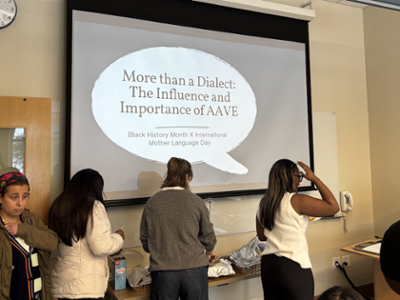
BLSU joined forces with the Writing Center on Tuesday, February 17th to host an educational event on African American Vernacular English, also known as Black English or AAVE. Facilitated by BLSU Fellow DanTe’ya Reedy ’26 and the Writing Center Assistant Director and Multilingual Specialist Laura Widman, the event invited students to take a closer look at AAVE, not as slang or broken English, but as a legitimate, rule-governed, and deeply influential language variety.
The discussion began by grounding AAVE in truth, establishing it as the native language of many Black Americans. For generations, AAVE has been unfairly labeled as “ungrammatical” or “improper,” dismissed in classrooms and professional spaces, and treated as something to be corrected rather than understood. Participants explored how these misconceptions are rooted not only in linguistics, but in anti-Blackness and systemic bias. Language, as the group discussed, is never neutral, it carries power, history, and identity.
The facilitators pointed out a striking contradiction. While AAVE is often stigmatized when spoken by Black communities, its vocabulary, cadence, and creativity have been widely adopted and frequently appropriated by mainstream American culture. From viral TikTok phrases to K-pop to campus slang, elements of AAVE have shaped how many of us communicate, especially in a way that dismisses and rejects the origin of the language. The group reflected on what it means for a language to be both marginalized and mined for cultural capital.
Widman guided attendees through the linguistic structure of AAVE, emphasizing the consistent grammatical rules and function, just as with any other dialect of English. Widman noted that as a dialect, AAVE actually functions more efficiently than traditional American English, noting the removal of unnecessary filler words. DanTe’ya added that individuals learning English as their second language often develop different elements of AAVE for its coherent structure and its centrality in US culture. Students examined common misconceptions and discussed in small groups how “standard” forms of English are socially constructed rather than inherently superior. The conversation encouraged attendees to think critically about code switching, and what it costs individuals to constantly navigate those shifts.
In her final thoughts DanTe’ya emphasized the importance for Hamilton as a community and institution to acknowledge AAVE’s existence and be aware of its discrimination and appropriation. She encouraged attendees to practice conscious understanding and use of AAVE both on and off campus, and inspired reflection on the origins of the dialect.
Beyond linguistics, the event centered the identity that AAVE represents. For many, AAVE is more than a dialect, but a form of identity expression centered around belonging and understanding. Through thoughtful dialogue and shared reflection, attendees left with a deeper understanding of how language shapes cultural connection and a renewed commitment to honoring the practice of AAVE.
Contact
Office / Department Name
Days-Massolo Multicultural Center
Contact Name
Koboul E. Mansour, Ph.D
Director, Days-Massolo Multicultural Center
