Newsletter
Black Women Betrayed: Missing Black Women in America
By Ava Garcia
February 25, 2026
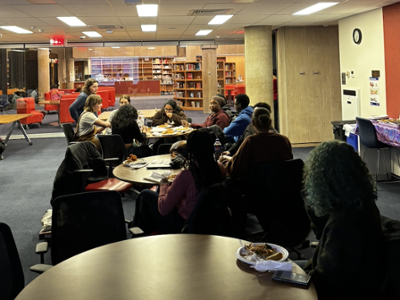
On February 16th, BLSU and CIF opened up this week’s events with Black Women Betrayed, forcing us to confront a devastating reality. Black women and girls go missing at staggering rates, and the country too often responds with silence. In 2022, around 271,492 women and girls were reported missing in the U.S. Thirty-six percent of them (around 97,924), were Black, despite Black women and girls making up only about 14% of the U.S. female population. In 2023, of the 563,389 people reported missing, 40% were Black women and girls. These numbers are not anomalies. They reflect a pattern of neglect.
The presentation, led by BLSU Fellow DanTe’ya Reedy ‘26 and BLSU Vice President Nat St. Helen ‘27, introduced “Missing White Woman Syndrome,” the media machine that mobilizes when a young, pretty white woman disappears, while Black women are ignored, mischaracterized, or erased. When Natalee Holloway vanished in 2005, her name became global. International resources were deployed. News outlets ran relentless coverage. Meanwhile, LaToyia Figueroa, a pregnant Afro Latina woman who disappeared that same year, received minimal media coverage and far less urgency. One story became a national obsession. The other was treated as expendable.
Melanie Santana ’28 spoke to the weight of that reality. “I had been aware of the disproportionate gap coverage between missing white women and missing Black women. However, this presentation truly put into perspective how media coverage is inherently rooted in racism and how thousands of missing Black women are erased from public attention as a result.” Her reflection did more than acknowledge disparity. It captured the event’s central truth that this silence is not incidental or unfortunate. It is systemic, embedded in the structures that decide whose stories are told and whose lives are treated as worthy of national concern.
The event also examined misogynoir, the specific hatred directed at Black women at the intersection of racism and sexism. Black girls are routinely labeled as runaways, assumed to be involved in crime, or blamed for their own disappearances. That label alone can dictate whether law enforcement responds with urgency or dismisses the case from the start. A video highlighted the case of Jeffrey Lynn Smith, whose disappearance was classified as a runaway case and never received national media coverage. Her case remains unsolved, her name largely unknown.
The 2021 disappearance of Gabby Petito consumed national headlines, social media timelines, and streaming platforms, turning her case into a nationwide fixation. Meanwhile, 29-year-old law student Rachel Imani Elizabeth Buckner received little to no national attention despite the horrific nature of her murder. The disparity was not about the severity of the crime, but about whose life the media deemed worthy of nonstop coverage. One became a household name, her face impossible to ignore. The other was denied that same visibility, her name barely spoken beyond her own community.
As DanTe’ya reminded the room, we must focus on “amplifying victims, not murderers.” The event called on attendees to support specialized task forces, demand equitable media coverage, and uplift community-led efforts like the podcast “Black Girl Gone”. Black Women Betrayed made one thing clear, silence is not neutral. When Black women go missing and the world looks away, that indifference becomes part of the harm.
“Missing African American Women and Children in the United States of America.” NAACP, 13 June 2022, naacp.org/resources/missing-african-american-women-and-children-united-states-america.
“Missing Persons Statistics 2023 (Infographic): Black and Missing.” BAMFI, 19 Aug. 2024, www.blackandmissinginc.com/statistics/.
Seabrook, Linda A. “Shining a Light on the Crisis of Missing or Murdered Black Women and Girls in the United States.” Office of Justice Programs, www.ojp.gov/archive/safe-communities/inside-perspectives/shining-light-on-the-crisis-of-missing-or-murdered-black-women-and-girls-in-the-united-states#:~:text=According%20to%20the%20National%20Crime,female%20population%20at%20the%20time. Accessed 25 Feb. 2026.
Contact
Office / Department Name
Days-Massolo Multicultural Center
Contact Name
Koboul E. Mansour, Ph.D
Director, Days-Massolo Multicultural Center
