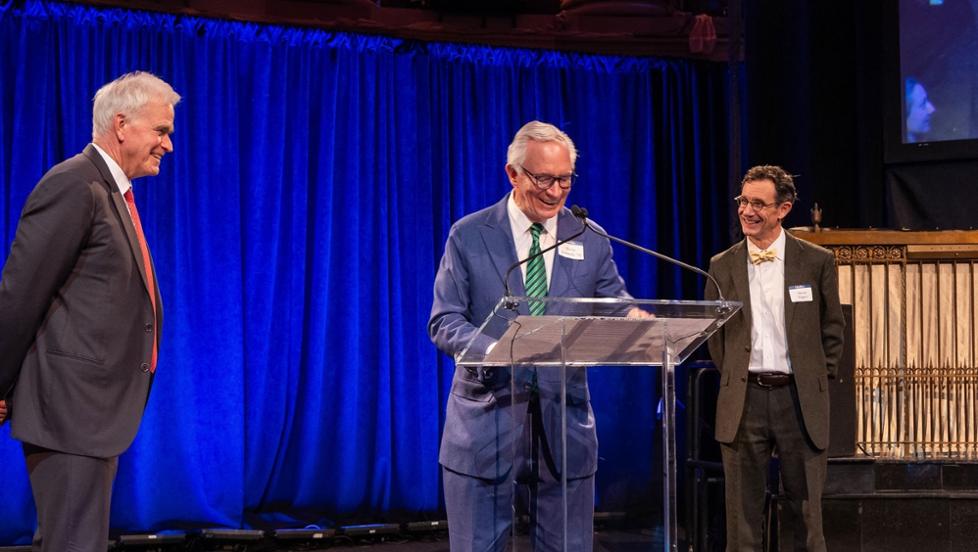
Life Trustee Kevin Kennedy ’70 presented Blood with the honor, calling him “a groundbreaking investment strategist, a design thinker, and a philanthropic exemplar.”
Blood is a third-generation Hamiltonian, following his grandfather Wayland, Class of 1914, and his father, Wayland “Bill” Blood ’53. After receiving his Hamilton degree in 1981, David Blood earned an MBA from the Harvard Business School, joined a Wall Street investment bank, made partner, and served as CEO of Goldman Sachs Asset Management.
“Every time I’m away and every time I return, I feel like I’m home. Hamilton taught me to be compassionate, to recognize the importance of communities. It taught me to think laterally… Hamilton taught me to collaborate ... to communicate.”
It was there that Blood was first exposed to sustainable investing, or sustainable capitalism, an economic concept often attributed to him and former U.S. Vice President Al Gore, one of the partners with whom he co-founded Generation Investment Management in 2004.
In 2021, Blood launched the Generation subsidiary “Just Climate” to focus on high impact climate solutions. At the time he said, “There is no doubt in my mind that a fundamental and important benefit of the rise in sustainable and ESG investing over the long term will be a cleaner planet and a more equitable, healthy, and safe society.”
Reading from the honorary degree citation, Kennedy noted, “You have brought that focus on equity to your service as a member of the Hamilton Board of Trustees. In 2009, you asked how much additional funding would be needed so Hamilton could immediately become need-blind in admission. Then you made a major gift to make this dream a reality. Five trustees followed your lead to achieve the goal. It was, you said, one of the most satisfying moments in your life.
“‘To limit students’ opportunity to go to Hamilton based on finance just felt inherently wrong to me,’ you said, ‘and I felt that we couldn’t allow that to be the case going forward,’” Kennedy read.
Colleges that practice need-blind admission promise to review applications without considering a student’s ability to pay the cost of attendance. Just over 100 colleges and universities in the United States are need-blind in their admission practices and promise to meet the full demonstrated need of the students they accept.
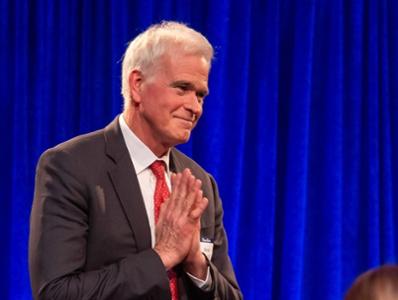
In accepting the honorary degree, Blood said the first time he went to Hamilton, he realized he was home. “Every time I’m away and every time I return, I feel like I’m home,” Blood said. “Hamilton taught me to be compassionate, to recognize the importance of communities. It taught me to think laterally… Hamilton taught me to collaborate ... to communicate.”
He continued, “Hamilton is a school of opportunity, and we must do everything we can to keep it that way. In fact, that’s why I believe participation in the need-blind initiative is the single most important philanthropic event of my life, and I don’t see that habit changing at all.”
Posted December 10, 2025

