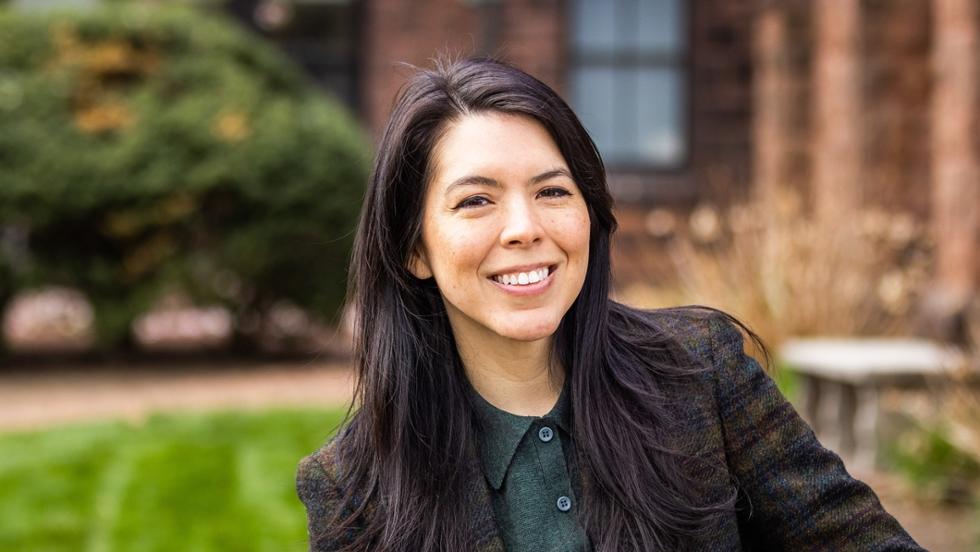
Madden, a Hawaiian writer and author, wrote her memoir, Long Live the Tribe of Fatherless Girls in 2019. It was named a New York Times Editors’ Choice, a finalist for the National Book Critics Circle John Leonard Prize, and a recipient of the Lambda Literary Award.
Hamilton Communications Office student writer Mairin Hoffman ’29 recently connected with Professor Madden to discuss the novel and the writing process.
Q
What inspired Whidbey?
My first book was a memoir, and in that book there was a section about surviving an early sexual assault. In 2019, I appeared in a federal trial against that abuser and started writing this book in the midst of that legal turmoil. I pivoted to fiction because I knew the memoir form would be limited by my own personal experience and beliefs. … In fiction, I could write about multiple people moving through the system, and I could investigate the system itself. This novel comes from a kernel of truth from lived experience, but it is a polyphonic multicast work of storytelling with many narrators and conflicting stories. This was, for me, a more interesting way to approach a difficult conversation.
Q
How long was the process?
A little over eight years. I started in early 2017. It was first a short story, and then it became two short stories. I realized the stories belonged together with two different narrators, but it kept growing and growing, and then it became a novel, with a third narrator, in about 2020. Then came the many years of editorial work and revision.
Q
Was it challenging to write a novel while also teaching?
I have been a teacher since I was 22, often while also working a 9-5, so full-time work outside of writing has always been a part of my life. Some semesters and seasons I can write before school, but mostly I sink into the work during summer and winter breaks. My subject matter is dark, so I’m not usually looking to land in that place just before classes. … These are mental, emotional landscapes that I don’t want interfering or leaking into my teaching day. During the semester, I often take notes on my work through journaling — plotting, revising, transcribing. But creating the raw material happens during winter and summer break. I log off the internet, literally and metaphorically, and do my best to disappear into the book.
Q
What surprised you most while writing it?
How much compassion I found as I wrote. It started with rage and anger toward the system and people who enable these systems of abuse, but I was surprised by how much joy I found in the writing. I felt a sense of safety in the practice of writing it; there is compassion within the pages, and some humor, too.
Q
Describe the process of finding an agent, publishing etc.
To find an agent one typically sends a query letter in which you write about yourself and your project, and you outline why you think they might be the best agent for you. My advice is to look to the writers that you love and see what agents represent them. There is no right or wrong way to do it, and everybody’s experience is totally different. Not everyone needs or seeks an agent, and not everyone wants the “traditional” publishing route. There is self-publishing, indie publishing, contests … there are many paths.
Q
What would you consider success for this book?
Success to me is readership over sales. The greatest success is anyone feeling seen or more known or accompanied by a work of art. Writers don’t publish things just for themselves, we write to open up dialogue, conversations.
Posted April 1, 2026