Julia Afsar-Keshmiri ’26
Major: Interdisciplinary Studies
Hometown: Queensbury, New York
High school: Queensbury High School
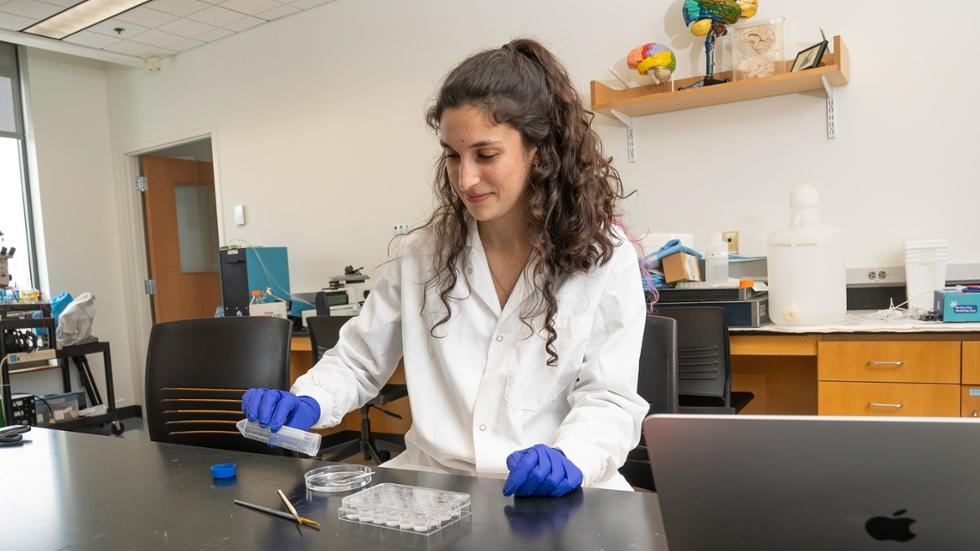
Through her fellowship, Afsar-Keshmiri has the opportunity to devote her entire senior year to her project, giving her a taste of life as a professional researcher.
What is your research goal for your Senior Fellowship?
I’m working with [Visiting Assistant Professor of Psychology] Abigail Myers to study a protein called Miro1, which moves mitochondria around in cells during development. We’re studying the protein during development and adulthood, trying to understand what happens if we knock out this protein and how it impacts large brain structures like axons. Among the consequences that we’ve observed are that some of these axon tracks don’t develop appropriately. When the mitochondria aren’t distributed, you don’t have energy at synapses, where neurons are connecting, meaning you can’t build those connections. This causes a host of issues.
“Rather than being directed at producing results, my goal for the Senior Fellowship has been to build a holistic set of skills for what I hope to be a thoughtful career in science.”
Why did you decide to pursue a Senior Fellowship?
I attended a dinner organized by the Career Center and health advisors with Benjamin Mittman [’18]. He’s currently in an MD/Ph.D. program at Case Western University, and I was pretty confident that I wanted to pursue the same degree. During our chat, he was telling the group about his experience as a senior fellow. I had no idea what he was talking about, but as he told us about it and his experience, I was like, “I want to do this too.”
I’d been working with Professor Myers since the summer before my junior year, and we had an instant click. We were starting to design a new project that included a little more biochemistry for my senior thesis. But [given time constraints], there was no shot of getting a productive amount done, so when I heard about the Senior Fellowship Program, I thought that it sounded like a great way to do the whole project and get it to a point where I could flesh out some of the questions that we were interested in.
What have you learned so far?
I wrote a proposal with three different, very specific aims. It turns out that within just our first aim, we’ve had so many fruitful results that led us to different questions. I’ve had to learn to pause and think about the project step-by-step and engage with the scientific process rather than always sticking to the plan.
How did you become interested in neurodevelopment?
One of the moments where I really got into the idea of brain development was in Professor Rhea Datta’s introductory biology class. She’s a developmental biologist, and the entire time I was in absolute awe learning about how we develop from a sperm and egg coming together and creating a human. The themes that emerged from learning about how we’re assembled really got me.
How has your Senior Fellowship fit into your liberal arts experience?
The fellowship has been an active learning experience that has given me a chance to be a part of the scientific process from start to finish, while working in a forgiving environment with really devoted mentors - which is what I think makes research at a liberal arts college so worthwhile!
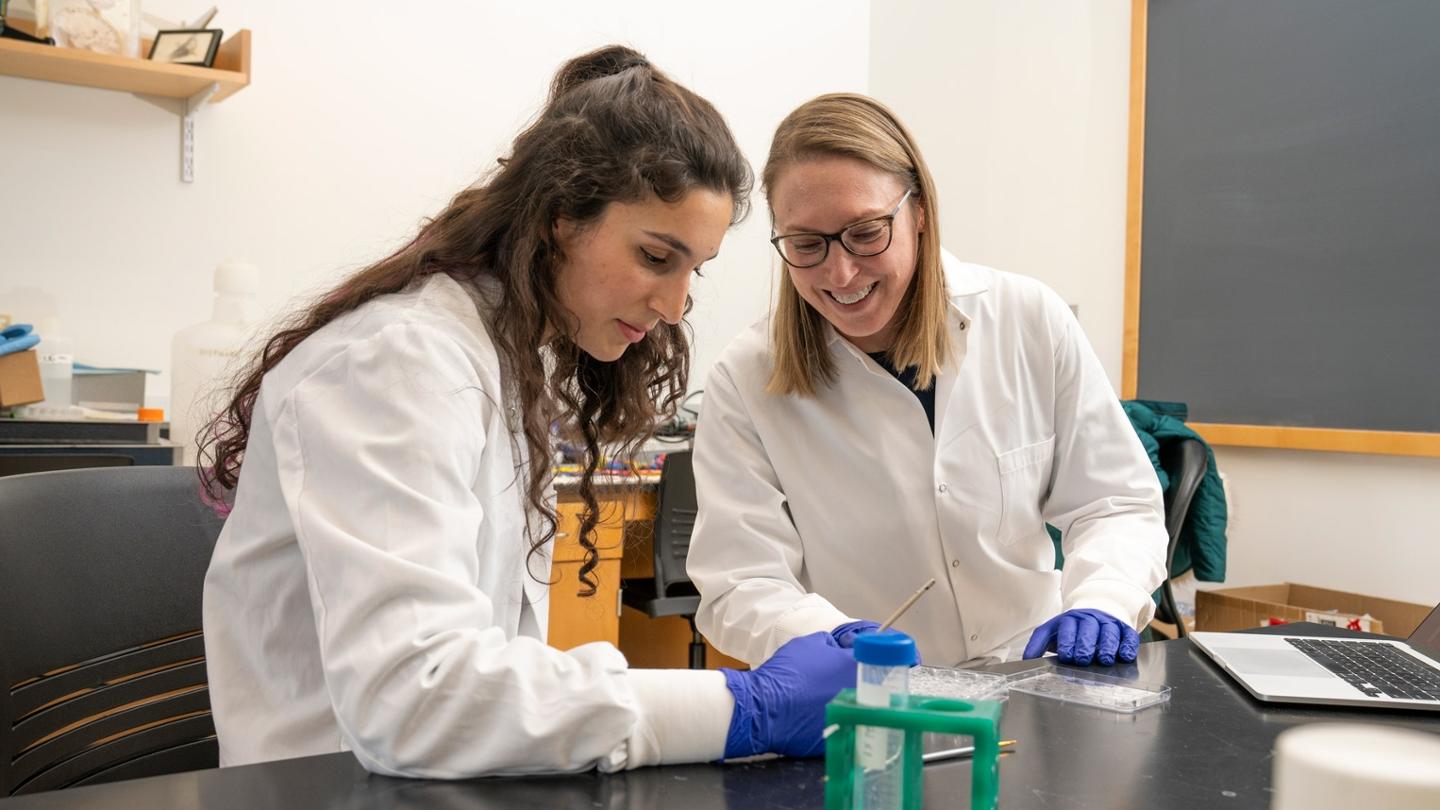
Rather than being directed at producing results, my goal for the Senior Fellowship has been to build a holistic set of skills for what I hope to be a thoughtful career in science. The opportunity developed very organically, and the skills I’m going to take away from this are not only hard-science skills. I've been managing collaborations with scientists outside of Hamilton, focusing on my oral and written communications skills through revising my proposal and protocols, updating advisors, and presenting to computer science students and the underclassmen who are helping me.
It has been an overwhelmingly collaborative and interdisciplinary project that has challenged me to contemplate themes in developmental biology from the molecular to the evolutionary level.
What’s next, after your graduation from Hamilton?
I’m going to work as a research assistant with Dr. Jennifer Morgan at the MBL, who studies how synapses function during neurodegeneration and regeneration. She was pivotal in organizing my trips to work with (MBL senior scientist) Dr. Michael Shribak, and I am thrilled to continue having her as a mentor. This is certainly a relationship and opportunity that grew throughout my visits to the MBL for my senior fellowship.
Posted February 18, 2026