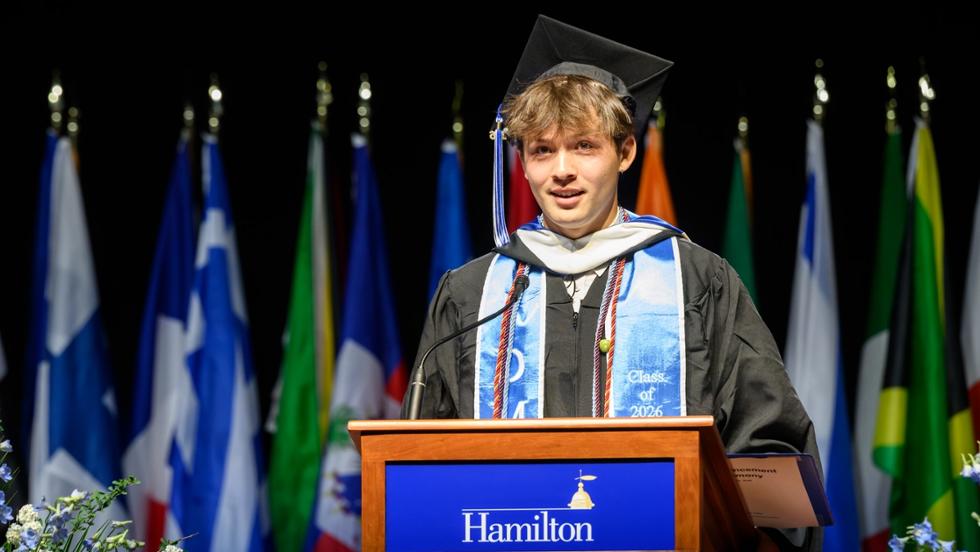
Reflecting on his achievement, Reiss was quick to offer appreciation for his mentors and peers who supported him along the way. “I’m so grateful for the people who advocated for me and for all the different organizations that I have been a part of,” he said. “I think I only received this award because of all of the amazing groups that I’m part of, so I can’t say that it’s just my work, but also that of so many others.”
At Hamilton, Reiss served as president of the Asian Student Union, a member of the men’s soccer team, a mentor with International Peer Mentoring, and an orientation leader.
“The irony of a small school is that you end up meeting way more people,” Reiss said. “I’ve been able to be a part of so many different groups, talk to so many different people, and hear about their perspectives on Hamilton and the world at large. At Hamilton, the idea of freedom and mobility within the College is valued, and the open curriculum is super indicative of that. There’s this ideal that you want to learn and you want to love learning, and you want to do it in as many ways as you can.”
At Hamilton, the idea of freedom and mobility within the College is valued, and the open curriculum is super indicative of that.
Besides his extracurricular activities, Reiss also worked as a docent at the Ruth and Elmer Wellin Museum of Art and a lead fellow at the Days-Massolo Multicultural Center, two experiences to which he attributes much of his personal growth.
“The Wellin has taught me to be incredibly intentional, to choose the words I want to say, and to use specific strategies to have people engage with different pieces of art,” Reiss explained. “The DMC has taught me to be unintentional, to lean into humanity, and to create a space where joy can be centered and you don’t have to be thinking precisely.”
Reiss also discovered his passion for working with refugees, beginning with an Emerson research fellowship the summer after his sophomore year. He applied his sociological knowledge to his home of New York City, performing an ethnographical study of unhoused populations in the subway system. Through this project, he learned about the struggles that recent refugees from Guatemala and Ecuador faced after being relocated from Texas to New York following political strife.
Reiss continued his work with migrants as an English language instructor for Shan Youth Power in Chiang Mai, Thailand, following his junior year. He worked with a migrant population from Myanmar fleeing a military dictatorship. During his senior thesis, he performed an ethnographical study on Myanmarese refugees in Utica. Each week, he would visit a church, mosque, or temple to interview community members. Reiss hopes to continue building on his experiences working with refugees post-Hamilton by securing a job in refugee resettlement or international human rights.
“I want to help people. I want to be around people. The more people that I meet from different backgrounds, the more I realize that everyone has a logic for the ways in which they do things, and so much of it is influenced by culture and social identity,” he said. “I want to interact and learn more from that, so I can help people even more.”
Posted June 22, 2026