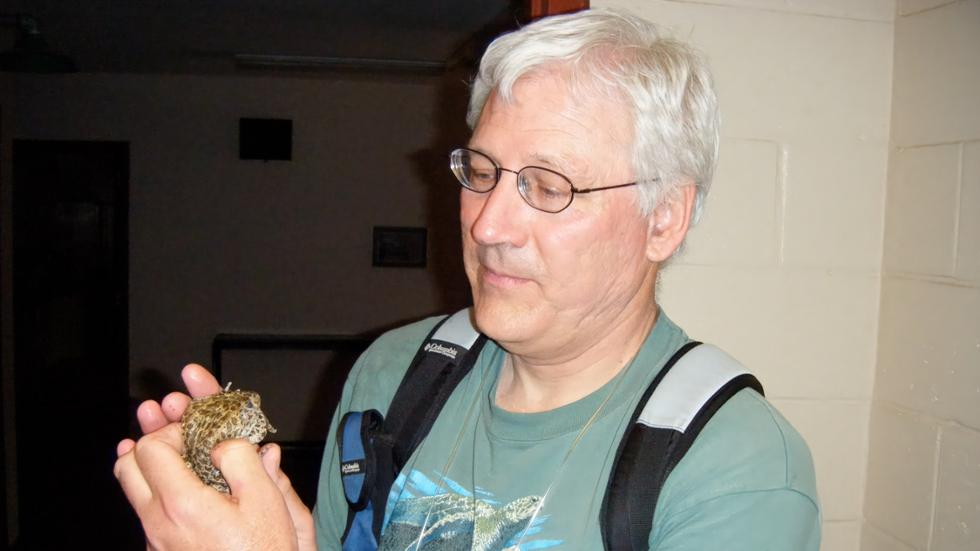
It likely would have become extinct had Joe Pechmann ’76, a population ecologist at Western Carolina University, not come to the rescue. For the past 20 years, he and other researchers painstakingly collected egg clusters, hatched them in livestock tanks, and battled parasites that threatened to wipe out the species. Today the frog, whose repetitive call sounds like snoring, has a fighting chance — its habitat has expanded to 15 ponds.
“I feel very privileged to have been able to help save endangered species. I love introducing students to ecology and the wonderful world of amphibians.”
Population fluctuations and the aquatic and terrestrial lifecycles of amphibians have always fascinated Pechmann. This species burrows in pine forests during scorching summers. That can be a deadly problem. Pechmann recorded a nine-year period when ponds dried up before tadpoles could metamorphose.
“There was no juvenile recruitment. They’re gambling and living on the edge,” the biology major said. “Their population fluctuates wildly with the weather. I’m interested in how they manage to survive that way and how to mitigate that to increase the chances they’ll still be around.”
Pechmann fears that proposed changes to the Endangered Species Act could jeopardize this frog’s future, especially if habitat alterations caused by humans are no longer banned. If so, “it’s likely the outlook will be far more grim for all endangered species,” he said.
As a teen, Pechmann was “a boy entomologist” — the first camper at Boy Scout Camp Tuscarora in 20 years to complete the insect study merit badge. He credits Professor of Biology Larry McManus with sparking his interest in ecology and conservation. “His course was very conceptual. He taught me there were all these interesting questions you could ask about populations and ecosystems.
“I feel very privileged to have been able to help save endangered species. I love introducing students to ecology and the wonderful world of amphibians,” Pechmann added.
Posted March 9, 2026