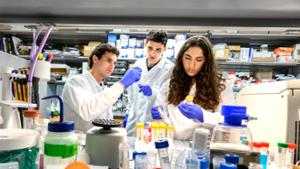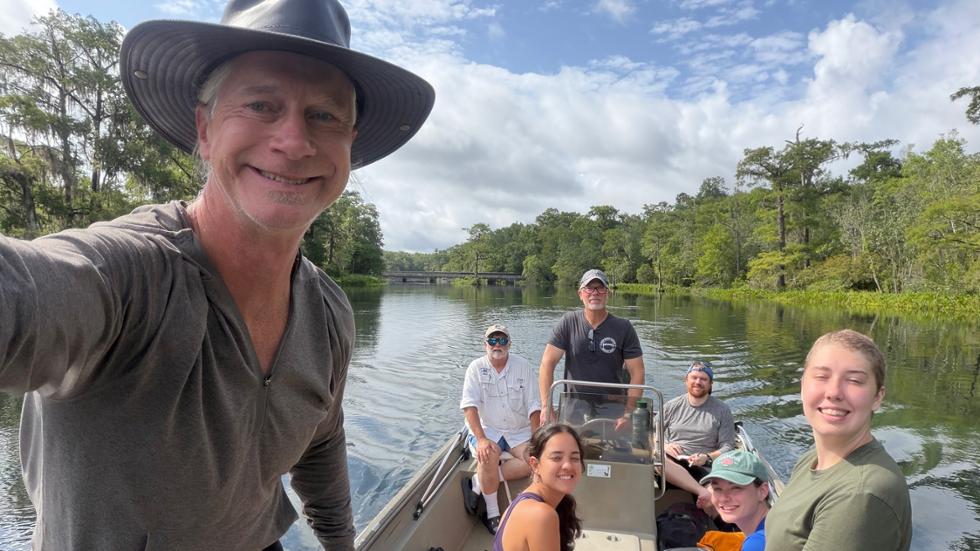
Assistant Professor of Geosciences Kris Kusnerik and student researchers Rocio Rodriguez ’28, Paige Wielgus ’28, and Lexi Groff ’29 conducted fieldwork as part of Kusnerik’s Conservation Paleobiology Project, which uses fossil and modern mollusks to understand how Florida’s freshwater ecosystems have changed over the past 20,000 years – and how that history can help guide future conservation.
By comparing the fossil record with species living in Florida’s rivers today, the researchers are tracing how sea level rise, warming temperatures, introduced species, pollution, and other environmental changes have reshaped these threatened freshwater ecosystems over thousands of years.
“The fossil record and other sources of geohistorical data are important as they fill in important gaps in our understanding of ecosystem change over time,” Kusnerik said. “If we want to fully understand the scope and scale of how these ecosystems have changed, we need to know what they used to look like, and the fossil record can provide a baseline.”
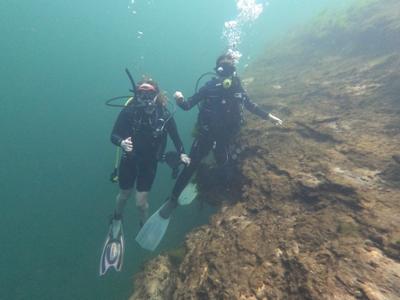
After a week of preparing equipment and working with collaborators at the Florida Museum of Natural History in Gainesville, the group launched a research boat each morning to sample sites along the Wakulla and St. Marks rivers. Using snorkel and SCUBA gear, they collected live and fossil mollusks, water, and sediment samples while documenting conditions at each location.
This summer also marked the project’s first season sampling the St. Marks River, giving researchers the opportunity to compare it with nearly a decade of data collected from the Wakulla. The samples gathered this summer will help researchers better understand how these freshwater ecosystems have evolved over thousands of years and how they continue to respond to environmental pressures today.
For Rodriguez, who has lived in Florida for four years, the project offered a chance to better understand the state’s freshwater environments.
“I became interested in it because it addresses environmental issues from home through paleontology and biology research,” she said.
Much of her work involved snorkeling and SCUBA diving to collect live mollusks, sediments, and shell remains. One of the discoveries that surprised her most was seeing how dramatically mollusk communities changed from one site to another, even when the rivers looked nearly identical from the surface.
“It is really interesting to later put the data together and see how the different snail communities can tell so much about the ecosystem,” Rodriguez said.
Back on campus, the research continued in the lab, where students sorted and identified freshwater mollusks, analyzed how well shells had been preserved, and learned techniques for processing and interpreting their data. The analyses are already beginning to reveal how environmental change is affecting Florida’s rivers.
“Hamilton students are just so excited to work and learn and take it all in, and I love being a part of that experience for them.”
“Our data suggest that salinity intrusion, likely driven by sea-level rise and human-caused environmental change, is affecting these freshwater ecosystems and reducing species diversity in some areas,” Wielgus said.
The project also offered experiences that extended beyond the lab. Spending long days on Florida’s rivers gave students a firsthand look at the rich biodiversity their research aims to better understand and protect.
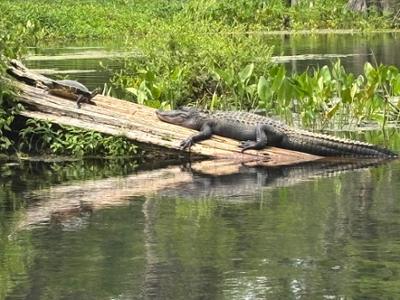
“We also saw baby armadillos, many alligators, manatees (and baby manatees!), several types of turtles, a gopher tortoise, blue crabs, barred owls, river otters, spotted gar, and my new favorite fish, the mullet,” Groff said.
For Kusnerik, those moments are just as meaningful as the scientific discoveries.
“Hamilton students are just so excited to work and learn and take it all in, and I love being a part of that experience for them,” he said. “Whether it’s watching a student’s first time to Florida, seeing the truly stunning field sites we get to visit and sample from, their first time realizing that we have to keep an eye out for things like alligators and manatees while we sample, or the excitement they have finding and collecting samples, it’s truly rewarding to be a part of that experience for them during the summer.”
Posted August 17, 2026