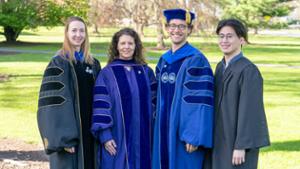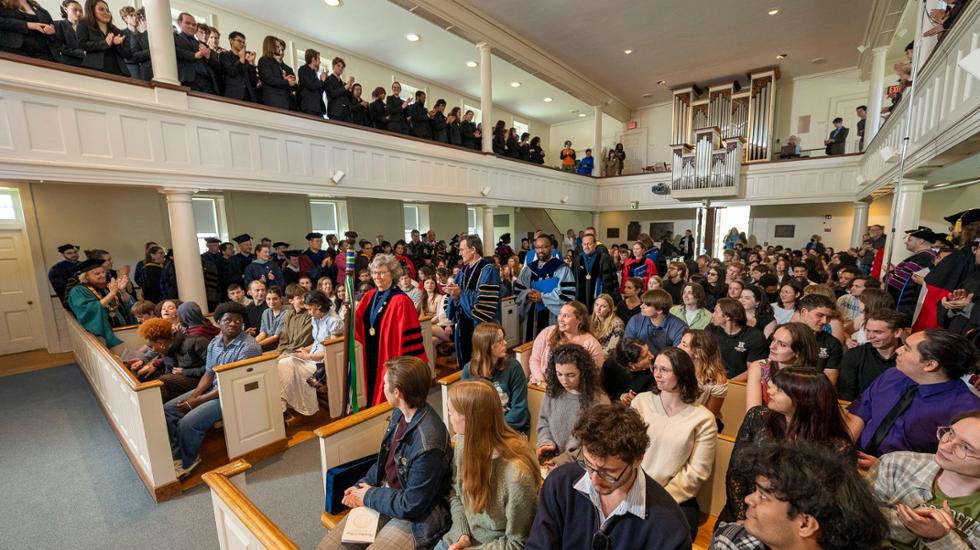
Among the top honors, Jun Reiss ’26 received the James Soper Merrill Prize, awarded to the member of the graduating class “who, in character and influence, has typified the highest ideals of the College.” The winner is selected by the faculty and speaks at Commencement.
Lucas Constantine ’27 received the Fillius Drown Prize Scholarship, “awarded to a student completing the junior year who has been very successful academically, who has demonstrated outstanding leadership qualities while at Hamilton, and who is likely to make a significant contribution to society in the future.”
View Award Recipients Watch Ceremony
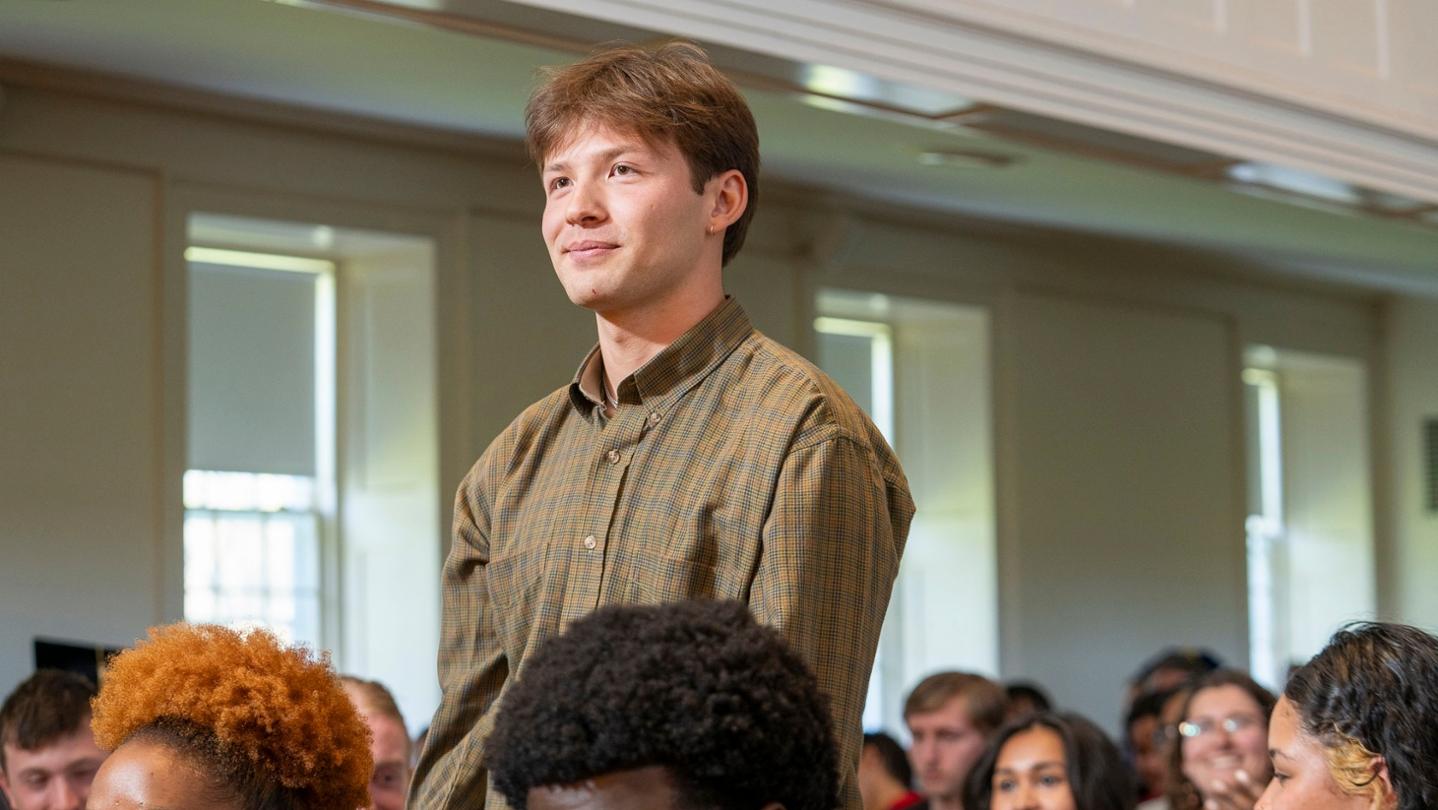
Jun Reiss ’26
The James Soper Merrill Prize Recipient
Reiss, a sociology major from Brooklyn, N.Y., works as a Days-Massolo Multicultural Center (DMC) student ambassador and a docent at the Wellin Museum of Art, and he played soccer for the Continentals.
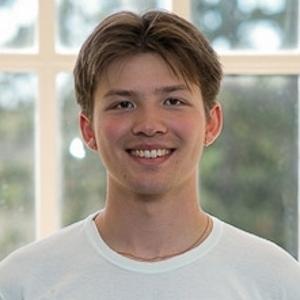
Jun Reiss ’26
Major: Sociology
Hometown: Brooklyn, N.Y.
Todd Franklin, the Eugene M. Tobin Distinguished Professor of Philosophy and Africana Studies, said, “Jun moves through the world without fanfare, and his most consequential contributions are rarely the ones that earn public notice. In the classroom, he is free-spirited in the best sense: genuinely curious, methodologically adventurous, and drawn to questions that resist easy resolution.
“As a sociology concentrator, rigorous social analysis comes naturally to Jun — but what sets him apart is his refusal to stay within disciplinary boundaries,” Franklin added. “He reaches across fields, synthesizes across traditions, and in doing so has distinguished himself as an intellectual heir to a long line of social conscience figures who look at the world as it is and take it upon themselves to help build the world as it ought to be.”
Franklin went on to point out that Jun’s efforts span the full gamut of campus life. Not only does he challenge ideas and assumptions in the classroom, Jun has, on many occasions, privately and directly challenged peers and campus leaders when their actions or attitudes fell short of the community’s stated ideals.
“What animates all of these efforts is a single, abiding goal: the cultivation of the greatest possible shared sense of belonging — here on the Hill and beyond,” Franklin said. “That goal is not incidental to who Jun is. It is the lens through which he sees everything. He has been a gracious and steadfast supporter of every student striving to make Hamilton their own, and a vigilant, principled voice whenever conventions or practices have threatened to undermine that effort. He is, in the truest sense, both a builder and a guardian of community — someone who creates the conditions for belonging and refuses to look away when those conditions are put at risk.”
Another of Reiss’ nominators said “[Jun] has consistently demonstrated positive influence, energy, and moral clarity in every community he joins. In my 20 years of working with students, he stands out as one of the very few who embodies such a comprehensive range of exemplary qualities.
“[Jun] has consistently demonstrated positive influence, energy, and moral clarity in every community he joins.”
“Jun is a rare combination of intellectual rigor, ethical leadership, and community impact. His academic work as a sociology major with a philosophy minor reflects both depth and initiative: ethnographic research in New York City subways, an independent field study across Vietnam, and a senior thesis exploring refugee communities in Utica all demonstrate curiosity, independence, and meticulous scholarship. Even as he pursues these demanding academic projects, he maintains excellence in athletics, service, and leadership,” the nominator wrote.
Jun’s contributions to campus life are equally exceptional. As a lead fellow at the DMC, he coordinates six identity-based organizations, organizes monthly community dinners, and mentors student leaders. As interim president of the Asian Student Union, he expanded programming, participation, and organizational capacity, and as a DEI representative for his soccer team, he designed initiatives that engaged teammates in meaningful conversations about inclusion and accountability.
Retired Utica City Court Judge Ralph Eannace said Reiss was a student in his Introduction to Law class in the fall term of 2024. “Jun quickly became a leader in class, often volunteering to start or continue discussions on our points or cases. … As I got to know him, I really came to appreciate his interest, his intellect and his integrity. Jun is an outstanding young man with a great future in front of him. He truly does exemplify the highest ideals of this great College.”
Another nominator from the Wellin Museum described Reiss as “a mentor and role model in every situation in which I’ve observed him, simply by using patience to empower others to express themselves fully. He is also a campus connector. This year, he organized an Identity Art Workshop for students in collaboration with the DMC, recruited his own professors to visit the Wellin for collection visits related to their course syllabi, and co-organized a special tour and artmaking event for Black History Month at the Museum.”
As a Wellin docent, Reiss helped welcome off-campus groups to the museum and extended invitations to groups that he thought would enjoy spending time there. In four semesters, he helped lead 15 visits for local K12 schools, eight Wellin Kids programs for families and children, and organized multiple programs for community groups that he is connected with off-campus, such as the Midtown Utica Community Center and the Karen Organization of Utica.
Another nominator recounted a Wellin Museum visit to Jefferson Elementary School fall festival in Utica, where Reiss walked around and struck up conversations with parents, working in the idea of the museum and the different free programs it offers to families. “Jun ... was excited about this event because we were going to be seeing a new demographic that we hadn’t worked with before, and many of them may not have had the opportunity or privilege to visit an art museum. Jun’s passion for helping underserved communities drove him to spark meaningful conversations with every parent he could,” a nominator added.
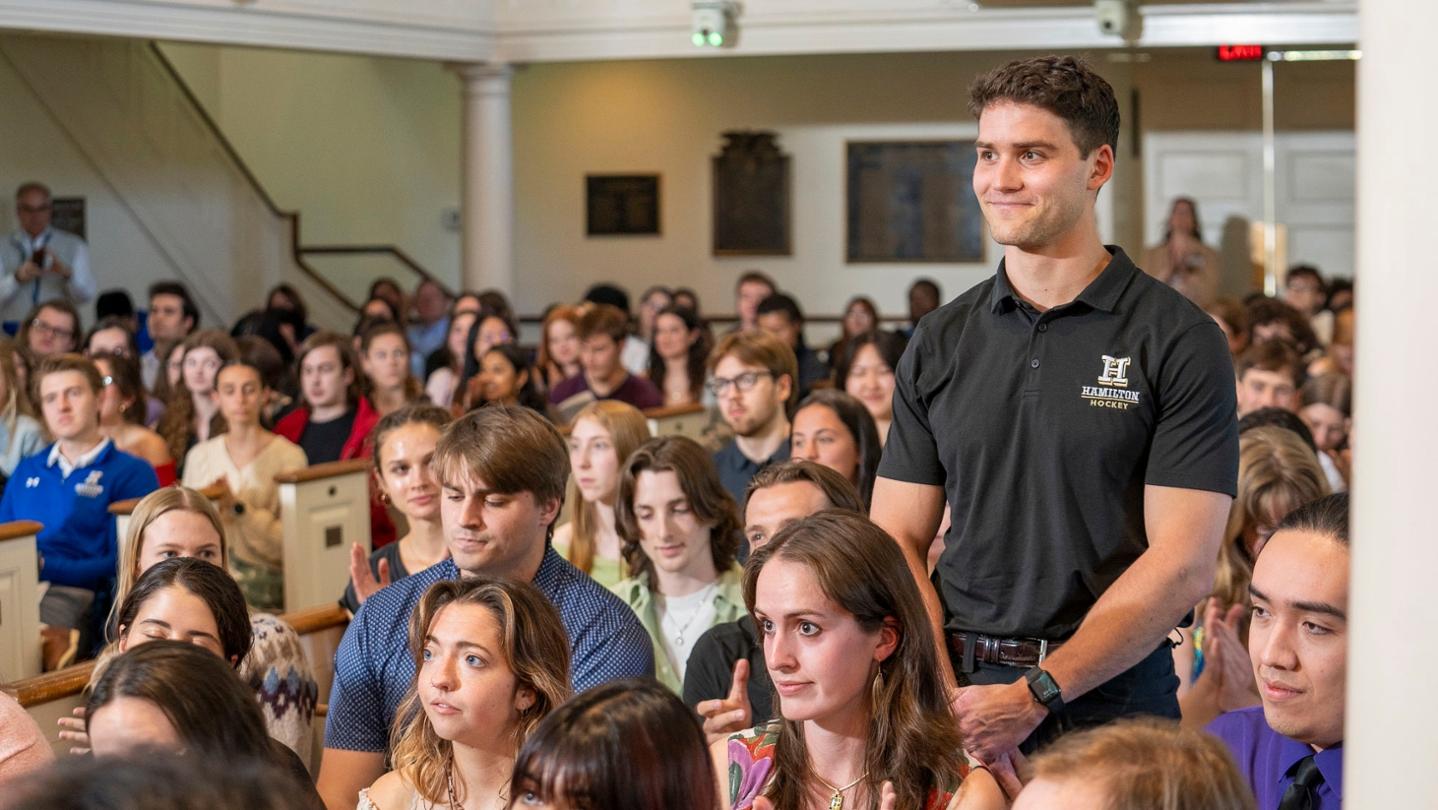
The Fillius Drown Prize Scholarship Recipient
Constantine, a biochemistry major from Los Angeles, is a defenseman on Hamilton’s national championship men’s hockey team. Coach Rob Haberbusch said, “Lucas exemplifies the highest standards of academic excellence, leadership, character, and commitment to the community. In my 15 years at Hamilton, he is without a doubt one of the finest human beings I have had the pleasure to coach.”
Lucas Constantine ’27
Major: Biochemistry
Hometown: Los Angeles, Calif.
A nominator noted that Constantine has been named to the Dean’s List every semester and is a two-time NCAA Academic All-American and NESCAC All-Academic honoree. “His intellectual curiosity extends well beyond the classroom, as evidenced by his extensive research experience in both neuroscience and nanomedicine. …. His work has already led to multiple poster and oral presentations at regional and national conferences, with additional work accepted for presentation this spring.
“Beyond his academic accomplishments, Lucas is an outstanding leader whose impact on the Hamilton community is deeply meaningful,” a nominator said. He serves as president of the Fellowship of Christian Athletes, where he leads weekly meetings for a large and diverse group of student-athletes, while managing programming and organizational responsibilities.
Constantine is a board member of the Pre-Health Club, where he mentors younger students and helps guide them through the demands of a pre-med path.
“Lucas’s leadership extends into experiential and service-based settings as well,” said a nominator, citing his selection as an Adirondack Adventure orientation leader. “[He is] entrusted with guiding incoming students through a demanding four-day program focused on team-building and transition to college life.”
Constantine has also remained consistently engaged in service through organizations such as Hamilton Sidekicks and Wishmakers, while contributing to numerous team-led community initiatives through Hamilton’s hockey program. “In each of these settings, Lucas leads not by seeking recognition, but by setting a consistent example of reliability, humility, and care for others,’” a nominator said.
“[Lucas] approaches his work with a genuine desire to improve the lives of others, whether through scientific research, mentorship, or community engagement.”
Haberbusch added, “As a member of our hockey program, Lucas has successfully balanced the demands of a nationally competitive NCAA schedule with his academic and extracurricular commitments. What ultimately sets Lucas apart is the combination of his intellectual ability and his character. He approaches his work with a genuine desire to improve the lives of others, whether through scientific research, mentorship, or community engagement.”
“His empathy, integrity, and commitment to service position him to make a meaningful and lasting contribution to society,” a nominator said. “I'm certain that he will continue to represent Hamilton with pride and distinction for a lifetime.”
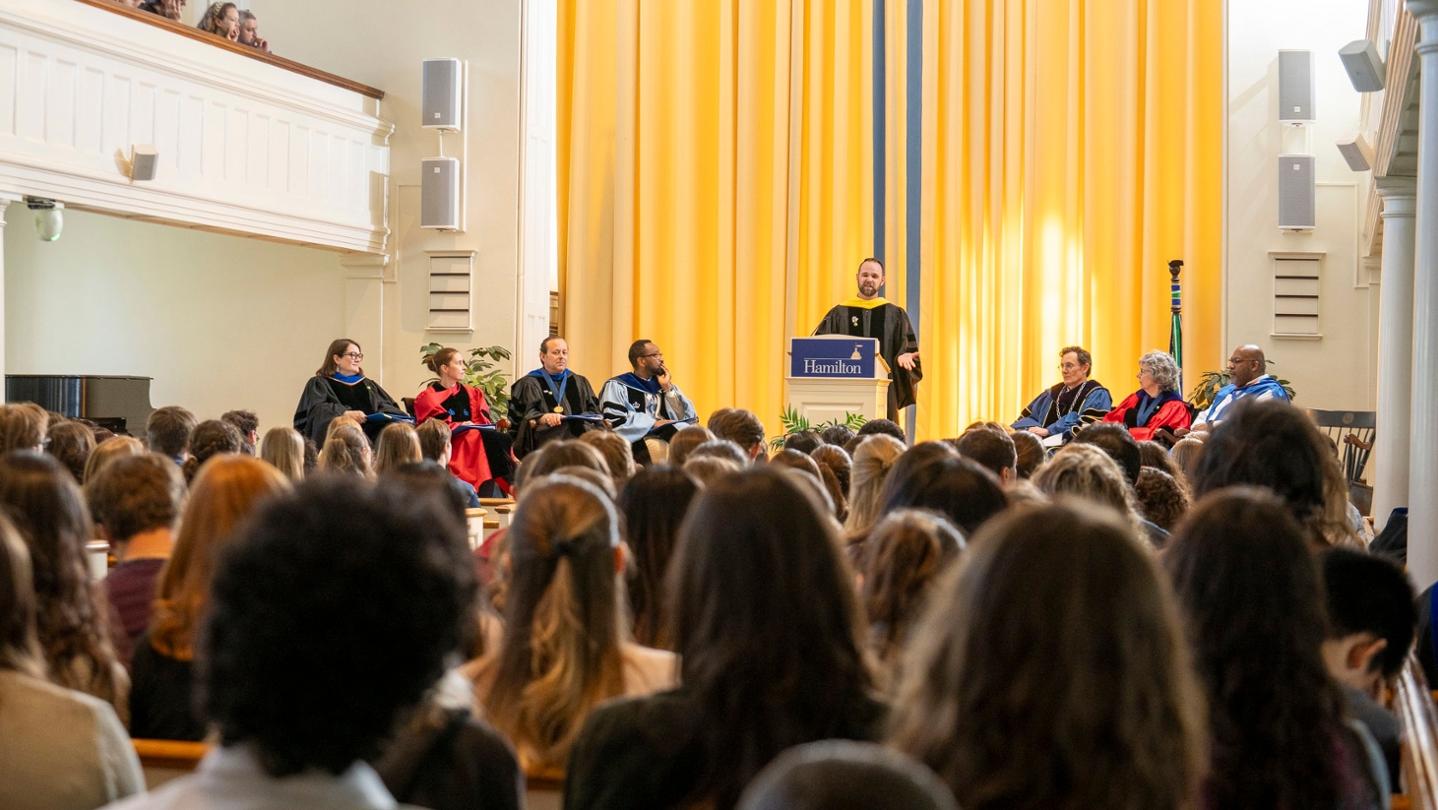
Associate Professor of Chemistry Max Majireck
Class & Charter Day Keynote Speaker
Associate Professor of Chemistry Max Majireck, last year’s winner of the Samuel and Helen Lang Prize for Excellence in Teaching, gave the keynote speech at the ceremony, urging attendees to embrace failure and find joy in their work.
Max Majireck
Associate Professor of Chemistry
Faculty Profile
Failure and fun don’t usually get paired together, Majireck said, “But in all seriousness, I think this combination, this creative tension, is one of the secrets to finding joy in your work. Have you ever asked yourself, why am I doing this? Why did I sign up for linear algebra? For quantum physics? … Why am I willingly subjecting myself to something so hard? I think it’s in the human spirit to seek challenge. Not in an ‘all work and no play’ sense. ... For us to do hard things on a consistent basis, we must also find some element of meaning, and with meaning comes joy.”
Majireck said everyone has overcome failure of some sort, yet persisted. “Maybe you chose your concentration or your profession because it had some strangely addictive combination of challenge and fun. And challenge implies the risk of failure. Success is not guaranteed. And if we’re going to stick with hard things, we need something that keeps us going. And strangely enough, that something is often learning through failure… while enjoying the process anyway.
“It’s always struck me as a little funny — maybe even a little dishonest — when we hear a long list of accomplishments about someone. Because what’s missing is the much longer list of mistakes, failures, near-misses, and ‘what was I thinking’ moments. So the real question isn’t what did a ‘successful’ person achieve? It’s why did they keep going?,” he added. “Organic chemistry – the subject I teach – that was one of my worst grades in college! What happened? The short answer: it sparked joy in my life.”
“Organic chemistry – the subject I teach – that was one of my worst grades in college! What happened? The short answer: it sparked joy in my life.”
Majireck said that at a very young age he knew he wanted to be a scientist: “I mean I was mixing chemicals in my mom’s basement at age 5.” He decided to major in chemistry. But, he said, “College was hard. The science topics that I loved, did not love me back. At least initially. Getting C’s on my intro physics and chemistry exams, my two favorite topics at the time, did not instill much confidence."
But then, Majireck said, his chemistry professor invited him to join his research lab. “I don’t know whether he saw something special in me, or was just desperate for help, but that changed everything for me. For the first time in a long while… science felt like play again. There were no exams. No grades. No right answer at the back of the book. It was just… trying things, failing, trying again. And boy were there some failures."
But, he added, “the thing that kept me going wasn’t success; it was that it was fun — the joy and the childlike wonder.”
Majireck asked students to consider “What still feels like play to you? And if your answer is ‘nothing right now’… that’s not a failure. That’s just a signal. It means the search is still on — take pleasure in trying new things. Don’t be afraid to fail. We all suck at trying new things. But remember this — the expert has failed more than the beginner has even tried."
He asked a second question: What if you lost the joy in something you used to love? “That’s ok too,” he said. “It might be time to find some other journey, some other problem to work on. But you might also need a reboot.
“You still have to work. … There will always be parts of your job that are tedious, frustrating, or just not fun,” Majireck acknowledged. “But when you find something you genuinely care about —something that feels, at least sometimes, like play, then you’re willing to do the hard parts, not in a toxic, burn-yourself-out way, but in a purposeful way. A way that makes you wake up each morning, ready to fail and have some fun while doing it.
“Do hard things. Expect to fail. Find what feels like play, or at least something that brings you joy and fulfillment. Hold onto that curiosity you had as a kid. You will grow older. That part is unavoidable. But please — don’t grow up,” Majireck said. “Stay curious. Stay playful. Stay a little weird. And when things get difficult — and they will — remember: Failure is part of the process. But joy, the kind that comes from knowing you are doing something meaningful … is what makes the process worth it.”
Posted May 12, 2026