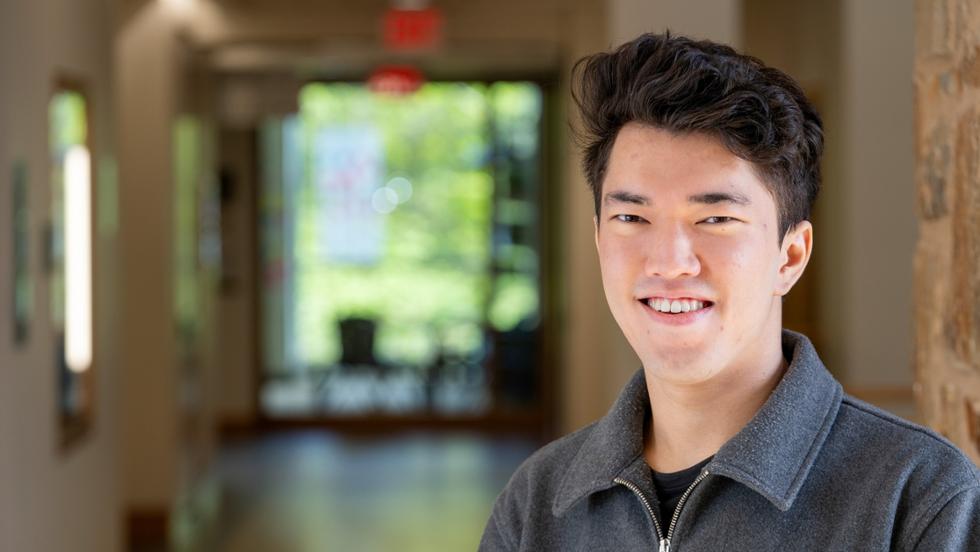
At the heart of his can-do attitude is a fondness for exploration. “I don’t feel restricted to one type of thinking or one dream,” said the biochemistry / molecular biology and mathematics double major with a biomedical research bent.
His Journey Begins: Discovering a Passion for Science
Jaboldinov’s high-level engagement in coursework at his magnet school earned him an invitation to contribute to a study on environmental genotoxicity in Almaty, Kazakhstan, his hometown. Jaboldinov knew he wanted to pursue his scientific aspirations, but he wasn’t completely sure what shape they would take. He found Hamilton, a “college with the flexibility [for students] to decide what they want to in their education,” and applied Early Decision.
First Year: Finding Mentorship
Entering Hamilton, Jaboldinov’s mentality was “If it works, or if it doesn’t work…let’s give it a try.” Professor Wei-Jen Chang, the Winslow Chair of Modern Science and Professor of Biology, took Jaboldinov under his wing as an eager, self-driven first-year student. Also influential was BIO 249: Genetics for Health Professions with Visiting Assistant Professor of Biology Ivan Bochkov, who would instill in Jaboldinov an interest in both the practical and theoretical applications of biology.
Sophomore Year: Taking the Lead
Jaboldinov helped lead Kazakhstan’s student team at the 2023 iGEM Grand Jamboree held in Paris, France. Renyi Student Leadership funding, coupled with the understanding of his professors at Hamilton, allowed him to miss classes to present and defend his team’s project in person. For iGEM, Jaboldinov’s role focused on public engagement and human-centered practices. He organized an online summer camp for students from underrepresented communities in Kazakhstan to learn synthetic biology from international experts — including Hamilton’s Associate Professor of Chemistry Max Majireck, director of Biochemistry/Molecular Biology.
That year, Jaboldinov also enrolled in Bockhov’s course on cancer biology where he not only examined methods in modern oncology, but also practiced grant writing and networked with an author of an assigned reading. This connection would directly lead to a summer internship down the road.
First, however, Jaboldinov took part in the Masonic Medical Research Institute (MMRI) Summer Fellowship Program in Utica, N.Y. He joined The McCarthy Lab and assisted with research on molecular imaging and drug delivery materials.
Junior Year: Research & Publishing
Jaboldinov became one of the first Hamilton students to participate in the Trudeau Institute’s Biomedical Research Scholars Program in Saranac Lake, NY. His research under Dr. Deborah Brown considered the effectiveness of small molecules, known as adjuvants, in protecting the immune system against lethal Influenza-A doses.
That summer, he also joined the MIT Koch Institute for Integrative Cancer Research thanks to the MIT researchers he met at iGEM and through Professor Bochkov’s cancer biology class. Jaboldinov co-authored an article on CDK-drug interactions.
Senior Year: Working with MIT and Harvard
Jaboldinov’s pace didn’t slow down. In early September 2025, he began scouting for a wide range of jobs in biomedical research. He received an offer to be a research associate at the Buenrostro Lab and Biology of Adversity Project at the Broad Institute of MIT and Harvard.
The Biology of Adversity Project aims to uncover how stress, trauma, and other adverse events, both in childhood and later in life, can inflict “molecular scars” in the genome and the body that lead to negative health outcomes. According to Jaboldinov, the project asks, “How can we direct our overall approach to personalized medicine to ask and answer more comprehensive questions? How can we scale things that are currently limited to add to our toolkits and answer questions of even greater depth?”
A Ph.D. is on the horizon for Jaboldinov, hopefully followed by a career in which he can continue sharing knowledge to people with a host of learning styles. He’s not attached to one particular place or path. “Science is global,” he said, and so he is keeping his options open. In the meantime, however, his ambitions are simple: to enjoy some well-deserved rest and relaxation at home in Kazakhstan.
Posted May 8, 2026