President Tepper Remarks
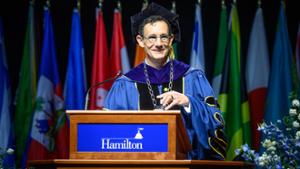
Good morning, Class of 2026.
I want to extend a big welcome to all of our family, friends, and members of the extended Hamilton community who are joining us from around the world.
I want to begin today with a gift. Gratitude. It turns out that if you practice gratitude, you get a bunch of short-term boosts in positive chemicals like serotonin and dopamine, but you also get long-term benefits of increased hope and optimism; empathy; lower stress; lower anxiety; increased wellbeing; and life satisfaction. So, I just want to make sure that all of our graduates are at their very maximum dopamine levels, I want all of our families and friends who are with us today to support our graduates to stand if you are able. Graduates, with all that you can muster, please show your gratitude to these people who have supported you through all of these years of study.
[applause]
Okay, that was pretty loud. But now I’m going to ask our faculty and staff who have supported and mentored our students on this journey to please stand.
[applause]
I want to call out, for special recognition, the ten distinguished members of the Hamilton faculty who are retiring this year. This morning, I will call their names and ask them to stand so you can join me in expressing our appreciation for their combined 300 years of service to Hamilton College.
- Mark Bailey, the Robert and Pamela (Craig) Delaney Professor of Computer Science
- Erol Balkan, Professor of Economics
- Sally Cockburn, the Samuel F. Pratt Professor of Mathematics & Statistics
- Ella Gant, Professor of Art
- Patty Kloidt, Professor of Physical Education
- Cheryl Morgan, Professor of French and Francophone Studies
- Quincy Newell, Professor of Religious Studies
- Onno Oerlemans, the Elizabeth J. McCormack Professor of Literature
- Margie Thickstun, the Jane D. and Ellis E. Bradford ’45 Distinguished Writing Chair
- Bruce Walczyk, Professor of Dance and Movement Studies
Families, you see how much our graduates love our faculty, as we all do.
Many employees of the College have worked long and hard on the arrangements for today’s ceremony and this weekend. I would like to thank the offices of the deans and president, Audiovisual Services, College Events, Advancement, Communications and Marketing, LITS, Facilities Management, Campus Safety, and the Registrar’s Office. Thank you all for all that you’ve done for us.
I have a final assignment for our students. Think about one word right now – it could be an adjective, a feeling, a hope, a memory – something that defines how you’re feeling in this moment. On the count of three, we’re going to shout it out. Ready? One, two, three.
[Graduates shout answers]
Wow. I heard hopeful, proud, optimistic, confident, cross-faded, hungover.
Beautiful. All of those words were an answer to this moment. But today, I want to talk not about answers, but about questions.
So, let me start with the question: what does it mean to Know Thyself?
One of your classmates, Leo Gerst, sent me a note a few weeks ago. He said — and I’m paraphrasing Leo — that he arrived as a freshman thinking he would graduate with a clear answer. But four years later, many things he felt seem uncertain. The world turned out to be wholly and utterly false. His interests have changed. His priorities have shifted. And he finds this process, in his words, “incredibly liberating.”
Leo asked the question: “To what extent is it truly possible to Know Thyself?”
Leo, by asking that question openly and honestly, you are already practicing an extremely powerful form of self-knowledge that is deep and that is enduring.
The question I asked when I graduated from college was similar, but rather than, “How will I know myself?” I asked, “How will I be known by others?” You know how Netflix has the three adjectives that describe every film in its catalogue: Stranger Things is Nostalgic, Suspenseful, and Chilling. Emily in Paris is Romantic, Slick, and Whimsical. Stepper – or Tepper — cerebral, warm, energetic. Or, maybe in the words of one recent Clinton eighth-grader who described me to her father after I gave a speech at her school’s career day, she said – in two words, not three – and I quote, “He was not awful.” It’s a low bar.
“How will I be known?” How will you be known? Several years after graduating, I came across a quote from Maya Angelou that offered this insight: “People will forget what you said, people will forget what you did, but people will never forget how you made them feel."
That became my North Star, and, it turns out, for me, I learned that asking questions has been the one thing that gets me a little bit closer to that star.
So, what does it mean to ask a good question?
There are two kinds of questioners, and – you know this because you’ve been in classes for 16 years or so – that the first kind of questioner asks the question to sound smart. The question is kind of a performance. “Hey, look at me, look at how much I know, look how sophisticated I am.” That kind of question closes down a conversation rather than opens one up. It tends to make your fellow classmates feel smaller.
Then there is the second kind of person who asks what I call the generous question that makes everyone else in the room feel smarter, the question that opens people up and generates more questions. Hamilton graduates are the second kind of questioners.
Children are natural and generous questioners. My daughter Sally, at 4, asked me this extremely important question. She said, “Daddy, who is the boss in the house between you and Mommy?” I said, “Well, naturally, I’m the boss. Your mother makes all the decisions, but I am in charge of the TV remote.” And she looked at me skeptically.
And then there is this question that I read every morning on my refrigerator magnet. It’s a Dalmatian dog looking up, ears back, with the words, “Are you the person your dog thinks you are?”
Staying on that theme of pets, here is a profound question that your classmate Natalie Yarnall asked me. “What distinguishes a cat person from a dog person?” I’ve been thinking about that for the last week. Cat people are okay being ignored or left alone, and dog people need constant positive affirmation. For better or worse, I am a dog person.
Just like practicing gratitude, there are real benefits to asking questions. Researchers at Harvard spent years studying thousands of real conversations. What they found was simple and extraordinary: people who ask more questions, including follow-up questions, are significantly better liked by the people they talk with. The researchers called their paper, “It Doesn’t Hurt to Ask,” and it turns out it doesn’t. It actually helps all of your relationships. It helps your career. It helps the people around you feel seen and valued.
A few weeks ago, I sent a note to a few dozen of you, and I asked: What questions are you leaving Hamilton with? Within minutes, Iain McGiffin replied and his question was: Will Southampton get promoted from the Championship to the Premier League?
Iain… I am optimistic.
Then the questions deepened.
Jared Maidman asked, “How will the fabric and identity of Hamilton College change over the next four years?” By then, we will have added three more framed photographs to the one that just went up last week in the Pub that read: National Hockey Champions 2026. We will add 2027, 2028, 2029. Rob – good luck.
Related to the theme of uncertainty, Jack Kertscher asked, “How can we create and manage change?”
Prim Udomphan provides an answer to Jack through her lens as a chemistry major: “Can experimental thinking (the trial and error approach) help us optimize our lives at every stage?”
One of your classmates asked, “Why are people so afraid of uncertainty?” As you consider these questions, think about how your Hamilton education and how it has prepared you to navigate that uncertainty – to think in all directions, to work with all types of people, to imagine pathways that others might not see.
Maybe the answer to Jack’s question about managing change lies in the question that Quentin Messer asked: “Is the curriculum of life open?” Building from Quentin’s question, let me ask all of you: What would it look like if you approached life as you have approached the open curriculum here at Hamilton?
Others are leaving Hamilton deeply interested and concerned about what it means to be part of a community. Muhammad Ahmad Rao asked: “What happens to largely tolerant people that causes something as unnatural as spewing hatred for political gain to become normal to them?”
Daniel Rodriguez asked: “Why is it that, though we only have each other in the expanse of this whole universe — UFOs aside — we so often insist on being divided from each other?”
Daphne Cerrato brings that question home to us and says, “What would it take for Hamilton to ensure unity between different groups on our campus?”
Community also came up for Peter Hinkle, who wondered, “What factors enable the formation of a strong community?”
Jun Reiss’ question suggests the answer lies in how we talk about support: “Is it better to support the greatest number of people or provide more support to those who need it most?”
Kate Connolly, who has spent four years studying what makes great communities and what helps them hold together, simply asked: “What do we owe to our communities?” Maybe the answer lies in kindness.
Which was Julia Afsar-Keshmiri’s question: “How did I find such kind people here, how do I do it again, and how do I be a kind person back?”
On a more personal note, Vincent Manni wonders which memories he will revisit time and again. Vincent continues, “Will it be the little interactions, the movie nights, the Groad walks, the rounds of Mario Kart races?” Start telling your stories now, as you’re saying goodbye, so that the memories that are most important to you stay fresh, stay bright, stay alive.
Know Thyself. You came here to find the answer to that question; but perhaps you are leaving having discovered something much more meaningful, and much more profound: the questions are really what matter.
So, go ask a question that changes everything.
There are so many people in this room who love you. I’m at the front of that line. I love you, graduates. We will miss you. Go forth. Congratulations.
“What question are you leaving Hamilton with?”
This is the question that President Tepper posed to a small group of seniors in the weeks leading up to their commencement. He wrote, “I love questions (far more than answers). So, what big, small, serious, or funny question are you leaving Hamilton with?”
He was looking for something that animates them, and he was inspired enough by their responses to include many of them in his commencement remarks. Here is the full list of the questions shared from our most recent graduates.
“If we compared student's post-grad plans to what they wanted to be when they were younger, how many people would be fulfilling their childhood dreams?”
“Is the curriculum of life open?”
“How do you build authentic relationships with people when there are inherent power imbalances (age, authority, title, status)?”
“Is the future as uncertain as it seems?”
“What percentage of Hamilton couples get married, and is this higher than other schools proportionately?”
“What happens to largely tolerant people as they develop into adults that something as unnatural and inhuman as spewing hatred for political gain becomes normal to them?”
“How do cities work, and how do they shape our experiences of everyday life? How do urban spaces uphold (or challenge) institutional power structures? And ultimately, how can we shape cities that are more habitable, sustainable, and equitable for everyone who lives in them?”
“To what extent is it truly possible to "Know Thyself?"”
“Why is it that, though we have only each other in the expanse of this whole, wide universe (UFOs aside), we so often insist on being divided from each other?”
“How did I find such kind people, how do I do it again, and how do I be a kind person back?”
“As a burgeoning physician-investigator, what is my role as an engaged citizen in our unpredictable and ever-changing climate?”
“How will the fabric and identity of Hamilton have changed four years from now?”
“There is only so much space in [Burke Library], so books must be removed in order to make space for new ones. Which books go, and where do they go? How has this process changed with more and more content being available online, and with students using physical copies less? How many books are acquired and removed each year?”
“Will Southampton get promoted from the Championship to the Premier League?”
“What do we owe to our communities?”
“How do we apply experimental thinking (or trial and error) to optimize our lives in each stage, from college life and beyond?”
“Is being uncomfortable with boredom something I will eventually grow out of, or will it always feel like something to avoid?”
“If I could go back and relive ONLY one moment, one memory, what would it be?”
“What are some initiatives we can take as a campus (student and staff) to better ensure unity between different communities?”
“Is the role of an institution (whether it be small-scale like a school, or large-scale like the US government) to support the most amount of the people it can, or to offer a larger degree of support to those who need it the most?”
“Is the human race still evolving, or have medical advances pushed us away from natural selection? Are all Jedi completely good? What distinguishes a cat person from a dog person? What is the ethical limit on CRISPR use?”
“What are the factors that enable the formation of a strong community?”
“Everyone privately votes by pressing a red or blue button. If 50% or more pick blue, everyone lives. If not, only people who pressed red live. Which button will you press?”
“Why are people so afraid of uncertainty, and what advice do you have for young people, like ourselves, going ‘into the wild”
