Baccalaureate Address
Emmy Award-winning storyteller Maryam Banikarim delivered the 2026 baccalaureate address.
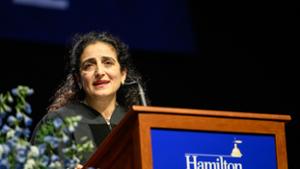
Maryam Banikarim’s Remarks
Thank you, President Tepper, faculty, staff, and board of trustees. And hello, graduates — and everyone who helped get you here.
These days I spend a lot of time thinking about belonging. And the lack thereof.
When I look out at you — a group of students about to be launched into the world — I want 2 things for you: success and belonging.
So let me tell you a little about my story — and along the way, share 3 tips that I hope help you find both.
I am eleven years old. It’s 1979 and we’re in the middle of the Iranian revolution.
Chaos. Martial law. Executions. Riots. That’s the backdrop.
And my father had just been named president of the International Bank of Iran — in which Chase Manhattan, now JP Morgan Chase, held a major stake. Neither I nor anyone in my family had any sense of what was about to happen to us.
Being associated with an American bank was not popular with the revolutionary guard. Bad timing doesn’t begin to cover it. My dad and his colleagues were rounded up and held under house arrest by men with machine guns who were no older than you.
I remember visiting him there. The house where he was being held as a prisoner belonged to a family that had left Tehran overnight — leaving everything behind. My mother brought home-cooked food. I disappeared into the bedroom of the child who’d fled — to hide and to read his comic books — while men with guns stood watch in the next room.
A few weeks later, my dad and his colleagues were released — the law changed daily. We breathed a sigh of relief. Then we heard he was going to be blacklisted — put on a list that would prevent him from leaving the country.
Our family pushed him to get out while he still could. Go on vacation, get out of the country just in case.
My father had his reservations. He was tied to his country, his home.
But he gave in. We went to the airport, taking our chances — my mother, my father, and me with just two suitcases. Without my three-year-old sister, who stayed behind with my grandparents. We left in a hurry. We planned to return.
I don’t remember much about this moment — I really did think we were going on vacation. After we checked in, while in the boarding area, my dad was called on the loudspeaker. My mom was very nervous but wasn’t letting on. Then a couple minutes later my dad returned with a smile on his face. Just like always. “It was nothing,” he said, as we boarded our flight to Paris.
By the end of the summer, it was clear we were not returning to Iran anytime soon. So my grandmother brought my little sister to Paris where we ended up living for one year. Realizing we needed a more permanent home, we relocated to the United States to “start over.”
I was going to start middle school in America. As Iranian immigrants. During the hostage crisis. Every night on television, a countdown of the days American hostages were held in Iran — broadcast into living rooms across the country, night after night, for 444 days.
Again, perfect timing. Talk about not belonging.
I eventually found my footing. My father never did. Not in America. Not anywhere after Iran.
My sophomore year of college, I’m hitting my stride. That fall my dad came to visit — he had decided he wanted to go back to Iran for a visit, to see his sisters and mother. He knew he was still blacklisted. We all did — which made this a bad idea. He went anyway. I think part of him always missed home. The home that feels familiar — where you belong.
That was him — romantic and reckless in the best possible way. Upon landing in Iran, his passport was confiscated. He was not fazed. He stayed there for nearly a year. A bureaucratic accident led to his passport being returned to him. Quickly, he got himself smuggled out through Pakistan.
A few days later, we met him in Geneva — my mother, my sister, and me.
The plan: get him his green card. Get him to America. Finally have our whole family in the same country again.
My father suggested we extend the trip a few days. “You’ll be back at college in a week and we won’t see you until Christmas. Let’s rent a car and have a little holiday.”
We found ourselves at a lakeside resort. The next morning — beautiful, clear, sunny — he announced we were going windsurfing. Something he’d learned to do in California.
My sister sits on the side of the lake and waves him off as he glides out onto the water. My mother and I go into town to buy our own bathing suits.
When we come back, there are emergency vehicles everywhere. We quickly learned — that they were there for my father.
Smuggled out through Pakistan. Drowned windsurfing a week later in Switzerland.
I was nineteen. A week later, I started my junior year of college. Because the one thing I had mastered by this point, was motion.
Tip one: There will be messy parts — maybe not as cinematic as mine. Remember, the only way is through. One foot in front of the other.
I graduated from college without a job or a plan. I had student loans — but I was determined to find work I could believe in.
I moved home. Got a job. Saved enough to buy myself a few months. Then I moved to Argentina — a country in economic and political turmoil where I knew no one.
I went with an idea. What if — I become a foreign correspondent?
After landing — and after being ripped off by the taxi driver, a rite of passage — I discovered they were shooting a Hollywood film in town: Highlander II, with Sean Connery. The original James Bond.
This was going to be my big break. I’d sneak into the production, get a story, that would then land me a job at the Buenos Aires Herald.
I figured out where the production offices were and just showed up.
When I arrived, I walked up to the receptionist and heard myself say: “I was told you were hiring.”
I have no idea where that came from. It wasn’t true. I hadn’t been told anything. But it was out of my mouth before I could stop it.
“Wait here,” she said.
The film company had just fired a bunch of people. Coincidentally, I'd walked in at the exact moment they needed replacements. Finally, good timing.
I landed a job.
I went to Argentina to be a foreign correspondent. I ended up on a Hollywood film set instead.
A year later, I’m in graduate school. A friend sees a book I’d made for fun — travel columns I’d written for my college newspaper combined with the current Gap advertising campaign.
He says: “You should send this to Mickey Drexler. The CEO of the Gap. He just spoke to my retailing class. I think he’ll like it.”
This is before the internet. I packaged up the book, wrote a letter, and mailed it to Gap headquarters. Addressed to: Mickey Drexler.
A few weeks go by. It’s finals. I’m at my desk, studying.
The phone rings.
“Is this Maryam?”
“Yes?”
“This is Mickey Drexler.”
I thought I was being pranked.
I didn’t end up working at the Gap. But that conversation — Mickey telling me “this is a marketing idea” — showed me a path I didn’t know existed. A career I was genuinely interested in AND one that paid the bills.
I had a lot of what if ideas. And since I wasn’t worried about being cool or being rejected, I acted on them. I sent a lot of letters. Most went unanswered. This one didn’t.
What made me think the CEO of a billion-dollar company would respond? I have no idea. But he did.
If this can happen for me — there is a version of this story out there FOR YOU.
Tip two: Don’t wait for perfect — or permission. Don’t self-reject. Don’t talk yourself out of it. Just go.
For the next 30 years, I did everything I just told you to do. I kept moving. Showed up. Didn’t hold back. I worked hard. I hustled.
My career worked. I was “successful.”
And it turns out it wasn’t enough for me. I’m betting it won’t be enough for you either.
But I don’t know that I fully felt like I belonged.
Corporate hierarchy is not a community. A title doesn’t hug you back.
So, I kept moving. Then I stopped. In fact, the world stopped.
It was August 2020. COVID had hit NYC early and hard. “New York is dead,” the headlines said.
I sent an email to twenty friends. I don’t know about you, but I’m tired of these stories.
What if we got on a Zoom to see if we could figure something out?
That was the whole plan.
We raised a little money, paid artists a stipend of $100, and produced pop-up concerts outside to remind ourselves and the world that we were very much alive.
One of the first was A Moment for Broadway. 24 performers — almost all Tony award winners stood together on the red steps of Times Square and sang one song.
It blew up.
By then, there were 700 of us. Together. Trying to save our city.
Work everyone did for free. We found purpose out of despair.
We found something we hadn’t expected. Community and belonging.
Coming out of COVID, I had another idea: what if we knew our neighbors?
An invitation: “We’ll bring the table and chairs — you bring friends and food.”
We set up a very long table down West 21st Street in Chelsea, the block where we live. We canvassed the neighborhood. We didn’t know if it would work, but we left no stone unturned.
The 1st year, 500 people showed up.
4 years later, over 2,000.
That one table inspired others.
Last year, 50 Longest Tables happened across the country. This year, over 100.
The table says: you have a seat here.
Recently, a woman came to a Longest Table. She’d lost her husband not long before, and she was nervous to come alone.
At check-in, someone overheard her story and said: come sit with us.
When she told me this, she was sitting with her new friends.
Tears were streaming down her face. “Hello — come join us” had made all the difference.
One person — noticed another person and said: you belong here. You matter.
Tip three: You won’t find belonging. You have to create it. Set a table. Say hello. And invite everyone in.
I was moving so fast I never stopped to notice what was missing. I’m not sure I ever would have — had COVID not forced us all to stop.
But this chapter led me somewhere I never planned. To something I didn’t even know I was looking for.
Belonging.
Belonging isn’t soft or a nice to have. It’s right after food and shelter in Maslow’s hierarchy of needs.
It’s the single greatest predictor of wellbeing — more than wealth, more than status.
And right now loneliness is at epidemic levels. Division is everywhere. Making new friends has become hard.
I want that for you. A successful career. And a place where you belong.
But here’s what I also know: the career, success, it’s not belonging.
You can do everything right and still feel like something’s missing. I did.
Remember that girl who arrived in middle school, who stuck out like a sore thumb — the one who wasn’t sure there was a seat for her in the cafeteria?
She stopped looking for one. She set a table. She said hello. She pulled up a chair for someone else. And 2,000 people showed up.
You won’t find belonging. You have to create it.
So set a table. Say hello. And pull up a chair for someone else.
Congratulations, Class of 2026.
