The Ever-Evolving Curriculum
These are among the questions that generations of presidents and faculty members have wrestled with throughout Hamilton’s history. Their answers have shaped the curriculum, each iteration of which builds on the previous in a continuing effort to provide the most meaningful experience for students.
It’s been 25 years since the last major curricular review re-introduced the open curriculum. Underway now is an aspirational design planning session titled Open Curriculum 2.0. The initiative challenges the community to “imagine a new integrated ecosystem of curricular programs, building from our open curriculum, that exponentially increases opportunities for students to pursue their interests while participating in the full richness of the Hamilton experiences, all as part of a coherent learning journey.”
As work continues on shaping tomorrow’s Hamilton experience, here’s a look at some of the milestones in curriculum development over the past two centuries on College Hill.
Classicism is Key
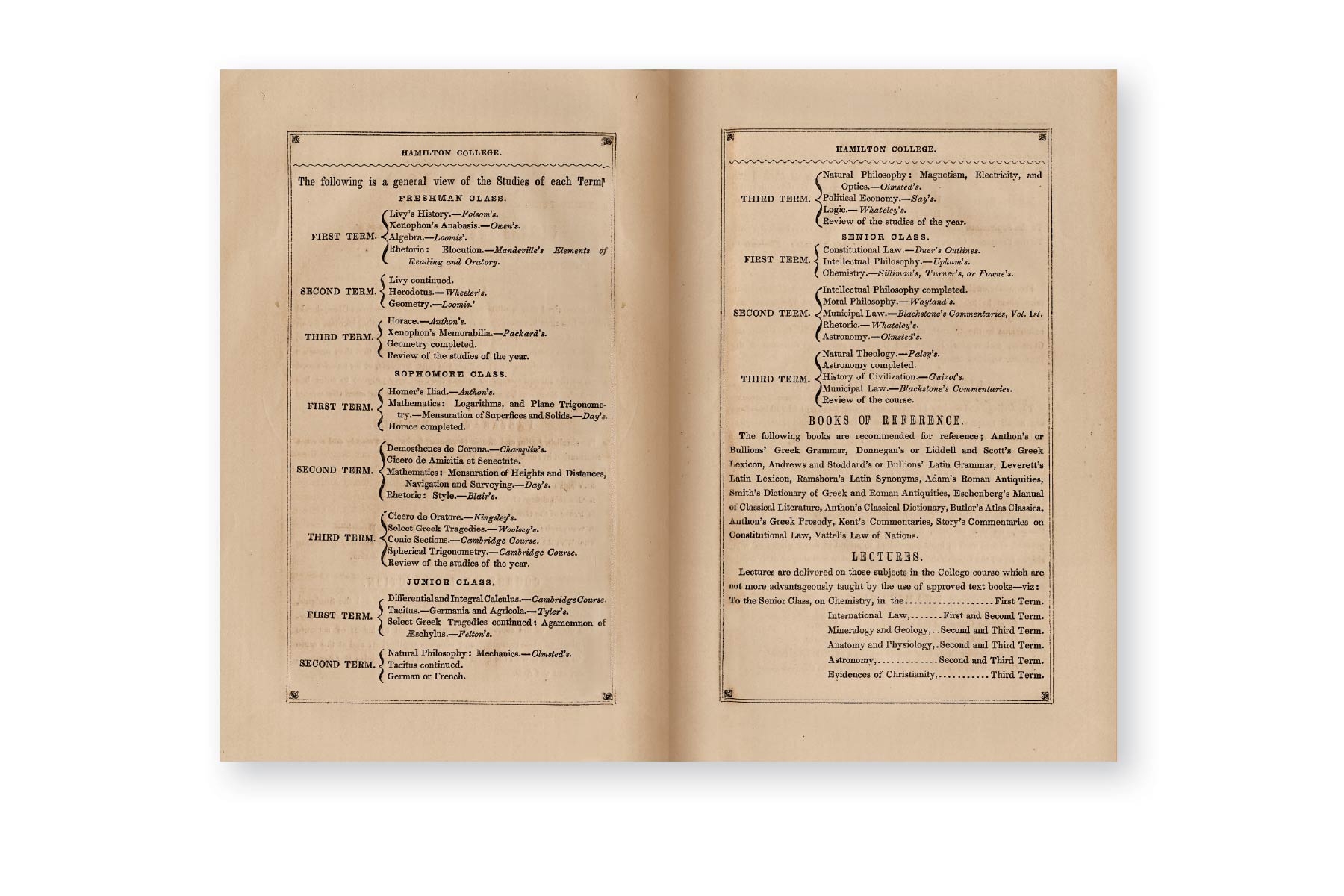
In the vision of its founders, the education of Hamilton students was to be structured and unchanging. There were no electives. Each entering class took the same courses in the same order — Latin, Greek, and a smattering of mathematics and geography. Much like the curriculum at other colleges and universities in the 1800s, the study of ancient languages was thought to inculcate valuable “faculties of the mind,” instilling in students the mental habits of order, system, and accuracy.
Among the requirements were recitations. Each day, students would be called upon randomly to recite previous class lessons. Tutors drilled students in preparation for the task of performing the necessary feats of memory before their professors, who would judge and correct them.
“It was a system that depended upon discipline and hard work, but did not necessarily instill the habits of an inquiring mind … The assumption underlying the curriculum was that there was a fixed body of truth that could best be assimilated by rote, and thus the best students were those who could effortlessly parrot their tutors, their professors, and their textbooks,” wrote Maurice Isserman, the Publius Virgilius Rogers Professor of American History, in On the Hill: A Bicentennial History of Hamilton College.
Adjustments came to Hamilton’s curriculum about once a decade in the later 19th century. In 1872, seniors were given a few elective choices, such as chemistry. Ten years later, the possibility of taking electives was extended to sophomores and juniors. In 1891, the College created an alternative path toward graduation, a “Latin-Scientific course.” Depending on the electives they took, students could graduate with the degree of B.Sc. (Bachelor of Science), B.Litt. (Bachelor of Literature), or Ph.B. (Bachelor of Philosophy). The vast majority continued to pursue the traditional Bachelor of Arts.
The Rumblings of Change
Under President Melancthon Woolsey Stryker’s watch, Hamilton adopted a semester format in 1911, abandoning the three-term structure that had been in place since the College’s founding. Two years later, the “group system” was adopted. Each year, a student’s course choices included one language, one science, and one other subject that was neither a language nor a science. There were other requirements: four years of public speaking, one year of English composition, and the completion of two majors, each consisting of three year-long courses in a department.
However, Stryker would not budge on other proposed changes to the academic program. He dismissed the recommendations of a trustee-appointed commission that called for dropping both prior knowledge of Latin as a prerequisite for admission to the Latin-Scientific course and the requirement that students pursing the A.B. should be required to take Greek. He cited these as “well-tested convictions as to what is basic and formative in education.”
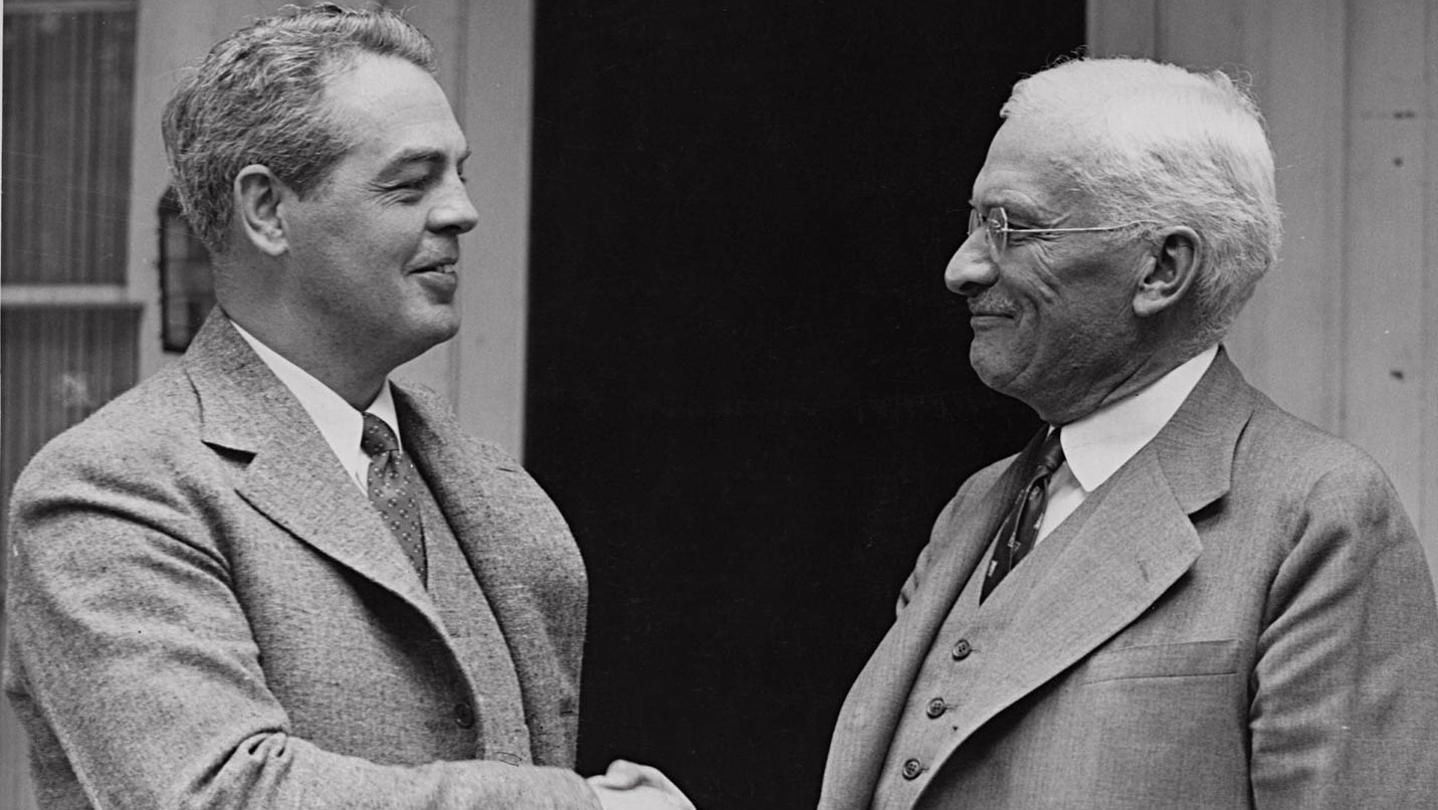
Stryker’s successor, President Frederick C. Ferry, saw things differently. “The number of desirable candidates who fulfill the heavy foreign-language and scholastic requirements made by the College seems lessening with the years,” said Ferry, who in 1935 charted a committee with reviewing the curriculum. “How long a small college can fill its ranks while making so heavy foreign-language requirements and granting the degree of Bachelor of Arts only when work is done in college in Latin or Greek is a serious question.”
Although Ferry did broaden the curriculum during his tenure with the creation of art and music programs, significant changes did not come until a few years later. In a report to the Board of Trustees and faculty in 1939, President William H. Cowley called for bold changes intended to give students the responsibility of self-choice and self-discipline. Beginning in 1940, the catalogue no longer required students to complete coursework in Latin or Greek. Instead, they would have to show proficiency in a language of their choice. Compulsory mathematics in the freshman year was also dropped. And for the first time since the 1890s, all graduating seniors would receive Bachelor of Arts degrees.
Hamilton had offered 117 courses prior to World War II and 140 thereafter. Anthropology and psychology were added, and some courses once labeled “history” now had a focus on “political science.” Yet despite these incremental changes, the College faced pressure to take a deeper look at its curriculum.
On Oct. 10, 1944, Dexter North, Class of 1913, wrote the following to Daniel Burke, chairman of the Hamilton Board of Trustees, on behalf of the Washington, D.C., Alumni Association: “We recognize the merit of the Hamilton educational program … Nevertheless, we who know from experience that life is a jealous and difficult task maker believe that the Hamilton preparation for it is no longer adequate. We do not mean to suggest that Hamilton should include technical or vocational skills in its curriculum. These have little or no place in a liberal arts college. We mean rather that literacy as to the structure of society, the basic relationships between the different sectors of knowledge, man’s artistic achievements down through the ages, the panorama of science, even the sure grasp which comes from evolving a working philosophy or a vital religion are among the many attributes of an educated man that Hamilton still leaves to chance electives or extracurricular discussion. We feel that the present program fails to integrate them to its requirements for all her graduates.”
A Balanced Curriculum: “The Hamilton Plan”
In 1947, a faculty committee released its report three years in the making. “The Hamilton Plan” called for students to participate more actively in the educational process. Committee members asked the faculty to espouse the notion that liberal education is not simply the possession of information. “No group of facts, no area of knowledge is literally indispensable to a man of enlightened understanding and liberal attitudes,” the report stated. “We must require not the bringing of a certain content of learning into the student’s mind, but the use of certain intellectual experiences to achieve the proper end of liberal education.”
The committee believed that graduates should have a superior command of their own language, both written and spoken; working knowledge of a language not their own; an understanding of the nature of reasoning; the inductive and deductive methods of science; the ability to enjoy and understand certain manifestations of the human spirit as revealed in the creative arts; and an understanding of the intellectual bases of ethical judgments. Achievement of these goals would lead students to “self-evaluation” and “self-realization” — qualities most likely to result from small seminars fostering freedom of discussion and considerable individual writing.
Instead of dividing the curriculum into divisions, the faculty voted to make a change that marked a departure from many colleges and universities of the time. As though defying pressures toward specialization, the faculty insisted that scientists teach philosophy and mathematicians aesthetics, that courses in literature may also train a student in the nature of the world in which he lives, and that courses in music may teach psychology and religion as well as acoustics and cadence.
The committee proposed a more structured process for the dean to review each student’s progress, allowing some flexibility during the senior year to undertake a program of fairly distinctive work. Also available would be “guided electives.”
Changes came into effect with the Class of 1954. Four years’ work in public speaking remained; however, participation in such activities as intercollegiate debate, a theatre production, or other types of expression could be substituted for traditional courses. Introduced was one major, or a major and allied minors, instead of two majors, which brought more depth and sequence to the student’s concentration.
In spring of 1959, further changes were introduced “to increase the amount of independent work each student does” and to provide for “more intensity in the field of concentration,” according to Dean Winton Tolles, Class of 1928, chairman of the Committee on Studies. Among them were required preparatory independent work leading up to the senior year as well as for seniors to pass a comprehensive exam in the department of their concentration.
The Impact of Kirkland
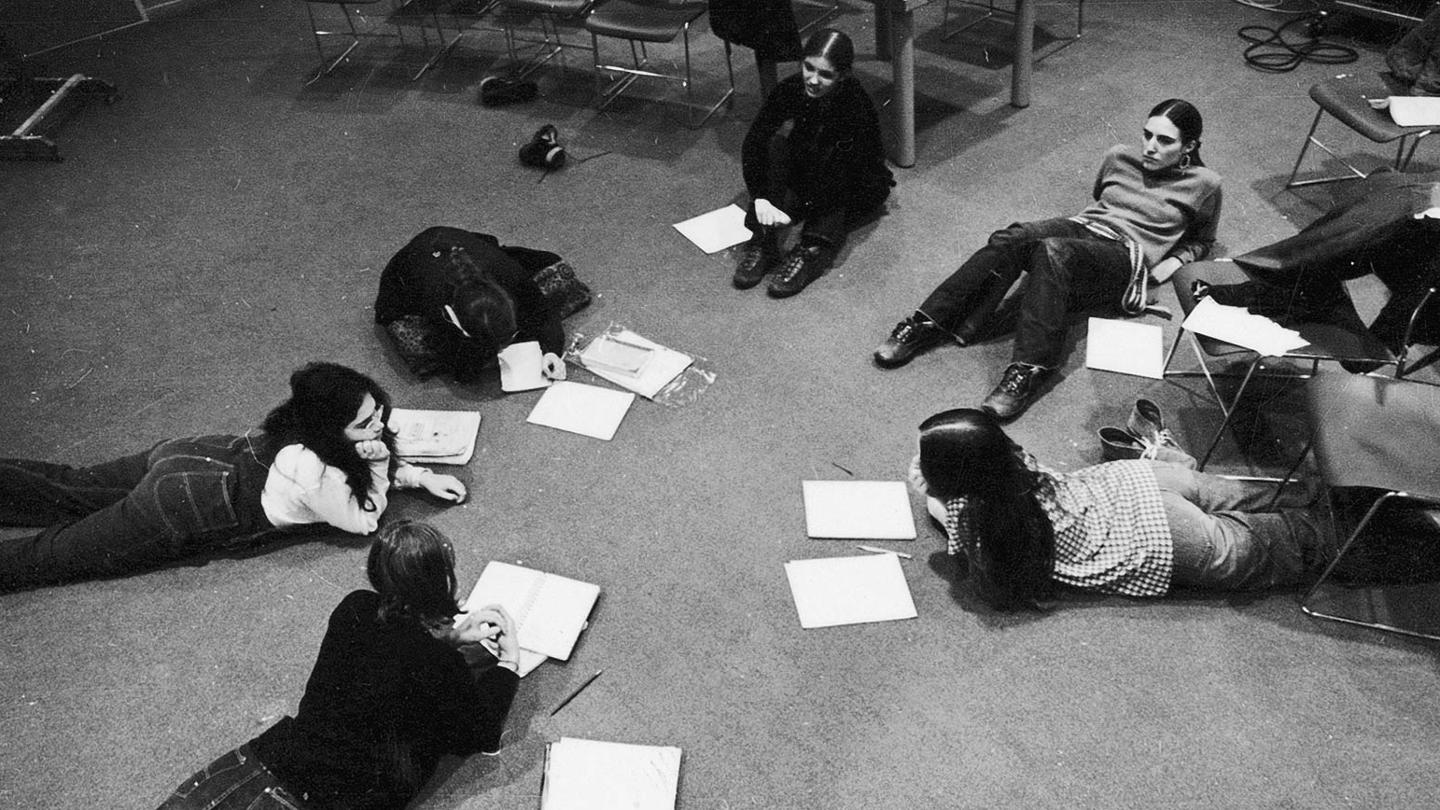
When Kirkland College opened its doors in 1968, it introduced more than women to the educational experience on College Hill. With its relatively few requirements, discussion-driven seminars, evaluations in place of traditional letter grades, and emphasis on self-guided projects, Kirkland was defined by innovation.
Kirkland President Samuel Babbitt described the College’s curriculum as centered on developing independent thought and imagination. He contrasted this with education that merely passes down received wisdom. “We are dedicated to the liberal arts, and we take that to mean the arts which enable, which liberate the individual to act out [their] potential,” Babbitt wrote in the 1968-69 Kirkland Catalogue. “Therefore, we dedicate ourselves to the development of individual capability.”
Kirkland’s approach, coupled with social change sweeping the country, soon prompted Hamilton to once again examine its educational program. The Committee on Academic Policy began a thorough review of the curriculum in late 1967. Faculty, students, and alumni were surveyed. Catalogues and reports of committees of educational policy from other colleges and universities were gathered, and visits were made to liberal arts institutions that had recently completed revisions of their own.
The committee debated the nature of distribution requirements. All agreed they served as a way to introduce students to subjects if not ultimately to their liking, at least to an appreciation of their merits. Yet, in the final analysis, the faculty maintained that students who achieved skills in language, in composition, and in science did not do so because these subjects had been prescribed. Rather it seemed that their importance stemmed from a necessary role in the whole pattern of the student’s education. In sum, the distribution role of prescribed courses could better be fulfilled if they were chosen by the student in an effort at conscious self-relation to his own goals and needs.
Graduation Requirements
Starting fully with the Class of 1973, Hamilton graduation
requirements included:
1
32 semester courses
2
Four Winter Study programs
3
A major requirement of at least eight semester courses
4
A comprehensive examination in the major field
5
Two years of satisfactory attendance in physical education
Taking effect in fall of 1969, a new curriculum removed distribution requirements and made Hamilton’s curriculum mesh more easily with Kirkland’s. The public speaking requirement, reduced from four to two years in 1965, was eliminated. Saturday morning classes were abolished, and course load was reduced from five to four a semester, with the addition of Winter Study in January. In this more flexible curriculum, the role of an advisor, who would offer “rational guidance” while being an “objective counselor,” became key. The College established a 20-man board of advisers to supervise the process.
“The new curriculum … is centered in the student. It is built to serve and to draw out the diversity of interests and aptitude which he brings with him to the College,” said Professor of History Charles Adler, chair of the Committee on Academic Policy. “Beyond that it requires the student to take a consciously reasoned approach to his education and provides him with guidance sufficient to that end.”
In Winter Study, students spent the month of January engaged in such projects as working for the Connecticut Public Expenditure Council to redraw district lines after a census, reading the works of E.M. Forster with Professor of English George Bahlke, and studying botanical illustration in Australia. Free of all competing academic obligations, students found not only a change of pace, but also an opportunity for independent work.
What Goes Around …
In the spring of 1986, the faculty voted to eliminate Winter Term and return to a calendar with two 14-week semesters. At the same time, they instituted a Senior Project requirement for all graduating seniors. The reasons for these changes were linked, according to Dean of the College Mel Endy, who told The Spectator that the faculty saw more value in investing resources in a senior project that “can provide motivation for the students and a chance for them to publicize their skills.”
In a back-to-basics approach, the faculty reiterated its commitment to breadth of coursework by reinstating distribution requirements. Beginning with the Class of ’92, students had to earn a minimum of two course credits in four different areas: social sciences, natural sciences and mathematics, humanities, and the arts. In addition, they were charged with acquiring knowledge of other peoples and cultures through coursework or study abroad. Also introduced was the requirement to take a minimum of three “writing-intensive” courses offered throughout the curriculum.
While in some ways Hamilton’s curriculum seemed to revert to the former distribution requirement era, an area of expansion came with the blurring and merging of academic areas of study into interdisciplinary offerings. For example, women’s studies became a concentration in 1984, and biochemistry/molecular biology made its appearance in 1986. In 1993, Hamilton began offering a concentration in Africana studies, and planning was underway for a program in environmental studies.
“Like the 18th-century rationalist, the student in our time wants to learn in order to do; he believes in the essential relevance of liberal learning to the practical world and in this belief is as likely to study Swahili as Latin, or the politics of underdeveloped nations as the politics of Aristotle.”
Liberal Arts for the 21st Century
The most recent major changes to Hamilton’s curriculum came during the presidency of Eugene M. Tobin. A liberal arts education, he believed, should help students find deep connections among ideas, knowledge, and experience. And because students would likely change careers multiple times throughout their lifetimes, a focused major was less essential than the ability to reason, communicate effectively, and amass a deep well of general knowledge. Also of increasing importance were opportunities for students to engage in the world through study abroad, service learning, and community internships.
In the Spring 2000 Hamilton Alumni Review, Tobin outlined a new curriculum, known as the “Plan for Liberal Education,” that would take effect with the Class of 2005. Unique to this plan were two capstone requirements — one at the end of the general education sequence (the Sophomore Program) and one at the conclusion of the concentration (the Senior Program) — that would serve as integrating and culminating experiences for students at decisive points in their undergraduate careers.
Also called the “gateway,” the Sophomore Program took the form of a required seminar that emphasized interdisciplinary learning and culminated in a project with public presentation. Gone again were distribution requirements in favor of a strengthened advising system and the creation of “limited enrollment seminars,” small, rigorous first-year courses that offered intensive interaction among and between students and instructors by emphasizing writing, speaking, and discussion. The three-course “writing-intensive” requirement remained in effect.
Many aspects of the new curriculum — a commitment to effective communication, opportunities for collaborative learning and research, the freedom and responsibility for students to chart an individualized course of study — remain key components of today’s Hamilton experience. However, after the 2005-06 academic year, the faculty voted to make the Sophomore Program optional. Logistical considerations arose as the number of incoming students increased, making it difficult to offer enough seminar-style courses.
“The Sophomore Seminars were intended to provide a place where some of the connections among general education experiences could be made,” Professor of Music and chair of the Committee on Academic Planning Sam Pellman told The Spectator in its Oct. 27, 2006, edition. “However, we’ve learned from the Mellon Assessment Project, which evaluated the curriculum through interviews with students for instance, that for many students, their general education continues to be just as important for them through the junior and senior years as well.”
“The core curriculum of the past was in some ways safe. A riskier approach was adopted by Hamilton’s faculty in 2000 and has borne fruit. The new curriculum reflects the College’s academic values and is a shining example of a liberal arts education that is at once challenging and flexible.”
Moving Forward
In the past quarter century, the open curriculum has become a defining part of the College’s culture. Hamilton remains one of a handful of colleges and universities with no distribution requirements, and the majority of students say that’s a primary reason why they chose to enroll. The open curriculum attracts students who are curious, open, and exploratory, while giving faculty more flexibility to teach original courses that match students’ passions and interests.
So, what would a Hamilton Open Curriculum 2.0 look like? While that remains to be determined, one thing is certain — a collaborative learning environment will be at its core. At a planning session this fall, President Steven Tepper said, “An open curriculum on the one hand can seem very individualized, but what if that meets the connected learner or the connected college? Can we leverage our small, residential, intimate community to maximize collaborative learning and discoveries? When you learn with others, your learning is enhanced; it’s accelerated. Your better and broader perspectives generate more creative solutions. You integrate and connect ideas. You learn how to work with others to advance ideas.
“Let’s think about how much more powerful we could be.”
Material for this article was sourced from On the Hill: A Bicentennial History of Hamilton College by Maurice Isserman and past editions of the Hamilton Alumni Review, The Spectator, and College catalogues.