Wednesday, February 25, 2026
Meet the Artists of EXODUS
EXODUS, the exhibition running concurrently with Jamea Richmond-Edwards: Another World and Yet the Same, features works by seven incredible artists. Some of which were in attendance for the exhibition opening on Saturday, September 9, and participated in a panel discussion that can be viewed here. Delve deeper into each artist’s work below.
Akili Ron Anderson
Akili Ron Anderson’s practice includes painting, sculpture, printmaking, stained glass, textile design, and theater set design. Emerging in the midst of the cultural and political awakenings of the 1960s and ’70s Black Arts Movement, Anderson’s work has often focused on the beauty and spirit he finds in African and Black American communities. Throughout his career, he has moved between presenting narrative imagery highlighting important moments in Black history and more abstract symbols and glyphs from the African diaspora that are meant to uplift, inspire, and affirm Black Americans. Both approaches are rooted in Anderson’s longstanding involvement with AfriCOBRA (African Commune of Bad Relevant Artists), a pioneering Black artist collective founded in 1968. Joining in 1979, Anderson quickly subscribed to the group’s mission to create art that is “accessible, community-focused, and steeped in the aesthetics of the African diaspora.” It was his experience working with other AfriCOBRA artists that led him to emphasize bold color, rhythmic composition, and positive imagery in his work, and to believe that aesthetic compositions can promote cultural affirmation and empowerment.
|
|
|
Works by Akili Ron Anderson, pictured left to right: Crying Time Again (2023), Birds of a Feather Fight Together (2025), 2020 Vision (2020, top) and Here Comes the Sun (2022, bottom). Installation view of EXODUS at the Wellin Museum of Art. Photo courtesy of John Bentham.
|
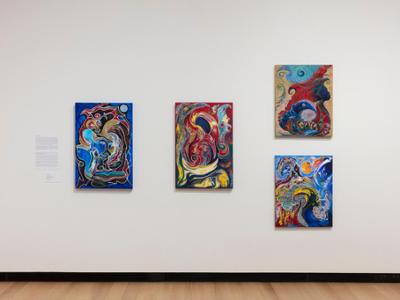
Akili Ron Anderson (b. 1946, Washington, DC) lives and works in Washington, DC. He earned a BFA and MFA from Howard University (1969, 2008) and is currently an Associate Professor in the Department of Art at Howard University. His work has been featured in institutions and public spaces including the American University Museum; Anacostia Community Museum; Corcoran Gallery of Art; Duke University; Hampton University Museum; Howard University Gallery of Art; Kreeger Museum; New Muse Community Museum; Orlando Museum of Art; Philadelphia Museum of Art; and Schomburg Center for Research in Black Culture at the New York Public Library.
Wesley Clark
Wesley Clark’s practice is rooted in a deep engagement with public space through the creation of large-scale murals, sculptures, and installations. He approaches these spaces as sites layered with overlooked histories, hoping to uncover the hidden narratives embedded in our everyday surroundings. Found objects such as car parts, scraps from welding shops, and sheet metal that has been exposed to natural elements become the raw material for his studio-based work, where he uses painting and assemblage to create what he calls “contemporary reliquaries.” Drawing from both the art historical canon and the visual language of modern, urban culture—especially graffiti—Clark layers surfaces with various forms of mark-making, often using industrial materials such as sealants, stains, and solvents. He then obscures, scrapes, or carves the surfaces away. This cyclical process of creation and erasure mirrors the ephemeral nature of graffiti, whose original meaning may be altered or added onto by the public.
|
|
|
Pictured: Wesley Clark in front of I Will Be My Own Nation (2025), during the public opening of EXODUS at the Wellin Museum of Art in September 2025. Photo courtesy of Janelle Rodriguez.
|
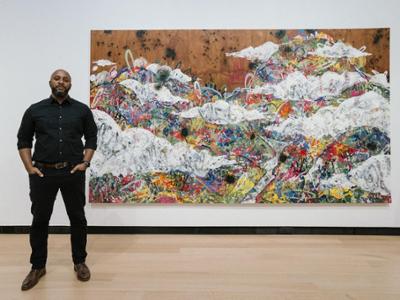
Wesley Clark (born 1979, Washington, DC) lives in Hyattsville, MD, and works in College Park, MD. He earned a BFA from Syracuse University (2001) and an MFA from George Washington University (2012). His work has been featured in exhibitions at the American University Museum at the Katzen Arts Center; Banneker-Douglass-Tubman Museum; Begonia Labs at Vanderbilt University; Glass Curtain Gallery at Columbia College; Kreeger Art Museum; and Minnesota Maritime Art Museum.
Larry Cook
Larry W. Cook uses photography, video, and mixed media to investigate how identity is constructed and represented. The pieces on view evolved out of his work as a photographer in nightclubs in Washington, DC, between 2007 and 2013, where he would set up large, makeshift photo booths with hand-painted backdrops featuring cars, luxury goods, tropical beaches, and iconic landmarks, and party-goers would pose for him to take their portraits. Over the years these photographs grew into a large personal archive from which Cook draws to create mixed media works embellished with rhinestones that lend an extra “bling” to the already celebratory scene. The silhouetting of the figures calls attention to their gestures and highlights how pose functions as an assertion of individual agency, particularly within social subcultures. By mining his own archive, Cook fuses personal memory with broader cultural discussions on how race, class, and community are visually coded and performed.
|
|
|
Works by Larry W. Cook, pictured left to right: Midnight Mirage (2023), Serenade (2023), and Tradewinds (2023). Installation view of EXODUS at the Wellin Museum of Art. Photo courtesy of John Bentham.
|
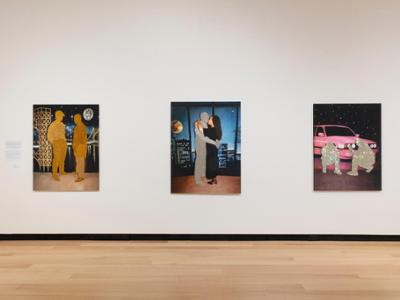
Larry W. Cook (born 1986, Silver Spring, MD) lives in Silver Spring, MD, and works in Washington, DC. He earned a BA from SUNY Plattsburgh (2010) and an MFA from George Washington University (2013) and is currently Associate Professor and Coordinator of Photography at Howard University. His work has been included in exhibitions at the Brooklyn Museum; Kemper Museum of Contemporary Art; and the Photography Gallery at Riley Hall, University of Notre Dame. Cook is a recipient of the 2024 Gordon Parks Artist Fellowship.
Shaunté Gates
Shaunté Gates began his formal artistic training in oil portraiture, but his visual language expanded after working as a video editor and motion graphics artist at Black Entertainment Television (BET). This experience introduced him to new ways of thinking about image construction, leading him to incorporate layers of found imagery, photography, and video into his practice. Gates’s process is both iterative and tactile — he builds up images through layering prints and photographs, then partially removes them, and obscures or reveals elements. Although his work focuses on twenty-first-century subject matter, it draws heavily on the century-old legacy of Surrealism. Dreams, absurd social realities, science-fiction fantasies, and childhood memories intermingle in scenes that feel both theatrical and disorienting. Through these layered compositions, Gates explores enduring questions of how identity is affected by our subconscious as well as the technology that surrounds us.
|
|
|
Pictured: Shaunté Gates in front of Pinnochio Knows III & Pinnochio Knows IV + Free Breakfast Program 1.8 (2005) during the public opening of EXODUS at the Wellin Museum of Art in September 2025. Photo courtesy of Janelle Rodriguez.
|
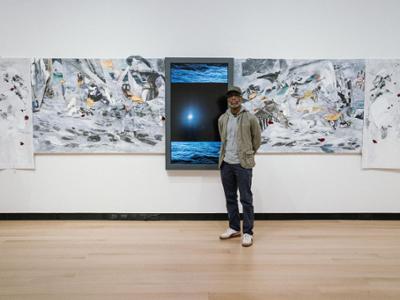
Shaunté Gates (b. 1979, Washington, DC) lives and works in Washington, DC. He earned a BA from Bowie State University (1998). His work has been included in exhibitions at the African American Museum of Dallas; Anacostia Community Museum; Birmingham Civil Rights Institute and Public Library; California African American Museum; Charles H. Wright Museum of African American History; International African American Museum; Levine Museum of the New South and Harvey B. Gantt Center for African-American Arts + Culture; National Museum of Women in the Arts; National Underground Railroad Museum; Reginald F. Lewis Museum of Maryland African American History and Culture; and Washington State History Museum. Gates has received awards and residencies from the Louis Comfort Tiffany Foundation, the Nicholson Project, the Kennedy Center, and Washington Project for the Arts.
Hubert Massey
Hubert Massey creates frescoes, murals, and other monumental public artworks that highlight the civic histories of the places in which they are situated. He began his career painting advertising billboards, and although he enjoyed working on a large scale, he longed to produce imagery of his own. This ambition led him to study at the University of London’s Slade School of Fine Art and later formally train in the technique of fresco under the guidance of former assistants to Diego Rivera. Like other fresco painters, Massey is a skilled draftsman, and he often produces multiple preparatory drawings before completing his vision in plaster and pigment. Two drawings are on view here, in addition to a small-scale fresco. Inspired by Rivera’s legacy and community-driven ethos, Massey approaches public art as a collaborative process that involves developing relationships with the subjects of his works. He believes that the most successful examples of public art “should be, first and foremost, meaningful to those who encounter it every day.”
|
|
|
Pictured: Hubert Massey in front of James (2025, left) and Otis (2019, right) during the public opening of EXODUS at the Wellin Museum of Art in September 2025. Photo courtesy of Janelle Rodriguez.
|
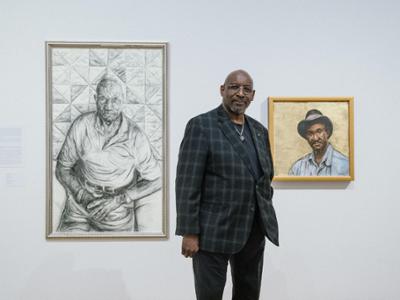
Hubert Massey (b. 1958, Flint, MI) lives and works in Detroit. He earned a BA from Grand Valley State University (1981) and was conferred with an honorary doctorate from Grand Valley State University in 2013. His work has been included in exhibitions and commissioned for public spaces including the Campus Martius Park; Charles H. Wright Museum of African American History; Detroit Athletic Club; Flint Institute of the Arts; Grand Valley State University; Huntington Place; and Paradise Valley Park. In 2011, Massey was named a Visual Arts Fellow by the Kresge Foundation.
Stan Squirewell
Stan Squirewell’s multidisciplinary practice spans painting, photography, installation, and performance. In works like those on view, the artist begins with vintage photographs—which he refers to as “vessels of cultural memory”—collected from museum archives and from friends and family. He then incorporates contemporary fabric into the images, along with additional elements of painting, photography, and collage. Squirewell describes this process of fusing past and present as “reaching back through history, creating a visual conversation with the often forgotten subjects of so many old photographs.” Each collage is set within a hand-carved frame treated using Shou Sugi Ban, a traditional Japanese wood-burning technique that preserves the wood. Bridging visual cultures across generations, Squirewell’s work challenges viewers to reflect on which histories are remembered, which are lost, and how they are reframed in contemporary culture.
|
|
|
Pictured: Stan Squirewell in front of Clay and Hutchinson (2025, left) and Linnea’s two lil brothers, lil Bud and Man-Man got into stuff (2025, right) during the public opening of EXODUS at the Wellin Museum of Art in September 2025. Photo courtesy of Janelle Rodriguez.
|
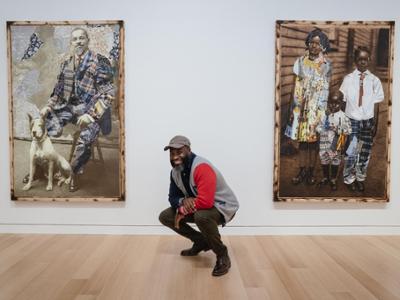
Stan Squirewell (born 1978, Washington, DC) lives and works in Louisville, KY. He earned an MFA from the Maryland Institute College of Art (2007). His work has been included in exhibitions at the Hunter Museum of American Art; Museum of Fine Arts Boston; Minneapolis Institute of Art; National Museum of African American History and Culture; and the Speed Art Museum. His work is in the collections of the Dr. David C. Driskell Center at University of Maryland, International African American Museum, Minnesota Museum of American Art, North Dakota Museum of Art, Reginald F. Lewis Museum of Maryland African American History and Culture, and Weisman Art Museum.
Felandus Thames
Felandus Thames’s practice engages with the politics of image-making, memory, and materiality, often through the lens of Black culture. His use of plastic pony beads, ubiquitous in Black hair care and youth adornment, operates both formally and conceptually. Thames refers to these small beads as “Black pixels” that, when strung on lengths of thin wire, form a legible image from a distance but dissolve into abstraction up close. The labor intensive process of creating these portraits involves threading thousands of beads onto a gridded matrix, and the resulting works function as what the artist calls “vessels of memory.” Thames often draws his subject matter from archival photographs and other images depicting figures rendered anonymous by time. Here, however, he has created a portrait of a close friend and mentor, the artist David Hammons—a fitting contribution to an exhibition documenting artistic camaraderie and community.
|
|
|
Pictured: Felandus Thames in front of King David of Harlem (2024) during the public opening of EXODUS at the Wellin Museum of Art in September 2025. Photo courtesy of Janelle Rodriguez.
|
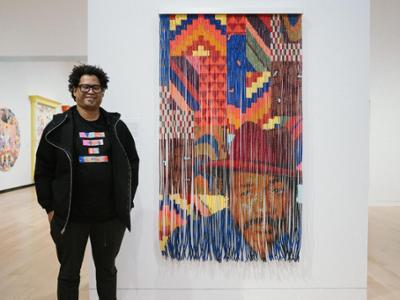
Felandus Thames (b. 1974, Jackson, MS) lives and works in the Greater New Haven, CT, area. He earned a BA from Jackson State University (2008) and an MFA from the Yale University School of Art (2010). His work has been included in exhibitions at the Cleveland Museum of Art; Clifford Gallery at Colgate University; Contemporary Art Museum Houston; Crystal Bridges Museum of American Art; Denver Museum of Contemporary Art; Eli Marsh Gallery at Amherst College; Mississippi Museum of Art; Museum of the African Diaspora; Pérez Art Museum of Miami; San Francisco Museum of Modern Art; Studio Museum in Harlem; and Virginia Museum of Fine Art. Thames is a 2024–25 Louis Comfort Tiffany Prize recipient
EXODUS is curated by Jamea Richmond-Edwards. Research support was provided by Taylor Scatliffe ’25 and Anna Totilca ’27.’ This exhibition is on view at the Wellin Museum of Art through April 18, 2026.
Slideshow
More Blog